
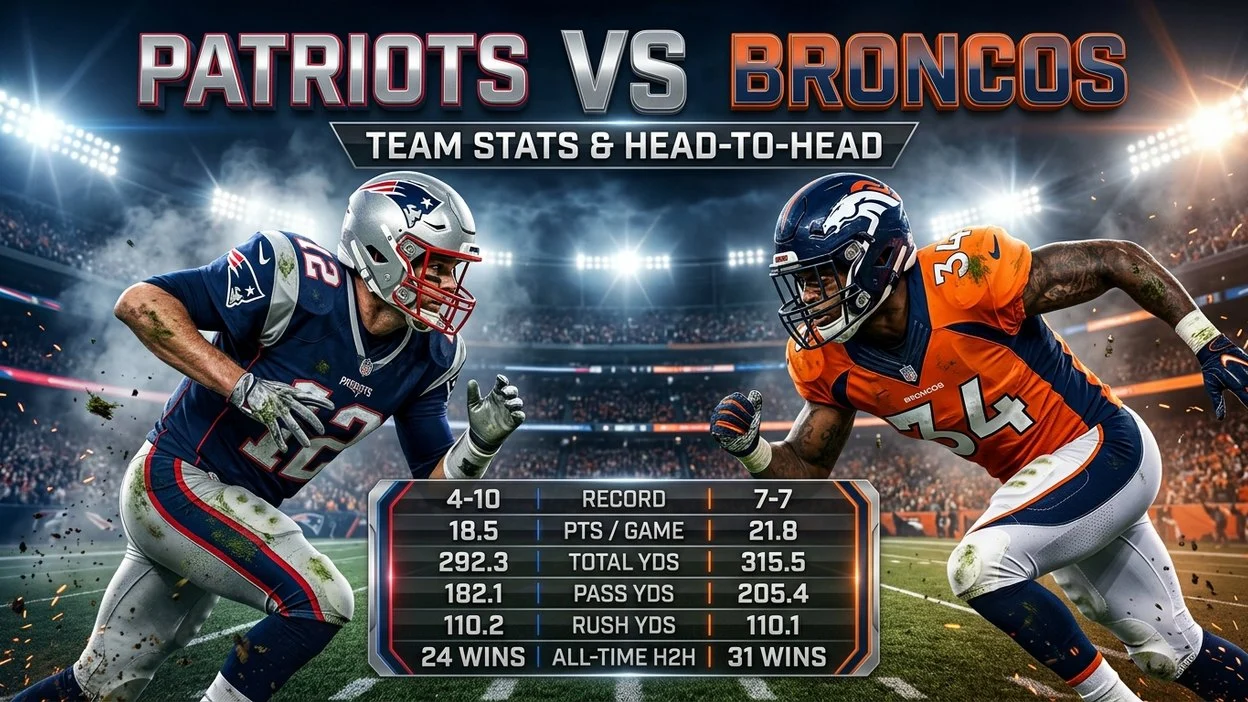
When fans search for Patriots stats vs Broncos, they usually want to compare the New England Patriots and Denver Broncos, two well-known teams in the National Football League (NFL). Their head-to-head statistics help explain how these teams have performed against each other, including wins, losses, playoff results, points scored, and memorable games. Understanding these numbers makes it easier to follow their rivalry and discuss their performances.
The New England Patriots and Denver Broncos have both enjoyed successful periods in NFL history. The Patriots became especially famous for their success during the Tom Brady and Bill Belichick era, while the Broncos built a strong legacy with quarterbacks such as John Elway and Peyton Manning. Their meetings have included regular-season contests and important postseason matchups. However, historical statistics and current-season performance are different things. A useful comparison should identify which records cover the full history, which concern the playoffs, and which relate to a particular season. This guide explains how to understand Patriots vs Broncos statistics, compare the teams fairly, and interpret the numbers without confusing historical achievements with current results.
Quick Answer
Patriots stats vs Broncos refers to the head-to-head performance of the New England Patriots and Denver Broncos in the NFL. Their comparison can include overall wins and losses, playoff results, points scored, quarterback statistics, and recent meetings. The exact figures depend on the date range and whether postseason games are included.
Why Do People Confuse Patriots vs Broncos Statistics?
Fans sometimes compare different sets of statistics without realizing that they measure different things. This can lead to incorrect conclusions about which team has the better record.
The most common reasons for confusion include:
- Regular season vs playoffs: Regular-season records do not include postseason games.
- All-time record vs recent form: Historical results cover many years, while recent results focus on a shorter period.
- Team stats vs player stats: Team statistics describe overall performance, while player statistics measure individual contributions.
- Total points vs average points: A team may score more total points simply because it has played more games.
- Historical success vs current strength: A franchise’s past achievements do not automatically predict its next game.
For example, a team may have a strong all-time record but lose several recent meetings. Both facts can be correct because they describe different periods.
First Word: Patriots
Patriots refers to the New England Patriots, a professional American football team based in the Boston metropolitan area, with its home stadium in Foxborough, Massachusetts.
The team competes in the NFL’s American Football Conference (AFC), specifically the AFC East division.
Important facts about the Patriots include:
- Full name: New England Patriots
- League: National Football League
- Conference: AFC
- Division: AFC East
- Home stadium: Gillette Stadium
- Famous historical figures: Tom Brady and Bill Belichick
The Patriots are known for their successful championship era in the 2000s and 2010s. When reviewing Patriots statistics, readers may examine passing yards, rushing yards, touchdowns, defensive performance, playoff appearances, and Super Bowl results.
Example: “The Patriots recorded more passing yards than the Broncos in that game.”
This sentence compares one specific statistical category rather than suggesting that the Patriots performed better in every area.
Second Word: Broncos
Broncos refers to the Denver Broncos, a professional American football team based in Denver, Colorado.
The Broncos compete in the NFL’s AFC West division and have a long history of significant regular-season and playoff performances.
Important facts about the Broncos include:
- Full name: Denver Broncos
- League: National Football League
- Conference: AFC
- Division: AFC West
- Home stadium: Empower Field at Mile High
- Famous historical figures: John Elway and Peyton Manning
The Broncos have won Super Bowl championships and have featured several notable quarterbacks throughout their history.
When studying Broncos statistics, fans often look at quarterback passing performance, rushing production, defensive turnovers, points allowed, and postseason results.
Example: “The Broncos gained more rushing yards than the Patriots.”
This statement identifies a specific advantage in running the football. It does not necessarily mean the Broncos won the game.
Patriots vs Broncos: Comparison Table
| Statistical category | New England Patriots | Denver Broncos |
| NFL conference | AFC | AFC |
| Division | AFC East | AFC West |
| Home stadium | Gillette Stadium | Empower Field at Mile High |
| Famous historical quarterback | Tom Brady | John Elway |
| Another notable quarterback | Drew Bledsoe | Peyton Manning |
| Main offensive statistics | Passing, rushing, touchdowns | Passing, rushing, touchdowns |
| Defensive statistics | Sacks, interceptions, points allowed | Sacks, interceptions, points allowed |
| Head-to-head record | Depends on the period counted | Depends on the period counted |
| Playoff performance | Must be counted separately when comparing records | Must be counted separately when comparing records |
The table summarizes the franchises and the main statistics used to compare them. It does not provide a verified current head-to-head win total. That figure should be calculated from a consistent historical record, with the chosen cutoff date and playoff inclusion clearly stated.
When Should You Use Each Type of Statistic?
Different statistics answer different questions. Choosing the right measurement helps you make a fair comparison.
1. Use the all-time head-to-head record
Use this record when you want to understand which team has won more games across their historical meetings.
For example, a question about the Patriots’ overall record against Denver requires a historical win-loss calculation, not just the results from the latest season.
2. Use regular-season statistics
Regular-season statistics help compare how teams performed during scheduled league games.
Useful measurements include:
- Wins and losses
- Points scored
- Passing yards
- Rushing yards
- Turnovers
- Defensive sacks
3. Use playoff statistics
Playoff statistics are useful when discussing postseason success. These games carry different stakes from regular-season games, so keeping them separate provides a clearer picture.
4. Use recent-game statistics
Recent results help readers understand current form. A team that performed well a decade ago may have a very different roster and coaching staff today.
5. Use player statistics
Player statistics are best when comparing individual performances. For example, you might compare the quarterbacks’ passing yards, touchdown passes, completion percentages, and interceptions in a particular matchup.
12 Examples of Patriots vs Broncos Statistics
The following examples show how to discuss the rivalry clearly. These are illustrative examples, not verified results from specific games.
- Head-to-head record: “The Patriots vs Broncos head-to-head record compares their wins and losses across their meetings.”
- Regular-season record: “The regular-season record excludes games played in the NFL playoffs.”
- Playoff record: “The playoff record shows how the Patriots and Broncos performed against each other in postseason games.”
- Points scored: “The team with more points scored in a game wins, unless the game ends in a tie.”
- Passing yards: “Passing yards measure the distance gained through completed forward passes.”
- Rushing yards: “Rushing yards show how much ground a team gains by running the football.”
- Touchdowns: “Touchdowns help explain how effectively a team converts offensive opportunities into points.”
- Quarterback comparison: “A quarterback comparison may include passing yards, touchdowns, interceptions, and completion percentage.”
- Defensive performance: “Sacks and interceptions can reveal how effectively a defense disrupts its opponent.”
- Turnover comparison: “A team that protects the football may avoid giving its opponent valuable scoring opportunities.”
- Recent meetings: “Recent meetings help fans assess short-term trends without relying entirely on older results.”
- Average points per game: “Average points per game can help compare scoring efficiency across teams that played different numbers of games.”
These examples demonstrate why it is important to name the statistic being discussed. Saying that one team is better is less precise than explaining that it scored more points or committed fewer turnovers in a defined set of games.
Common Mistakes When Reading Patriots vs Broncos Stats
Even experienced football fans can misinterpret statistics when they overlook context.
Mistake 1: Mixing regular-season and playoff records
Regular-season wins and playoff wins should not be combined without explaining the method. Otherwise, two different records may appear to contradict each other.
Mistake 2: Treating historical success as current performance
A franchise’s championship history is important, but it cannot tell you exactly how the team will perform in its next matchup.
Mistake 3: Comparing total statistics from unequal periods
A team with more games may naturally have higher totals. Use averages or per-game statistics when appropriate.
Mistake 4: Assuming more yards always means victory
Yardage is only one part of football performance. Turnovers, red-zone efficiency, special teams, and defensive stops can determine the outcome.
Mistake 5: Confusing individual and team records
A quarterback’s personal statistics do not automatically represent the entire team’s performance. Football results depend on offense, defense, special teams, coaching, and other factors.
Mistake 6: Using an outdated head-to-head record
Historical totals can change after new games. Any published win-loss figure should have a clear cutoff date.
Memory Trick: How to Remember the Main Statistics
Use the simple word W-P-Y-T to remember four useful categories when comparing the Patriots and Broncos.
- W — Wins: Which team won more games?
- P — Points: Which team scored more?
- Y — Yards: Which team gained more offensive yardage?
- T — Turnovers: Which team protected the ball better?
This method is not a complete measure of football performance, but it provides a useful starting point for beginners.
For example, if the Patriots have more passing yards but the Broncos score more points, the Broncos may have been more effective at converting opportunities into scoring plays.
American vs British English
The Patriots and Broncos play American football, so American football terminology is the most relevant language for discussing their statistics.
| American football term | Meaning |
| Yard | A unit used to measure football field distance |
| Touchdown | A scoring play worth six points before any extra scoring attempt |
| Quarterback | The player who commonly directs the offense |
| Defense | The unit that tries to stop the opponent from advancing or scoring |
| Regular season | Games played before the playoffs |
| Playoffs | The postseason competition that determines the league champion |
British English commonly uses the word football to mean association football, which Americans call soccer. In British English, American football is the clearer term for the NFL sport.
The statistical terms above are widely used in American football coverage, including British coverage of the NFL. The difference is mainly in the meaning of everyday words, rather than in the underlying statistics.
Similar Terms in Patriots vs Broncos Searches
Readers searching for Patriots vs Broncos information may encounter several related phrases. Each phrase focuses on a different part of the comparison.
- Patriots vs Broncos head-to-head: The historical results between the two teams.
- Patriots vs Broncos all-time record: The overall win-loss record, subject to the stated cutoff date and inclusion rules.
- Patriots vs Broncos last game: The result and statistics from their most recent meeting.
- Patriots vs Broncos playoff history: Their postseason matchups and results.
- Patriots vs Broncos box score: A detailed summary of an individual game’s scoring and statistics.
- Patriots vs Broncos player stats: Individual performances by quarterbacks, running backs, receivers, and defenders.
- Patriots vs Broncos team stats: Collective offensive and defensive performance.
- New England Patriots statistics: Statistics related to the Patriots across a selected season or historical period.
- Denver Broncos statistics: Statistics related to the Broncos across a selected season or historical period.
- Patriots vs Broncos score: The points recorded by both teams in a particular game.
These terms are related, but they are not interchangeable. A box score covers a particular game, while an all-time record summarizes multiple meetings.
Final Verdict: What Do Patriots Stats vs Broncos Tell Us?
Patriots stats vs Broncos is a broad comparison covering the historical rivalry between New England and Denver. The most useful analysis separates head-to-head wins, regular-season results, playoff games, team statistics, and individual player performances.
Neither historical championships nor a single statistical category tells the entire story. To understand which team performed better, identify the time period, use comparable statistics, and consider the context of each game.
FAQs:
1. What does Patriots stats vs Broncos mean?
It refers to statistics comparing the New England Patriots and Denver Broncos in the NFL. These statistics can include head-to-head wins, losses, points, offensive production, defensive performance, and playoff results.
2. Where can I find the Patriots vs Broncos all-time record?
You can consult official NFL historical records, team archives, or reliable football statistics databases. Check whether the published record includes only regular-season games or both regular-season and playoff games.
3. Are Patriots vs Broncos playoff statistics different from regular-season statistics?
Yes. Playoff statistics cover postseason games, while regular-season statistics cover scheduled games before the playoffs. Keeping these categories separate helps prevent misleading comparisons.
4. Which team has more wins, the Patriots or the Broncos?
The answer depends on the historical cutoff date and whether the comparison includes postseason games. A reliable answer requires counting their meetings under a clearly defined method rather than relying on an unverified total.
5. What statistics matter most in a Patriots vs Broncos game?
Important statistics include points scored, passing yards, rushing yards, touchdowns, turnovers, sacks, and third-down conversion rates. The most useful category depends on whether you want to study offense, defense, or the final result.
6. How can I compare Patriots and Broncos quarterbacks?
Compare their passing yards, completion percentages, touchdown passes, interceptions, and passer ratings from the same game or season. Using the same period makes the comparison fairer.
7. Does the all-time record predict the next Patriots vs Broncos game?
No. The historical record provides context, but the next result depends on factors such as current players, injuries, coaching decisions, recent form, and game conditions.
8. What is the difference between Patriots vs Broncos team stats and player stats?
Team stats measure collective performance, such as total yards and points scored. Player stats measure individual contributions, such as a quarterback’s passing yards or a defender’s sacks.
Remember This
- The Patriots represent New England, while the Broncos represent Denver.
- Both teams compete in the AFC.
- Head-to-head records summarize results between the two franchises.
- Regular-season and playoff statistics measure different sets of games.
- Passing yards, rushing yards, touchdowns, and turnovers help explain game performance.
- Historical success does not guarantee future victories.
- Always check the period covered by a statistic before comparing teams.
Conclusion:
The Patriots vs Broncos comparison helps football fans understand the history and performance of two established NFL franchises. By examining head-to-head results, playoff meetings, scoring, offensive yardage, and defensive statistics, readers can develop a clearer picture of how the teams compare. The key is to use consistent figures and understand what each statistic measures.
For students, ESL learners, beginners, and general readers, the simplest approach is to start with wins and losses, then explore points, yards, touchdowns, and turnovers. Remember that historical records describe past performance, while recent statistics provide a more current view. A fair comparison always considers the time period, the type of game, and the context behind the numbers.

Nova Turner specializes in imaginative science fiction blending futuristic technology, thrilling adventures, and powerful human emotions. Her innovative storytelling inspires curiosity, creativity, and exploration among readers of every age.