When someone dies, English has several words for expressing grief, remembrance, and respect. Elegy and eulogy are two of the most commonly confused terms because both can relate to death and mourning. However, they are not interchangeable. One usually refers to a type of poem or reflective expression of sorrow, while the other is a speech or piece of writing that praises someone who has died.
The confusion becomes easier to understand when you look at how each word is used in real situations. You might write an elegy about the loss of a loved one, while you might deliver a eulogy at that person’s funeral or memorial service. Both words are associated with remembrance, grief, and honoring the dead, but they serve different purposes and appear in different contexts. Learning this distinction will help you choose the right word in academic writing, literature discussions, funeral related conversations, and everyday English.
Quick Answer
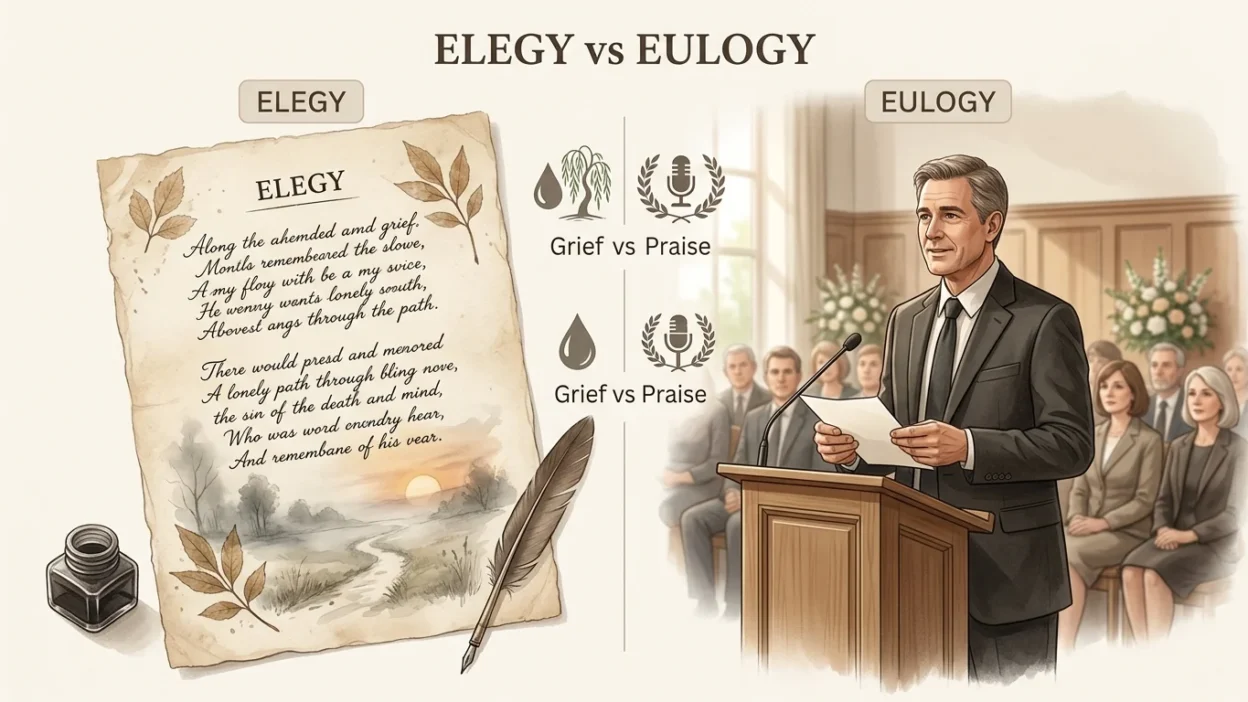
Elegy is a poem or reflective work expressing sorrow, especially for someone who has died. Eulogy is a speech or written tribute praising someone who has died. An elegy focuses more on grief and reflection; a eulogy focuses more on praise and remembrance.
Why People Confuse It
The words elegy and eulogy are easy to mix up because they share several characteristics:
- Both can relate to death.
- Both can express sadness or remembrance.
- Both may honor someone who has died.
- Both are commonly associated with funerals or mourning.
- Both can be spoken or written in certain contexts.
The important difference is purpose and form.
An eulogy is typically a tribute delivered at a funeral or memorial service. It highlights the person’s character, achievements, relationships, and positive qualities.
An elegy, on the other hand, is traditionally a poem or literary work expressing sorrow over someone’s death. It can also refer more broadly to a mournful or reflective work about loss.
So, if you are standing at a funeral and giving a speech about the person who died, you are probably giving a eulogy, not an elegy.
First Word: Elegy
Elegy (noun) refers to a poem, song, or other reflective work expressing sorrow, especially following someone’s death.
Definition of Elegy
An elegy is usually associated with mourning, grief, loss, and reflection. In literature, an elegy often explores the emotional experience of losing someone or something.
For example:
The poet wrote an elegy for his childhood friend.
The word doesn’t always have to refer to a specific person. An elegy can mourn a broader loss, such as a lost era, culture, place, or way of life.
Examples of Elegy
- She wrote an elegy after her brother’s death.
- The poem is a moving elegy for a fallen soldier.
- The author composed an elegy for a disappearing tradition.
- His latest collection contains several elegies about loss and memory.
Key idea
Think of elegy = a mournful work expressing grief.
Second Word: Eulogy
Eulogy (noun) refers to a speech or piece of writing that praises and remembers someone who has died.
Definition of Eulogy
A eulogy is most commonly associated with funerals and memorial services. A family member, friend, colleague, religious leader, or another person may deliver a eulogy to honor the deceased.
For example:
Sarah delivered a heartfelt eulogy at her father’s funeral.
A eulogy commonly discusses:
- The person’s life
- Their personality
- Their achievements
- Their relationships
- Meaningful memories
- Their impact on others
Although a eulogy is generally associated with someone who has died, eulogy can sometimes be used more broadly to mean an expression of high praise.
Key idea
Think of eulogy = a tribute praising someone who has died.
Comparison Table
| Feature | Elegy | Eulogy |
| Basic meaning | A mournful poem or reflective work | A speech or written tribute |
| Main focus | Grief, loss, mourning, reflection | Praise, remembrance, appreciation |
| Common setting | Literature, poetry, artistic writing | Funerals and memorial services |
| Usually about | A person, group, place, or broader loss | Usually a deceased person |
| Typical form | Often a poem | Usually a speech |
| Emotional emphasis | Sorrow and reflection | Honor and praise |
| Example | “She wrote an elegy for her friend.” | “He gave a eulogy at the funeral.” |
When to Use Each
Use “elegy” when:
Use elegy when you are talking about a mournful literary or artistic work expressing grief or loss.
- A poet writes about someone’s death.
- A poem reflects on personal loss.
- A song expresses mourning.
- A literary work mourns a lost person, place, or era.
Example:
The poet composed an elegy for the soldiers who died in the war.
Use “eulogy” when:
Use eulogy when referring to a speech or tribute honoring someone who has died.
- Someone speaks at a funeral.
- A family member remembers a loved one publicly.
- A friend praises the deceased at a memorial.
- A written tribute celebrates someone’s life.
Example:
Maria gave a touching eulogy for her grandmother.
The simplest distinction
Elegy = expression of grief.
Eulogy = speech or tribute of praise.
Examples
Here are some examples showing the difference clearly:
- The poet wrote an elegy after his mother’s death.
→ The focus is on grief and reflection. - James delivered a eulogy at his father’s funeral.
→ He gave a speech honoring his father. - The poem is an elegy for the victims of the tragedy.
→ It is a mournful literary work. - Her brother gave a heartfelt eulogy during the memorial service.
→ He publicly honored the deceased. - The writer’s elegy captured her sense of loss.
→ The work expresses mourning. - His eulogy described his grandfather as generous and wise.
→ The speech praised his character. - The musician composed an elegy for his late friend.
→ The song expresses sorrow over the loss. - Several relatives spoke during the eulogy.
→ The context is a funeral tribute. - The novel contains an elegy for a vanished generation.
→ The work mourns a broader loss. - She was nervous about delivering her first eulogy.
→ She was preparing to speak in honor of someone who died. - The elegy reflects on death, memory, and love.
→ It is a reflective expression of mourning. - His eulogy brought laughter and tears to the funeral.
→ The speech remembered and celebrated the person’s life.
Common Mistakes
Mistake 1: Calling every funeral speech an “elegy”
Incorrect:
He gave an elegy at his mother’s funeral.
Better:
He gave a eulogy at his mother’s funeral.
A funeral speech honoring the deceased is normally a eulogy.
Mistake 2: Assuming an elegy must be delivered at a funeral
An elegy is generally a literary or artistic expression of mourning. It does not have to be delivered at a funeral.
The poet wrote an elegy several months after his friend’s death.
Mistake 3: Thinking the words are interchangeable
They overlap in subject matter, but their meanings aren’t identical.
An elegy emphasizes mourning and reflection.
A eulogy emphasizes praise and remembrance.
Mistake 4: Assuming an elegy must always be about a person
An elegy can mourn something broader than an individual.
For example:
The poem is an elegy for a disappearing culture.
That use is perfectly natural.
Memory Trick
Here’s an easy way to remember the difference:
EULOGY → U = You praise someone.
A eulogy praises and remembers a person who has died.
For ELEGY, think:
Elegy → emotion + loss.
An elegy expresses sorrow, grief, or reflection about loss.
So remember:
Elegy = grief.
Eulogy = praise.
If you’re writing a poem about loss, think elegy.
If you’re giving a speech honoring someone at a funeral, think eulogy.
American vs British English
There is no major difference in meaning between American and British English for elegy and eulogy.
Speakers of both varieties generally use elegy for a mournful literary or artistic expression and eulogy for a speech or tribute honoring someone who has died.
The pronunciation can vary slightly between individual speakers and regional accents, but the basic distinction remains the same.
So whether you’re writing for an American or British audience, the same rule applies:
- Elegy: mournful or reflective work
- Eulogy: tribute or speech of praise
Similar Words
Understanding related vocabulary can make the distinction even clearer.
Tribute
A tribute is an expression of admiration, respect, or appreciation. It does not necessarily involve death.
The organization published a tribute to the retiring teacher.
Obituary
An obituary is a notice or article reporting someone’s death and often summarizing their life.
The newspaper published an obituary for the former mayor.
An obituary is different from a eulogy because its primary purpose is to announce or document a death and provide biographical information.
Memorial
A memorial is something established to remember a person or event.
The town built a memorial for the victims.
Dirge
A dirge is a mournful song or piece of music, especially one associated with a funeral.
The musicians played a solemn dirge.
Lament
A lament is an expression of grief, sadness, or regret.
The poem is a lament for a lost homeland.
These words overlap with elegy and eulogy, but each has its own specific use.
FAQs
Is an elegy the same as a eulogy?
No. An elegy is generally a mournful poem or reflective work about loss, while a eulogy is a speech or tribute praising someone who has died.
Is a eulogy always given at a funeral?
No, but eulogies are strongly associated with funerals and memorial services. A eulogy can also be delivered or published in another setting to honor someone who has died.
Can an elegy be a speech?
Traditionally, an elegy is associated with poetry or other artistic expressions of mourning. It is not the usual word for a funeral speech.
Can an elegy be about something other than death?
Yes. An elegy can mourn the loss of a place, culture, period, tradition, or other thing, although death is a common theme.
What is the difference between an obituary and a eulogy?
An obituary usually announces someone’s death and provides information about their life. A eulogy is primarily a tribute intended to honor and praise the deceased.
Which word should I use for a funeral speech?
Use eulogy.
She delivered a beautiful eulogy at her father’s funeral.
What is an easy way to remember elegy vs eulogy?
Remember elegy = grief and eulogy = praise. An elegy mourns a loss, while a eulogy honors a person.
Final Verdict
The difference between elegy vs eulogy becomes straightforward once you focus on their main purposes. An elegy is a mournful or reflective work, often a poem, that expresses grief over loss. A eulogy is a speech or written tribute that praises and remembers someone who has died.
When you’re unsure, ask yourself what you’re describing. Is it a work expressing sorrow over a loss? Choose elegy. Is it a speech or tribute celebrating someone’s life after their death? Choose eulogy. This simple distinction will help you use both words naturally and accurately.
Remember This
Elegy = grief and reflection.
Eulogy = praise and remembrance.
Elegy mourns the loss; eulogy honors the person.
Conclusion
Although elegy and eulogy are closely connected with death and remembrance, they are not synonyms. An elegy is primarily a mournful literary or artistic expression, while a eulogy is a tribute that praises and remembers someone who has died. Knowing this difference is especially useful when discussing poetry, literature, funerals, and memorial services.
The easiest rule is to remember “elegy = grief” and “eulogy = praise.” Once you connect each word with its central purpose, choosing between them becomes much easier. Use elegy for mourning and reflection, and eulogy for honoring and praising the deceased.

Adam Aaron writes engaging mystery and adventure novels featuring intelligent characters, unexpected twists, and emotional storytelling. His creative imagination and compelling narratives have earned admiration from readers across generations.