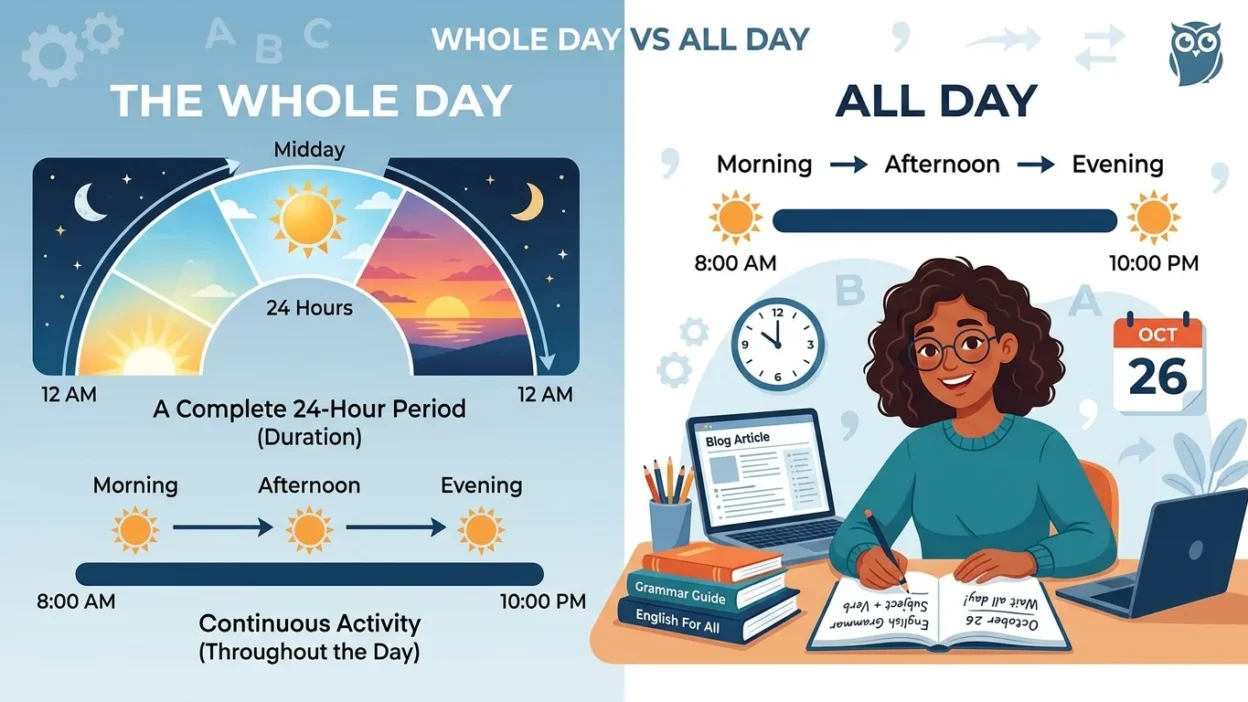
“Whole day” and “all day” are very close in meaning, so it’s easy to assume they can always be used interchangeably. In everyday English, however, they can emphasize slightly different ideas. All day usually means something continues throughout the day, while the whole day often emphasizes the complete duration of a day from beginning to end. The difference is subtle, but understanding it can make your English sound more natural and precise.
For example, you might say, “I worked all day” when describing continuous activity. But if you say, “I spent the whole day at home,” you are emphasizing that the entire day was spent there. Both expressions are grammatically correct, and native speakers commonly use both. The best choice depends on what you want to emphasize: duration throughout the day or the complete day as one period of time.
Quick Answer
“All day” means throughout the day and is especially common when describing an activity or condition that continues for many hours. “The whole day” emphasizes the entire day as a complete period. In many situations, they are interchangeable, but “all day” is usually more natural in everyday English.
Why People Confuse It
The confusion happens because both expressions can describe something lasting from morning until night.
Compare:
- I studied all day.
- I studied the whole day.
Both can communicate that the person studied for essentially the entire day. However, the first sentence sounds more natural in most everyday contexts.
There is also an important difference in emphasis:
- All day focuses more naturally on duration.
- The whole day focuses more strongly on completeness.
Another reason for confusion is that learners sometimes leave out the before “whole day.”
Usually, we say:
- the whole day ✅
- a whole day ✅
- whole day ❌ in most standard sentence structures
For example:
I waited the whole day.
or:
It took a whole day to finish.
First Word: “Whole Day”
What does “whole day” mean?
Whole day means an entire day or the complete period of one day.
In normal English, it is usually preceded by the or a:
- the whole day
- a whole day
- my whole day
- his whole day
- her whole day
“The whole day” often gives the idea that something occupied or affected the complete day.
Examples
- I spent the whole day cleaning the house.
- She was busy for the whole day.
- We stayed at the beach the whole day.
- He wasted his whole day watching television.
- It took a whole day to repair the machine.
Notice that whole emphasizes the day as a complete unit.
Second Word: “All Day”
What does “all day” mean?
All day means throughout the day or during most or all of the day.
It is extremely common in everyday English, especially when describing an action, activity, feeling, or condition that continues for a long period.
Examples include:
- I worked all day.
- She talked all day.
- It rained all day.
- I’ve been waiting all day.
- He was tired all day.
“All day” commonly answers the question:
How long?
For example:
How long did you work?
I worked all day.
This makes “all day” particularly natural when talking about duration.
Comparison Table
| Expression | Main meaning | Typical emphasis | Example |
| all day | Throughout the day | Duration | I worked all day. |
| the whole day | The entire day | Completeness | I spent the whole day there. |
| a whole day | One complete day | Length/completeness | It took a whole day. |
| my whole day | The entirety of my day | Personal time | The meeting took my whole day. |
| all of the day | The entire day | Formal/emphatic | The process continued for all of the day. |
The key distinction is simple: “all day” is generally the more natural everyday expression for duration, while “the whole day” often stresses the complete day.
When to Use Each
Use “all day” for ongoing activities
When an action continues throughout the day, all day is usually the most natural choice.
- I worked all day.
- She studied all day.
- They played outside all day.
- We traveled all day.
Use “the whole day” for emphasis
Use the whole day when you want to emphasize that something occupied the complete day.
- I spent the whole day with my family.
- The conference lasted the whole day.
- We waited the whole day for an answer.
Use “a whole day” for one complete day
When talking about the amount of time something requires, a whole day is common.
- The journey took a whole day.
- You need a whole day to complete this project.
- It took me a whole day to organize everything.
Use possessive + “whole day”
You can also emphasize someone’s complete available time:
- The meeting took my whole day.
- The project consumed his whole day.
- Cooking for the event took her whole day.
Examples
Here are natural examples showing how native speakers commonly use these expressions.
- I worked all day and came home exhausted.
- She studied all day for her final exam.
- We spent the whole day at the museum.
- It rained all day yesterday.
- He spent the whole day playing video games.
- The trip took a whole day.
- I’ve been waiting all day for your call.
- They stayed at the park the whole day.
- She was feeling tired all day.
- The meeting took my whole day.
- We drove all day before reaching the city.
- I spent the whole day preparing for the interview.
- The children were outside all day.
- It took a whole day to paint the room.
- He complained about the problem all day.
“All day” vs “the whole day” in context
Consider these two sentences:
I was at work all day.
This naturally emphasizes the duration of your time at work.
I was at work the whole day.
This is understandable, but it gives stronger emphasis to the fact that your entire day was occupied by work. Depending on the context, a native speaker might prefer all day.
Common Mistakes
1. Saying “whole day” without a determiner
A common learner error is:
I studied whole day. ❌
Better:
I studied all day. ✅
or:
I studied the whole day. ✅
2. Assuming “all day” always means literally every minute
“All day” generally means throughout the day, but it does not necessarily mean every single minute.
For example:
I worked all day.
This normally means work occupied most or essentially all of the relevant daytime period. It does not mean the person literally worked without stopping for food, breaks, or other necessities.
3. Using “whole” when “all” sounds more natural
Some learners translate directly from their first language and say:
I waited the whole day for you.
This is grammatically possible, but in many conversational contexts:
I waited all day for you.
sounds more natural.
4. Confusing “a whole day” with “all day”
These structures have different grammatical roles:
- It lasted all day.
- It lasted a whole day.
The first emphasizes the duration throughout the day. The second emphasizes that the duration amounted to one complete day.
5. Forgetting the article
When “whole” modifies a singular countable noun such as “day,” a determiner is normally needed:
- the whole day ✅
- a whole day ✅
- my whole day ✅
- whole day ❌
Memory Trick
Think of ALL as a timeline and WHOLE as a complete package.
ALL DAY = throughout the day
I worked all day.
→ The activity continued throughout the day.
THE WHOLE DAY = the complete day
I spent the whole day at home.
→ I am emphasizing the entire day as one complete period.
A quick memory formula:
ALL = throughout
WHOLE = entire
If you remember that distinction, you can usually choose the more natural expression.
American vs British English
There is no major grammatical difference between American and British English when it comes to all day and the whole day.
Both varieties commonly use:
- I worked all day.
- We stayed there all day.
- I spent the whole day at home.
- It rained all day.
However, all day is extremely common in both American and British conversational English.
British English may sometimes use the whole day in contexts where an American speaker might naturally choose all day, but this is mainly a matter of preference and emphasis rather than a strict grammar rule.
The important point is that both expressions are standard English.
Similar Words
Several expressions are related to whole day and all day.
All day long
This strongly emphasizes duration.
She worked all day long.
It can sound more expressive than simply “all day.”
Throughout the day
This is a slightly more formal alternative.
Please drink water throughout the day.
It is common in professional, academic, and informational writing.
The entire day
This has almost the same meaning as the whole day but sounds somewhat more formal.
We spent the entire day discussing the project.
All day and night
This means continuously through both daytime and nighttime.
The baby cried all day and night.
For the whole day
This focuses on the duration of a scheduled period or arrangement.
The room is available for the whole day.
For a whole day
This means for one complete day.
We rented the car for a whole day.
FAQs
Is “all day” grammatically correct?
Yes. All day is completely correct and very common in English. It means throughout the day and is frequently used to describe activities or conditions lasting for many hours.
Is “whole day” correct?
“Whole day” by itself is usually not correct in standard sentence structures. You normally need a determiner, such as the whole day, a whole day, or my whole day.
Is “all day” better than “the whole day”?
Not always. Both can be correct. All day is generally more natural when describing duration, while the whole day can place greater emphasis on the entire day.
Can I say “I worked the whole day”?
Yes. The sentence is understandable and grammatically acceptable. However, I worked all day is often the more natural choice in everyday conversation.
What is the difference between “all day” and “a whole day”?
All day usually describes something happening throughout a particular day. A whole day emphasizes a complete period of one day.
I worked all day.
It took a whole day to finish.
Can “all day” mean 24 hours?
Not necessarily. “All day” usually refers to the daytime or the relevant period of the day. If you specifically mean 24 hours, all day and all night or for 24 hours may be clearer.
Which is more common: “all day” or “the whole day”?
All day is generally more common and natural in everyday English, especially when talking about an activity or condition that continues for many hours.
Final Verdict
“Whole day” and “all day” are both useful expressions, but they are not identical in emphasis. Use all day when you want to describe something happening throughout the day. Use the whole day when you want to emphasize the day as a complete period.
For most everyday situations, all day will sound more natural:
I worked all day.
When completeness matters, choose the whole day:
I spent the whole day with my family.
The difference is subtle rather than absolute. Native speakers may use both expressions in similar situations, so context and emphasis matter more than trying to follow a rigid rule.
Remember This
ALL DAY = throughout the day
THE WHOLE DAY = the entire day
A WHOLE DAY = one complete day
When in doubt, “all day” is usually the safest and most natural choice for everyday conversation.
Conclusion
The expressions “all day” and “the whole day” both describe an extended period covering an entire day, but they can communicate slightly different emphasis. “All day” naturally highlights duration, while “the whole day” draws attention to the day as a complete unit. “A whole day” is especially useful when describing something that takes one complete day.
Learning this distinction can help your English sound smoother without forcing you to memorize complicated grammar rules. Listen for how the expression fits the sentence: if you are describing something continuing throughout the day, all day will often be the natural choice.
If you want to emphasize that the complete day was involved, the whole day may be better.

Hadley Price creates heartfelt contemporary fiction exploring relationships, hope, resilience, and personal growth. Her emotionally rich storytelling connects with readers through memorable characters and inspiring life experiences worldwide.