Have you ever come across the words extensible and extendible and wondered whether they mean the same thing? You’re not alone. These two adjectives look almost identical, share the same root verb (extend), and are often used interchangeably in everyday writing. However, depending on the context especially in technology, engineering, and general English one word is usually a better choice than the other.
In this guide, you’ll learn the difference between extensible vs extendible, discover where each word fits naturally, and avoid one of the most common vocabulary mix ups. Whether you’re writing technical documentation, academic papers, or everyday content, this article will help you choose the right word confidently.
Quick Answer
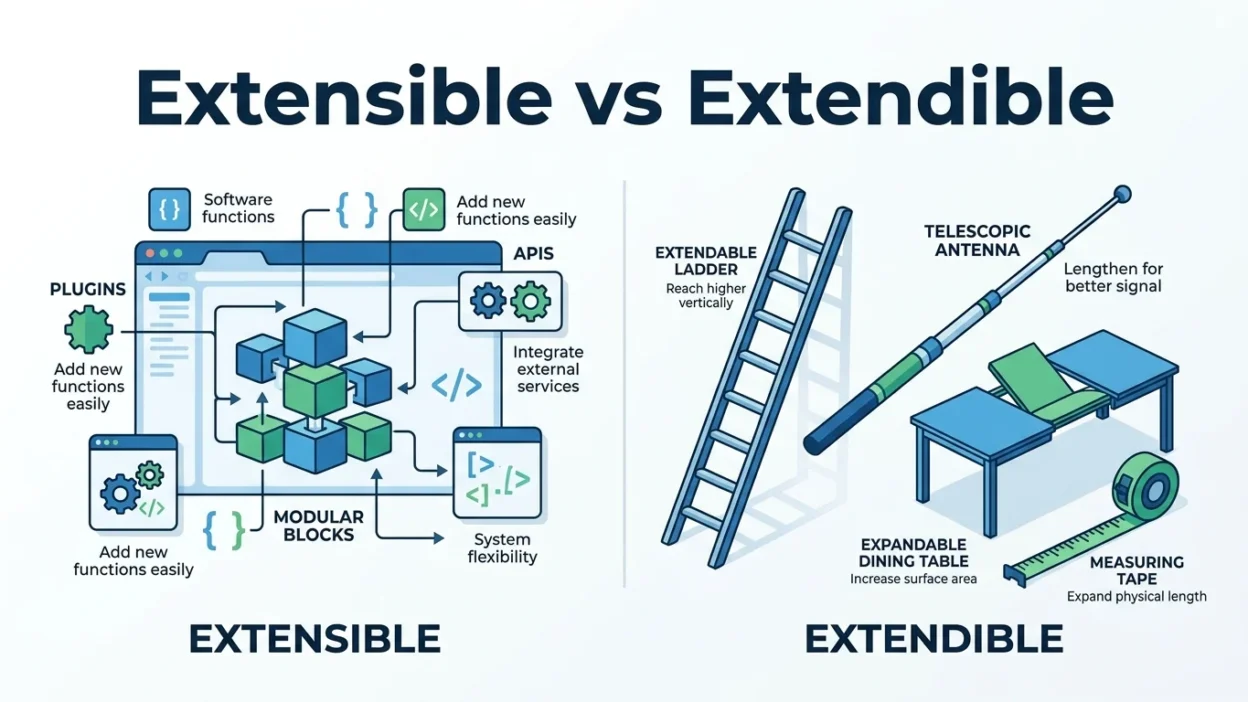
Extensible describes something designed to be expanded by adding new features, functions, or capabilities, especially in software and technology. Extendible simply means capable of being extended or made longer. While both are correct English words, extensible is far more common in technical contexts, whereas extendible usually refers to physical or general expansion.
Why People Confuse It
It’s easy to confuse these words because they:
- Come from the same root verb: extend
- Have nearly identical spellings
- Share related meanings involving expansion
- Are both grammatically correct adjectives
The difference lies in how something is expanded.
- Extensible focuses on adding new functionality or capabilities.
- Extendible focuses on making something longer or increasing its size.
Although dictionaries recognize both terms, modern usage has developed distinct preferences.
Extensible: Meaning and Usage
Extensible means designed so that additional features, functions, or components can be added without changing the original structure significantly.
This word is especially common in:
- Software development
- Programming
- Database design
- System architecture
- Technical documentation
Examples
- The software has an extensible architecture.
- Python is known for its extensible libraries.
- The application uses an extensible plugin system.
- XML is an extensible markup language.
- We built an extensible framework for future updates.
Common LSI Keywords
- scalable software
- modular design
- customizable system
- plugin architecture
- expandable framework
- software flexibility
Extendible: Meaning and Usage
Extendible means capable of being extended, stretched, enlarged, or lengthened.
It usually refers to physical objects or general situations rather than software functionality.
Examples
- The ladder is extendible.
- We bought an extendible dining table.
- The antenna is extendible for better reception.
- The lease is extendible for another year.
- The measuring rod is extendible.
Although technically correct, extendable is often more common than extendible in everyday English.
Extensible vs Extendible Comparison Table
| Feature | Extensible | Extendible |
| Meaning | Can gain new features or functions | Can be lengthened or extended |
| Common Context | Software, programming, technology | Physical objects, contracts, general English |
| Focus | Functional expansion | Physical or measurable extension |
| Frequency | Very common in technical writing | Less common overall |
| Example | Extensible software | Extendible ladder |
When to Use Each
Choose extensible when talking about:
- Software platforms
- APIs
- Programming languages
- Frameworks
- Systems that accept new features
- Technical architecture
Choose extendible when talking about:
- Ladders
- Tables
- Antennas
- Contracts
- Physical objects
- Anything that becomes longer
Easy Rule
If you’re adding capabilities, use extensible.
If you’re adding length, use extendible.
Examples
Here are practical examples showing both words correctly.
Extensible
- The CMS has an extensible plugin system.
- Java provides an extensible class library.
- Our framework is highly extensible.
- The software remains extensible after updates.
- Developers appreciate an extensible API.
- The architecture was built to be extensible.
Extendible
- The extendible pole reached the rooftop.
- She purchased an extendible dining table.
- The warranty is extendible by one year.
- We packed an extendible tripod.
- The crane has an extendible arm.
- The extendible handle makes storage easier.
Common Mistakes
Here are mistakes writers often make.
Using extendible in software documentation
❌ The application has an extendible architecture.
✅ The application has an extensible architecture.
Using extensible for physical objects
❌ We bought an extensible ladder.
✅ We bought an extendible ladder.
Assuming they’re always interchangeable
Although dictionaries may list overlapping meanings, context determines which word sounds natural.
Memory Trick
Remember this simple tip:
Extensible = Extra Features
Think of the “s” in extensible as standing for software and system.
Extendible = Extend Length
Think of something physically stretching or becoming longer.
This quick association makes choosing the correct word much easier.
American vs British English
Both American English and British English recognize extensible and extendible.
However:
- Extensible is the preferred spelling in technical writing worldwide.
- Extendible appears in both varieties but is less common than extendable in everyday usage.
- International software documentation overwhelmingly favors extensible.
There is no major regional spelling difference between these two words.
Similar Words
You may also encounter these related terms:
- Extendable
- Expandable
- Expandable architecture
- Scalable
- Modular
- Flexible
- Configurable
- Adaptable
- Customizable
- Expandable system
Each has a slightly different meaning, so choose based on your context.
Frequently Asked Questions
Is extensible a real word?
Yes. Extensible is a standard English adjective, especially common in computing and software engineering.
Is extendible grammatically correct?
Yes. Extendible is also correct English, although extendable is more common in everyday writing.
Which word is used in programming?
Extensible is the preferred term in software development because it refers to adding new functionality.
Can extensible and extendible be used interchangeably?
Sometimes, but not always. Technical writing generally prefers extensible, while physical objects are more naturally described as extendible.
Is XML called extensible or extendible?
XML stands for Extensible Markup Language, not Extendible Markup Language.
Which word is more common?
Overall, extensible dominates technical fields, while extendable is often preferred over extendible in general English.
Is extendible outdated?
No. It remains a valid English word, though it is less frequently used than extendable.
Final Verdict
Although extensible and extendible share the same origin, they serve different purposes in modern English.
Use extensible when describing systems, software, or frameworks that can gain new features without major redesign. Use extendible when referring to objects or situations that can be physically lengthened or extended. Understanding this distinction makes your writing clearer and more professional.
Conclusion
Choosing between extensible and extendible becomes simple once you understand the difference in context. While both words relate to the idea of extension, extensible emphasizes adding capabilities, making it the standard choice in technology and software development. Extendible, on the other hand, refers to physical or measurable extension and appears more often when describing objects or agreements.
The next time you write about a software platform, think extensible. If you’re describing a ladder, table, antenna, or another object that grows longer, extendible is the better fit. Using the correct word not only improves accuracy but also makes your writing more polished and credible.
Remember This
Extensible = Add new features or functions (software, systems, technology).
Extendible = Make something longer or physically extended (objects, tools, contracts).

Adam Aaron writes engaging mystery and adventure novels featuring intelligent characters, unexpected twists, and emotional storytelling. His creative imagination and compelling narratives have earned admiration from readers across generations.