
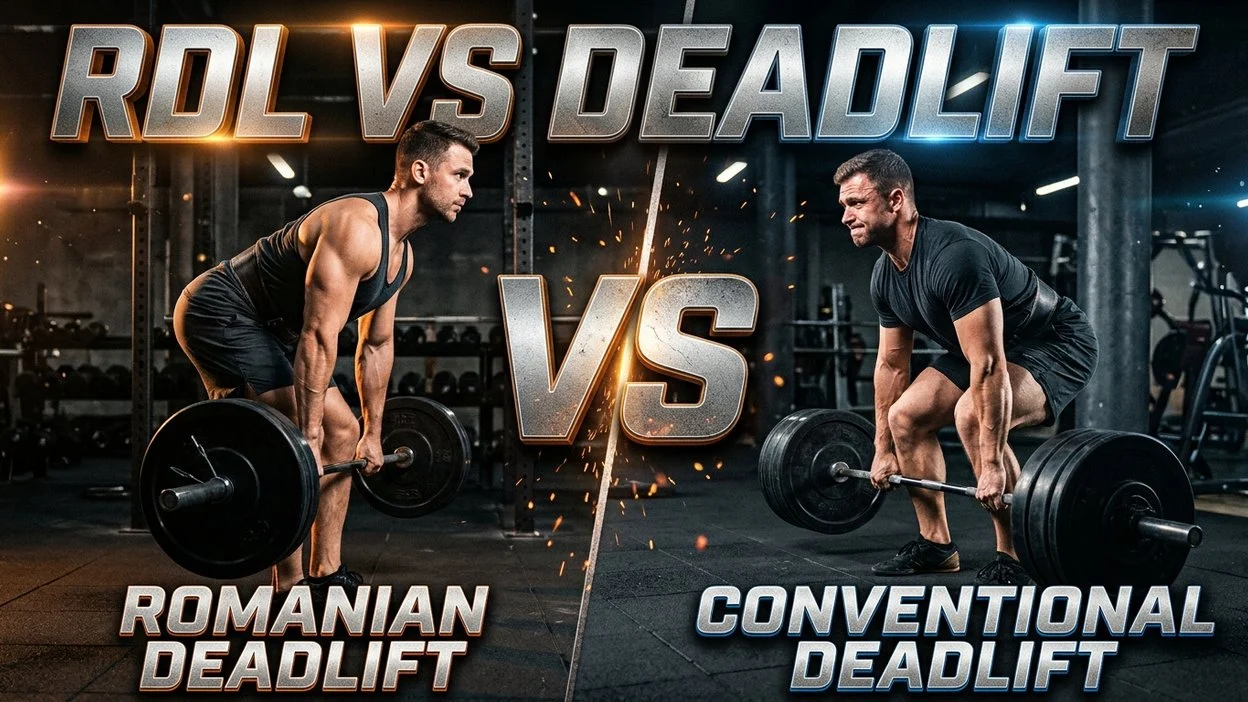
The main difference between an RDL and a deadlift is how you move your hips and knees, how you lift the weight, and which muscles receive the most attention. An RDL, or Romanian deadlift, focuses on moving the hips backward while keeping the knees slightly bent. A conventional deadlift starts with the weight on the floor and involves more knee bending to lift it. Both exercises strengthen the lower body, but they serve slightly different training goals.
Understanding RDL vs deadlift can help you choose the right exercise for your workout. Whether you are a beginner learning strength training, an athlete building power, or someone looking to strengthen the hamstrings and glutes, knowing the differences makes your training more effective. Although both exercises use a hip-hinge movement, their starting positions, range of motion, and lifting techniques are not the same. Learning proper form is important for getting the benefits of each exercise while managing unnecessary stress on your back and joints.
Quick Answer: RDL vs Deadlift
An RDL is a hip-hinge exercise that emphasizes the hamstrings and glutes by lowering the weight from a standing position without placing it on the floor between repetitions. A conventional deadlift lifts the weight from the floor and uses more knee bending. Choose RDLs for focused posterior-chain training and conventional deadlifts for overall strength development.
Why Do People Confuse RDLs and Deadlifts?
People often confuse these exercises because both involve lifting a weight while bending at the hips. They also work several of the same muscles, including the glutes, hamstrings, and spinal erectors.
However, the movement mechanics are different.
In a conventional deadlift, you begin with the barbell on the floor. You bend your hips and knees, grip the bar, and stand up while keeping the weight close to your body.
In an RDL, you begin standing with the weight in your hands. You push your hips backward, keep your knees slightly bent, and lower the weight along your legs before returning to the starting position.
The key difference is that a conventional deadlift starts from the floor, while an RDL emphasizes a controlled lowering movement from the standing position.
What Is an RDL?
RDL stands for Romanian deadlift. It is a strength exercise that primarily targets the hamstrings and glutes while also engaging the muscles that support the spine.
How Do You Perform an RDL?
- Stand with your feet approximately hip-width apart and hold a barbell or dumbbells in front of your thighs.
- Keep your knees slightly bent.
- Push your hips backward while lowering the weight close to your legs.
- Keep your spine in a comfortable, neutral position.
- Stop when you reach the deepest position you can control without rounding your back or losing your balance.
- Drive your hips forward to return to standing.
The movement should come mainly from your hips rather than from repeatedly bending and straightening your knees.
Which Muscles Does an RDL Work?
The main muscles involved are:
- Hamstrings: Help control the lowering movement and extend the hips.
- Gluteus maximus: Helps bring the hips forward as you stand.
- Spinal erectors: Help maintain your torso position.
- Core muscles: Support stability throughout the movement.
- Forearms and grip muscles: Help hold the weight.
RDLs are especially useful for developing strength in the posterior chain, which refers to the muscles along the back of the body.
What Is a Conventional Deadlift?
A conventional deadlift is a compound strength exercise in which you lift a barbell from the floor to a standing position. It trains several muscle groups at once and is commonly used to develop overall strength.
How Do You Perform a Conventional Deadlift?
- Stand with your feet approximately hip-width apart, with the barbell over the middle of your feet.
- Bend your hips and knees to reach the bar.
- Grip the bar just outside your legs.
- Brace your core and keep your back in a stable, comfortable position.
- Push through your feet and extend your knees and hips to stand upright.
- Lower the bar under control until it returns to the floor.
Reset your position before the next repetition, particularly when learning the exercise.
Which Muscles Does a Deadlift Work?
A conventional deadlift involves several major muscle groups:
- Glutes: Help extend the hips.
- Hamstrings: Assist with hip extension and control.
- Quadriceps: Help straighten the knees during the lift.
- Spinal erectors: Help stabilize and maintain the position of the spine.
- Core muscles: Help brace the torso.
- Trapezius and upper-back muscles: Help stabilize the shoulders and upper body.
- Forearms and grip muscles: Hold the barbell.
Because the conventional deadlift combines hip and knee extension, it generally involves more quadriceps activity than an RDL.
RDL vs Deadlift: What Are the Main Differences?
The following table compares the Romanian deadlift with the conventional deadlift.
| Feature | Romanian Deadlift (RDL) | Conventional Deadlift |
| Starting position | Standing with the weight in your hands | Weight resting on the floor |
| Main movement | Primarily a hip hinge | Combined hip and knee extension |
| Knee movement | Slight bend maintained throughout | Knees bend more at the start |
| Main emphasis | Hamstrings and glutes | Overall lower-body and back strength |
| Range of motion | Usually ends around the shins or when hamstring mobility limits further movement | Starts at the floor and finishes standing |
| Weight used | Often lighter, depending on the lifter and goal | Often heavier, depending on the lifter and goal |
| Quadriceps involvement | Generally lower | Generally higher |
| Lowering phase | Controlled, with tension maintained | Weight is returned to the floor |
| Training goal | Posterior-chain development and hip-hinge control | Overall strength and lifting performance |
| Common equipment | Barbell or dumbbells | Usually a barbell, but other equipment can be used |
Neither exercise is automatically better than the other. The right choice depends on your goals, experience, technique, and training program.
When Should You Use an RDL or a Deadlift?
Your choice should depend on what you want to improve.
When Is an RDL the Better Choice?
Consider RDLs when you want to:
- Build hamstring and glute strength.
- Improve your hip-hinge technique.
- Train the posterior chain with controlled repetitions.
- Add a supplementary exercise to a lower-body workout.
- Develop strength for sports that involve sprinting, jumping, and powerful hip extension.
For example, if your workout already includes squats and you want an exercise that emphasizes the hamstrings and glutes, RDLs can be a useful addition.
When Is a Conventional Deadlift the Better Choice?
Consider conventional deadlifts when you want to:
- Improve overall strength.
- Practice lifting a weight from the floor.
- Develop coordination between hip and knee extension.
- Train multiple major muscle groups in one exercise.
- Prepare for a powerlifting competition that includes the conventional deadlift.
For example, if your main goal is to improve your ability to lift progressively heavier weights from the floor, the conventional deadlift is a direct choice.
Can You Do Both Exercises in the Same Workout?
Yes. You can include both exercises in the same training program because they provide overlapping but different benefits.
One approach is to perform conventional deadlifts as your main strength exercise and use RDLs as an accessory exercise with lighter weights and controlled repetitions.
However, both exercises can fatigue the hamstrings, glutes, and lower-back muscles. Adjust the sets, repetitions, and loads to match your experience and recovery needs.
RDL vs Deadlift: 12 Practical Examples
These examples show how the two exercises differ in actual training situations.
- Building hamstring strength: RDLs are a strong option because they emphasize the hamstrings during the controlled lowering phase.
- Building glute strength: Both exercises train the glutes. RDLs are useful when you want to emphasize hip-hinge work.
- Lifting a barbell from the floor: The conventional deadlift is the direct choice because every repetition begins with the weight on the floor.
- Learning to move your hips backward: RDLs help you practice the hip-hinge pattern without repeatedly resetting the weight on the floor.
- Training the quadriceps: Conventional deadlifts generally involve more quadriceps activity because the knees bend more during the initial lift.
- Developing overall strength: Conventional deadlifts are useful because they train multiple large muscle groups and allow progressive loading.
- Adding an accessory exercise after squats: RDLs can complement squats by placing additional emphasis on the posterior chain.
- Improving control during the lowering phase: RDLs are useful for practicing a slow, controlled eccentric movement.
- Training with dumbbells at home: Dumbbell RDLs are practical when you have limited equipment and want to strengthen your hamstrings and glutes.
- Preparing for a powerlifting deadlift event: Practicing the competition-specific deadlift is important, although the exact style depends on the event rules and your chosen technique.
- Learning basic lifting mechanics: Beginners can practice a bodyweight hip hinge before progressing to light RDLs or learning the conventional deadlift with appropriate instruction.
- Training both strength and muscle growth: A program can include conventional deadlifts for strength and RDLs for additional posterior-chain volume, provided the workload is manageable.
These examples are general training suggestions. Exercise selection should reflect your current ability, equipment, and any movement limitations.
What Are the Common Mistakes in RDLs and Deadlifts?
Good technique helps you train the intended muscles and control the load.
Common RDL Mistakes
- Bending the knees too much: This can turn the movement into something closer to a squat. Keep the knees slightly bent and relatively steady.
- Rounding the back to lower the weight farther: Do not chase extra depth at the expense of spinal position. Stop where you can maintain control.
- Moving the weight away from the legs: Keep the barbell or dumbbells close to your body.
- Using excessive weight: A load that is too heavy can make it difficult to maintain a controlled hip hinge.
- Leaning backward at the top: Finish standing tall with your hips extended rather than arching your lower back.
Common Conventional Deadlift Mistakes
- Starting with the bar too far away: Position the bar over the middle of your feet and keep it close during the lift.
- Lifting with a loose torso: Brace your core before initiating the movement.
- Jerking the bar off the floor: Build tension before lifting rather than pulling suddenly.
- Allowing the bar to drift forward: Keep the bar close to your legs to maintain an efficient lifting path.
- Rushing the setup: Establish a consistent starting position before every repetition.
If you experience sharp pain, numbness, or unusual symptoms during either exercise, stop and seek appropriate professional advice rather than trying to push through it.
What Is an Easy Memory Trick for RDL vs Deadlift?
Use this simple rule:
RDL = hips back. Deadlift = weight from the floor.
Think of an RDL as a controlled hip-hinge exercise. Your hips travel backward as the weight slides down your legs.
Think of a conventional deadlift as picking a weight up from the ground and standing tall.
This memory trick focuses on the most noticeable difference in the exercises. Both movements still involve the hips, glutes, hamstrings, and back muscles.
Is There an American vs British English Difference?
No major American-versus-British English distinction changes the meaning of these exercise names.
- Romanian deadlift (RDL): The standard name used in both American and British English.
- Deadlift: The standard term in both varieties of English for the strength exercise.
- Barbell: Common in both varieties of English.
- Dumbbell: Common in both varieties of English.
- Weight training / weightlifting: Both terms are used in the United States and the United Kingdom, although their meanings can vary by context.
In everyday gym conversation, people in either country may simply say “RDLs” or “deadlifts.”
What Words Are Similar to RDL and Deadlift?
Several exercise names are related to these movements, but they do not all describe the same technique.
1. Stiff-Leg Deadlift
A stiff-leg deadlift uses a relatively straight-knee position and emphasizes the posterior chain. Despite its name, the knees should not necessarily be locked. Its exact technique varies, and it is not identical to the Romanian deadlift.
2. Sumo Deadlift
A sumo deadlift uses a wider stance and a more outward foot position than a conventional deadlift. It changes the movement mechanics and the relative contribution of different muscles.
3. Trap-Bar Deadlift
A trap-bar deadlift uses a hexagonal or trap-shaped bar that allows the lifter to stand inside the frame. Its mechanics can differ from those of a conventional barbell deadlift.
4. Good Morning
A good morning is a hip-hinge exercise performed with a barbell across the upper back or with other suitable resistance. It trains the posterior chain but uses a different loading position from an RDL.
5. Hip Thrust
A hip thrust emphasizes hip extension, especially through the glutes. Unlike an RDL, it is usually performed with the upper back supported on a bench.
6. Back Extension
A back extension trains the muscles that extend the hips and support the trunk. Depending on the technique, it can emphasize the glutes, hamstrings, and spinal erectors.
These exercises can complement one another, but the best combination depends on your training objectives and recovery capacity.
Final Verdict: Should You Choose an RDL or a Deadlift?
Choose the Romanian deadlift if your main priority is hamstring and glute development through a controlled hip hinge. Choose the conventional deadlift if your priority is lifting strength from the floor and developing overall lower-body strength.
Both exercises are valuable, and neither is universally superior. You can use both in the same program if you manage your training volume, technique, and recovery appropriately.
FAQs:
1. Is an RDL better than a deadlift for glutes?
Both exercises train the glutes. RDLs are useful for emphasizing hip-hinge work and the posterior chain, while conventional deadlifts train the glutes alongside the quadriceps and other major muscle groups. The better choice depends on your goals and overall program.
2. Is an RDL the same as a deadlift?
No. An RDL is a variation of the deadlift that begins from a standing position and emphasizes a controlled hip hinge. A conventional deadlift typically starts with the barbell on the floor and involves more knee bending.
3. Which is better for hamstrings, RDLs or deadlifts?
RDLs are often a particularly useful choice for hamstring development because they load the hamstrings during hip flexion and the controlled lowering phase. Conventional deadlifts also train the hamstrings but distribute the work across more muscle groups.
4. Can beginners do Romanian deadlifts?
Yes. Beginners can start with a bodyweight hip hinge, a light dumbbell RDL, or another manageable variation. Learning to maintain a stable torso, control the weight, and move through a comfortable range of motion is more important than lifting heavy loads.
5. Do RDLs work the lower back?
Yes. RDLs train the spinal erectors, which help stabilize the spine while the hips move. These muscles work alongside the glutes and hamstrings. The exercise should not be performed by repeatedly rounding and straightening the lower back.
6. Should I do RDLs and deadlifts on the same day?
You can, but it is not necessary. Both exercises place demands on overlapping muscle groups. If you perform them in one session, consider making one the main lift and using lighter loads or fewer sets for the other.
7. Can RDLs replace conventional deadlifts?
RDLs can replace conventional deadlifts when your main goal is posterior-chain training and you do not need to practice lifting from the floor. However, they are not a complete substitute if your goal is to improve conventional deadlift performance.
8. How low should you go during an RDL?
Lower the weight until you reach the deepest position you can control while maintaining a stable spinal position and keeping the weight close to your legs. For some people, this is around mid-shin level; for others, it is higher. Touching the floor is not required.
Remember This
- RDL: Start standing, push the hips backward, and emphasize the hamstrings and glutes.
- Conventional deadlift: Start with the weight on the floor, extend the knees and hips, and build overall lifting strength.
- Both: Train the posterior chain, require sound technique, and benefit from gradual progression.
- Best choice: Select the exercise that matches your training goal rather than assuming one is always better.
Conclusion:
The difference between an RDL and a conventional deadlift comes down to the starting position, movement pattern, and training emphasis. Romanian deadlifts focus on a controlled hip hinge and are particularly useful for strengthening the hamstrings and glutes. Conventional deadlifts start from the floor and develop strength across multiple muscle groups, including the quadriceps, glutes, and back.
If you are new to strength training, learn the movement patterns with manageable resistance before increasing the weight. As your technique improves, you can choose one exercise or combine both to support your goals. Consistency, appropriate loading, and good form matter more than choosing a supposedly perfect exercise.

Hadley Price creates heartfelt contemporary fiction exploring relationships, hope, resilience, and personal growth. Her emotionally rich storytelling connects with readers through memorable characters and inspiring life experiences worldwide.