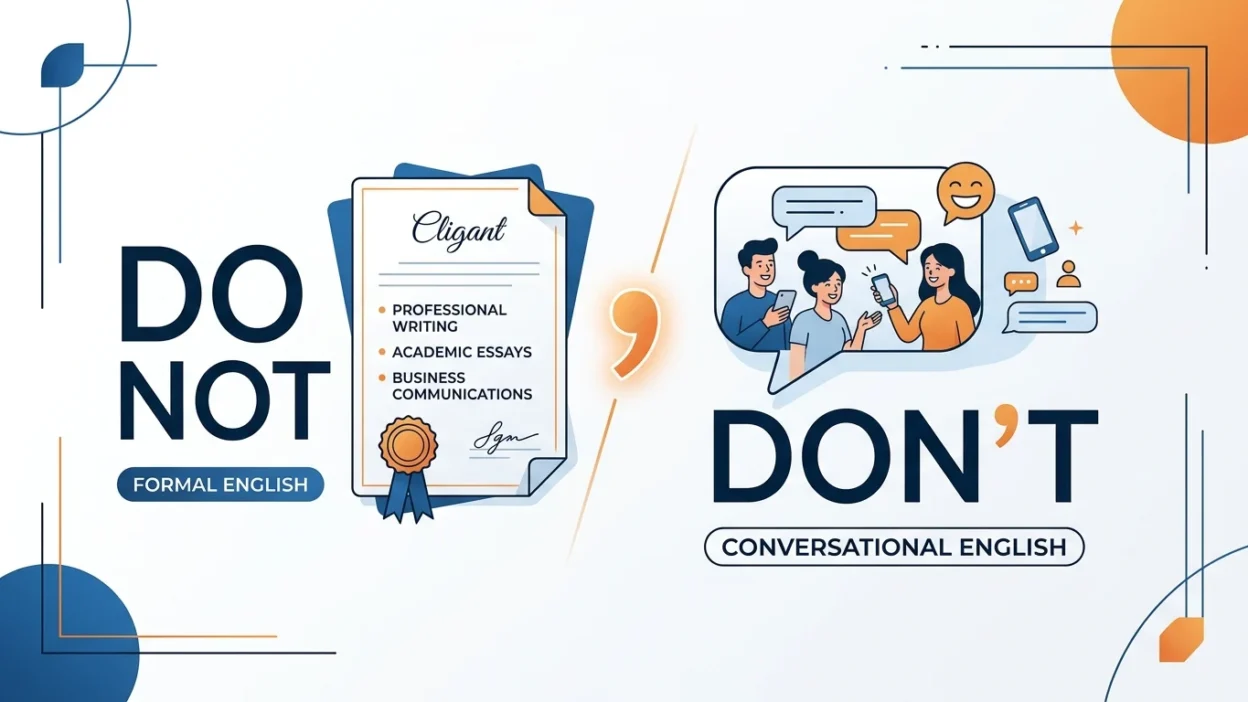
“Do not” and “don’t” have the same basic meaning, but they are not always interchangeable in tone, style, or context. Both forms are used to make negative statements and commands, such as “Do not touch the button” and “Don’t touch the button.”
The difference is mainly one of formality, emphasis, and conversational style. Understanding when to use each can make your English sound more natural and appropriate for the situation.
In everyday conversations, don’t is much more common because contractions make speech and informal writing sound relaxed and natural. Do not, however, is often preferred in formal writing, official instructions, warnings, rules, and situations where the negative command needs extra emphasis. Learning this distinction is useful for students, professionals, and anyone who wants to communicate clearly in English without sounding unnecessarily formal or informal.
Quick Answer
“Do not” and “don’t” mean the same thing, but their tone differs. “Don’t” is the normal contraction used in everyday English, while “do not” sounds more formal or emphatic. Use “do not” for formal instructions, rules, and emphasis; use “don’t” for casual conversation and informal writing.
Why People Confuse It
People often wonder whether do not vs don’t represents a difference in grammar or meaning. In most situations, it does not. “Don’t” is simply the contracted form of “do not.”
For example:
- Do not worry.
- Don’t worry.
Both sentences tell someone not to worry.
The important difference is register, meaning the level of formality appropriate for a particular situation.
Consider these examples:
- Please do not enter. → formal and official
- Please don’t come in yet. → natural and conversational
Another reason for confusion is that do not can sometimes add emphasis. Compare:
I don’t want to go.
with:
I do not want to go.
The second sentence can sound stronger, more deliberate, or even slightly dramatic depending on the context.
First Word: “Do Not”
Do not is the full, uncontracted form. It is grammatically correct and can be used in both formal and informal English, although it generally sounds more formal or emphatic.
Common uses of “do not”
Use do not when you want to:
- Give formal instructions
- State an official rule
- Write a warning or notice
- Create a serious or authoritative tone
- Emphasize a negative statement
- Avoid contractions in formal writing
Examples
- Do not open the door.
- Do not share your password.
- Do not use this equipment without permission.
- I do not agree with that decision.
- We do not accept returns without a receipt.
You will frequently see do not in signs, policies, academic writing, legal language, manuals, and professional communication.
For example:
Do not park in front of the entrance.
This sounds appropriate for an official sign.
Second Word: “Don’t”
Don’t is the contraction of do not. It is extremely common in spoken English and informal writing.
The apostrophe replaces the omitted letters in do not.
Do not → Don’t
Common uses of “don’t”
Use don’t when you want to:
- Sound conversational
- Speak naturally in everyday situations
- Give casual advice
- Write informal messages
- Make ordinary negative statements
Examples
- Don’t worry about it.
- I don’t know the answer.
- Don’t forget your keys.
- We don’t need any more food.
- Please don’t interrupt me.
Using “don’t” in everyday conversation is completely normal.
For example:
Don’t be late.
sounds natural between friends, family members, or coworkers.
Comparison Table
| Feature | Do Not | Don’t |
| Meaning | Negative form of “do” | Same meaning |
| Grammar | Full form | Contraction |
| Tone | Formal or emphatic | Informal and conversational |
| Common in speech | Less common | Very common |
| Formal writing | Often preferred | Sometimes avoided |
| Official rules | Very common | Less common |
| Everyday conversation | Correct but can sound formal | Most natural |
| Emphasis | Can provide stronger emphasis | Usually more relaxed |
The key point is simple: the meaning is generally the same, but the style is different.
When to Use Each
Choosing between do not and don’t depends mainly on your audience and purpose.
Use “do not” when:
- Writing a formal report
- Creating official instructions
- Writing academic or professional material
- Giving a serious warning
- Writing a policy or rule
- You want to emphasize the negative
Example:
Employees do not have permission to access this area.
This sounds official and authoritative.
Use “don’t” when:
- Talking with friends
- Sending casual messages
- Speaking in everyday situations
- Writing informal emails
- Giving friendly advice
Example:
Don’t worry. I’ll handle it.
This sounds friendly and natural.
One important exception: emphasis
Sometimes do not is used even in informal speech because the speaker wants to stress the negative.
Do not tell anyone what happened.
This can sound much stronger than:
Don’t tell anyone what happened.
So, context matters.
Examples
Here are several examples showing how both forms work.
- Do not touch the machine.
Formal instruction or warning. - Don’t touch the machine.
Natural everyday command. - I do not understand the question.
Formal or emphatic. - I don’t understand the question.
Normal conversational English. - Please do not enter this room.
Appropriate for an official notice. - Please don’t enter yet.
Natural in conversation. - We do not accept cash payments.
Formal business statement. - We don’t accept cash payments.
Common in everyday business communication. - Do not forget to submit the form.
Formal reminder or instruction. - Don’t forget to submit the form.
Friendly, everyday reminder. - They do not agree with the proposal.
More formal or deliberate. - They don’t agree with the proposal.
More conversational. - Do not make this mistake again.
Strong and authoritative. - Don’t make this mistake again.
Direct but more conversational. - I do not want to discuss this matter.
Stronger and potentially more formal. - I don’t want to discuss this.
Normal conversational phrasing.
Notice that changing do not to don’t usually does not change the basic meaning. What changes is the tone.
Common Mistakes
1. Thinking “don’t” is grammatically incorrect
It isn’t.
Don’t is a standard English contraction of do not.
I don’t like coffee.
is perfectly correct.
2. Avoiding “don’t” in all situations
Some learners believe formal English requires “do not” everywhere. That can make ordinary English sound unnecessarily stiff.
For example:
I do not know what you mean.
is grammatically correct, but in casual conversation:
I don’t know what you mean.
usually sounds more natural.
3. Using “don’t” when a highly formal tone is expected
A contraction may be inappropriate in certain formal contexts.
For example, an official safety notice would normally say:
Do not operate the machine without authorization.
rather than:
Don’t operate the machine without authorization.
The second sentence is understandable, but the first better matches the formal context.
4. Confusing “do not” with “does not”
Remember that do not is used with I, you, we, and they, while does not is used with he, she, and it.
- I do not know.
- You do not know.
- They do not know.
- He does not know.
- She does not know.
The contraction of does not is doesn’t, not “don’t.”
Memory Trick
Think of don’t as the everyday version and do not as the full or formal version.
A simple memory trick is:
DON’T = DO NOT, but shorter and more conversational.
If you can imagine saying the sentence naturally to a friend, don’t will often work well.
If the sentence looks like something you would see on an official sign, in a rulebook, or in a formal document, do not is often the better choice.
American vs British English
Both do not and don’t are standard in American and British English.
There is no major difference in grammar between the two varieties regarding these forms.
In both forms of English:
- don’t is common in everyday conversation.
- do not is used for formal language and emphasis.
- Both are grammatically correct.
For example, an American speaker might say:
Don’t worry about it.
A British speaker can say exactly the same thing.
Likewise, an official instruction in either variety may use:
Do not enter.
The choice is therefore primarily about formality, context, and emphasis, rather than American versus British grammar.
Similar Words
Understanding related negative forms can make this topic easier.
Do not / don’t
These are the two forms discussed in this article.
- Do not = full form
- Don’t = contraction
Does not / doesn’t
These are used with third person singular subjects.
- She does not understand.
- She doesn’t understand.
Did not / didn’t
These are used for past actions.
- They did not arrive.
- They didn’t arrive.
Cannot / can’t
These express inability or lack of permission.
- You cannot enter.
- You can’t enter.
The same general pattern applies: the full form often sounds more formal or emphatic, while the contraction is more conversational.
FAQs
Is “do not” more correct than “don’t”?
No. Both are grammatically correct. Don’t is simply the contracted form of do not. The appropriate choice depends on context, tone, and level of formality.
Is “don’t” informal English?
It is commonly associated with conversational and informal English, but it is not incorrect or slang. Contractions such as don’t are standard English and are widely used.
Should I use “do not” in formal writing?
Often, yes, particularly when writing formal instructions, policies, warnings, or official documents. However, contractions are not automatically wrong in every type of formal writing.
Can “do not” show emphasis?
Yes. A speaker may deliberately use do not instead of don’t to make a negative statement sound stronger or more serious.
Is “do not” rude?
Not necessarily. Its tone depends on context. Do not enter sounds authoritative on a sign, while I do not agree may sound firm or formal in conversation.
Is “don’t” acceptable in academic writing?
It can be, depending on the style guide, subject, and type of academic writing. Some academic contexts favor avoiding contractions, while others allow them. Follow the requirements of your institution or publication.
What is the difference between “do not” and “don’t”?
The basic meaning is the same. Do not is the full form and often sounds more formal or emphatic, while don’t is the contracted form and sounds more natural in everyday English.
Final Verdict
Do not and don’t are grammatically equivalent in most situations. The real distinction is not meaning but tone and context. “Don’t” is the natural choice for most everyday conversations, casual messages, and informal communication. “Do not” is especially useful for formal instructions, official rules, warnings, and situations where you want extra emphasis.
When choosing between them, ask yourself how the sentence should sound. If it should feel relaxed and conversational, don’t is usually the best choice. If it should sound official, serious, or deliberately emphatic, do not is usually more appropriate.
Remember This
Do not = full form, often formal or emphatic.
Don’t = contraction, usually conversational and natural.
Both are correct. Choose the form that matches your context and tone.
Conclusion
The difference between do not vs don’t is easy to understand once you stop treating them as two different grammatical expressions. They express the same basic negative meaning, but they create slightly different impressions. “Don’t” keeps everyday English smooth and natural, while “do not” can add formality, authority, or emphasis.
For practical English communication, use don’t freely in ordinary conversation and informal writing. Choose do not when writing formal instructions, official notices, policies, or when you intentionally want to stress a negative statement. Mastering this small distinction can make your English sound more precise, natural, and appropriate for the situation.

Nova Turner specializes in imaginative science fiction blending futuristic technology, thrilling adventures, and powerful human emotions. Her innovative storytelling inspires curiosity, creativity, and exploration among readers of every age.