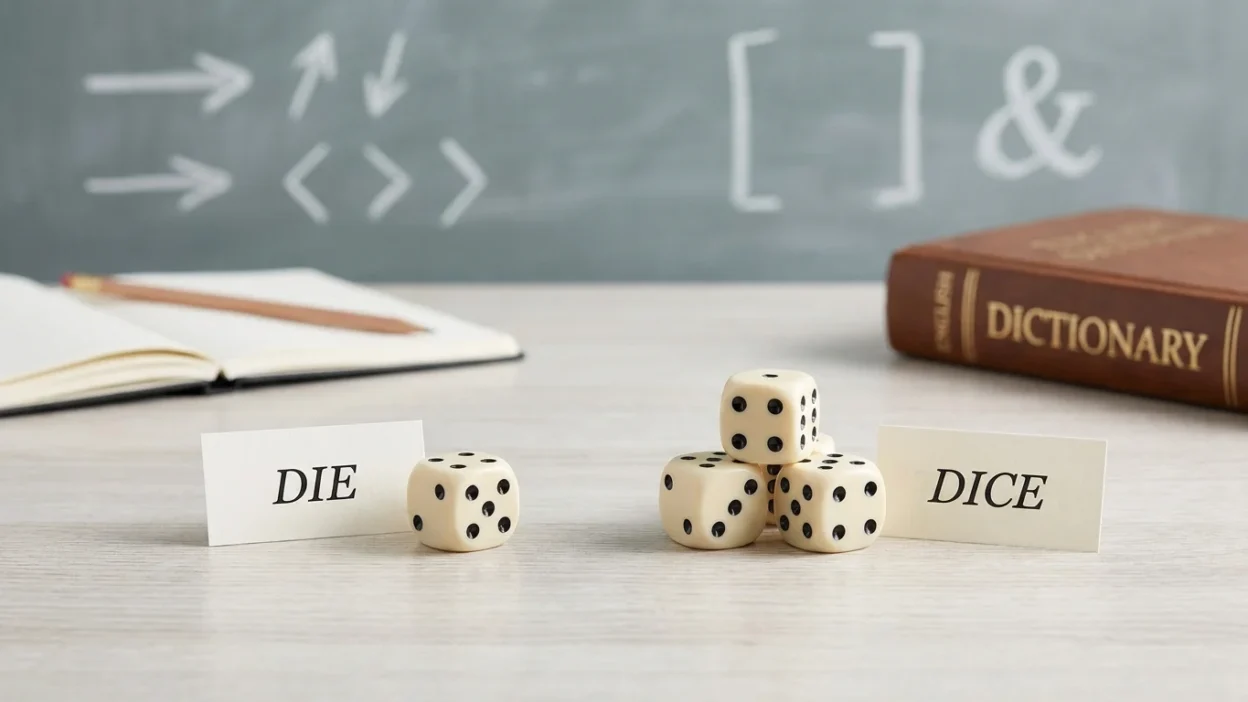
When talking about games, gambling, board games, or even ordinary objects, you may have wondered whether die and dice mean the same thing. They are closely related words, but traditional English grammar gives them different meanings. The main difference is simple: die is singular, while dice is traditionally the plural form. So, if you are talking about one six sided game cube, “die” is the standard term; if you are talking about two or more, “dice” is traditionally correct.
However, modern everyday English has made things slightly more complicated. Many speakers use dice for both singular and plural, especially when referring to gaming. That usage is common enough that you will hear phrases such as “roll the dice” even when only one die is involved. Understanding the traditional distinction helps you write accurately while also recognizing how native speakers actually use these words.
Quick Answer
Die is traditionally the singular form, meaning one gaming cube. Dice is traditionally plural, meaning two or more. For example, “Roll one die” and “Roll two dice.” In informal modern English, however, dice is often used for both singular and plural.
Why People Confuse It
The confusion comes from the fact that dice is extremely common in everyday speech.
Most people learn expressions such as:
- “Roll the dice.”
- “A pair of dice.”
- “The dice are on the table.”
Because “dice” is so strongly associated with games, speakers may naturally use it when referring to a single object too.
There is also a second source of confusion: die has several unrelated meanings in English. It can be the verb meaning “to stop living,” or a noun referring to a tool used for cutting, shaping, or stamping material.
So context matters.
First Word: Die
Die is the traditional singular noun for one gaming cube.
A standard die usually has numbered faces, commonly from 1 to 6.
Examples
- “Roll one die.”
- “The die landed on six.”
- “I found a red die under the table.”
- “The player rolled a die to determine the number of spaces.”
In other contexts, die can have completely different meanings:
- Verb: “Plants may die without water.”
- Manufacturing noun: “The metal was shaped using a die.”
When discussing board games or gambling, though, die means one gaming cube.
Second Word: Dice
Dice is traditionally the plural form of die.
Use it when you are referring to two or more gaming cubes.
Examples
- “Roll the dice.”
- “She rolled two dice.”
- “The dice showed a four and a five.”
- “He bought a new set of dice.”
In modern English, however, dice is also widely used as a singular noun, particularly in casual conversation.
For example:
“I need a dice for this game.”
This is common in informal usage, although “I need a die” follows the traditional singular/plural distinction.
Comparison Table
| Feature | Die | Dice |
| Traditional number | Singular | Plural |
| Meaning | One gaming cube | Two or more gaming cubes |
| Example | “Roll one die.” | “Roll two dice.” |
| Common modern usage | Singular | Singular and plural |
| Part of speech | Noun | Noun |
| Related phrase | A single die | A pair/set of dice |
When to Use Each
Use die when you want to be grammatically precise about one gaming cube.
Use die for:
- One die
- A single die
- One six sided object
- Formal or technical writing
Use dice for:
- Two or more dice
- A pair of dice
- A collection or set of dice
- Everyday expressions such as “roll the dice”
The easiest rule
One = die
Two or more = dice
That traditional rule will almost always keep your writing clear.
Examples (10+)
Here are some natural examples showing the difference:
- “Roll the die and move your piece.”
- “She rolled two dice at the same time.”
- “The die landed on number three.”
- “The dice rolled across the table.”
- “I only need one die for this game.”
- “He bought a new set of dice.”
- “Each player receives one die.”
- “The players rolled their dice together.”
- “Pick up the die and roll again.”
- “The dice showed matching numbers.”
- “One die was missing from the box.”
- “Three dice were lying beside the board.”
- “The game requires two dice.”
- “She tossed the die into the cup.”
- “The children shook the dice before rolling them.”
Singular in modern usage
You may also encounter:
“Roll the dice.”
when only one die is actually being used.
This is widely understood and common in informal English, but traditional grammar would prefer “Roll the die.”
Common Mistakes
1. Saying “one dice” in formal writing
Traditionally, one dice is incorrect because dice is the plural of die.
Better:
“Roll one die.”
2. Saying “two dies”
The traditional plural of the gaming noun die is dice, not “dies.”
Correct:
“She rolled two dice.”
3. Assuming “die” always relates to games
It does not. “Die” can be a verb meaning to stop living or a noun describing a manufacturing tool.
For example:
“The flowers will die without water.”
Here, “die” has nothing to do with a board game.
4. Thinking “dice” is always grammatically wrong for one object
Modern English frequently uses dice as a singular noun, especially in casual speech. Calling it “always wrong” would not accurately describe contemporary usage.
Memory Trick
Think of the number 1:
1 die → 2 dice
You can also remember:
One die, more dice.
The word die is short and singular, while dice signals the larger group.
American vs British English
The traditional distinction between die and dice exists in both American and British English.
In both varieties, die can refer to one gaming cube, while dice traditionally refers to more than one.
However, everyday usage increasingly allows dice to function as a singular noun as well. This is particularly noticeable in gaming communities, casual conversation, and discussions of tabletop games.
So the difference is not really “American vs. British.” It is more about traditional grammar versus modern usage.
For careful formal writing, the safest approach remains:
- One die
- Two dice
- Three dice
Similar Words
A few related terms are worth knowing:
Dice roll
The act of throwing one or more dice.
“The outcome depends on the dice roll.”
Pair of dice
Two dice considered together.
“He rolled a pair of dice.”
Die roll
A roll involving a single die.
“The player gets one die roll.”
Dice game
A game that uses dice.
“Yahtzee is a popular dice game.”
Six sided die
A die with six faces, normally numbered 1 through 6.
“Most standard board games use a six sided die.”
FAQs
Is die singular and dice plural?
Yes. Traditionally, die is singular and dice is plural. For example, “one die” and “two dice.”
Can dice be singular?
Yes. In modern informal English, dice is commonly used as a singular noun as well as a plural noun. Traditional grammar, however, uses die for one object.
Is “one dice” correct?
It is common in informal usage, but “one die” is the traditional and more precise form.
Is “two dies” correct?
No, not when you mean gaming cubes. The traditional plural is dice: “two dice.”
Why is the singular of dice called die?
Die is the older singular form, while dice developed as its plural form. The distinction has been maintained in traditional English usage.
Should I say “roll the die” or “roll the dice”?
If you are talking about one gaming cube, “roll the die” is traditionally precise. “Roll the dice” is extremely common as a general expression and may refer to dice in general.
Is “die” only used for board games?
No. Die has several meanings. It can be a verb meaning to stop living, and it can also refer to a tool used to shape or cut materials.
Remember This
Die = one.
Dice = more than one.
For traditional, precise English, write “one die” and “two dice.” In modern informal English, dice can also be used for a single gaming cube, so context and register matter.
Final Verdict
The traditional difference between die vs. dice is straightforward: die is singular, and dice is plural. If you are writing formally or teaching English grammar, this is the distinction you should use. Say, “Roll one die,” but “Roll two dice.”
At the same time, real world English is flexible. Many native speakers now use dice as both singular and plural, particularly when discussing games. Therefore, “one die” is the safest choice for precise English, while “dice” as a singular noun is a common modern usage rather than a communication error.
Conclusion
Knowing the difference between die and dice is useful because these words appear frequently in board games, tabletop gaming, probability, mathematics, and everyday expressions. The traditional rule is easy: one die, two or more dice. Once you remember that pattern, you can use the words confidently.
Still, good English also means recognizing how language is actually used. Dice has become common as a singular noun in informal contexts, so you may hear or read “a dice” without confusion. For formal and careful writing, however, sticking with die for one and dice for several remains the clearest choice.

Nova Turner specializes in imaginative science fiction blending futuristic technology, thrilling adventures, and powerful human emotions. Her innovative storytelling inspires curiosity, creativity, and exploration among readers of every age.