
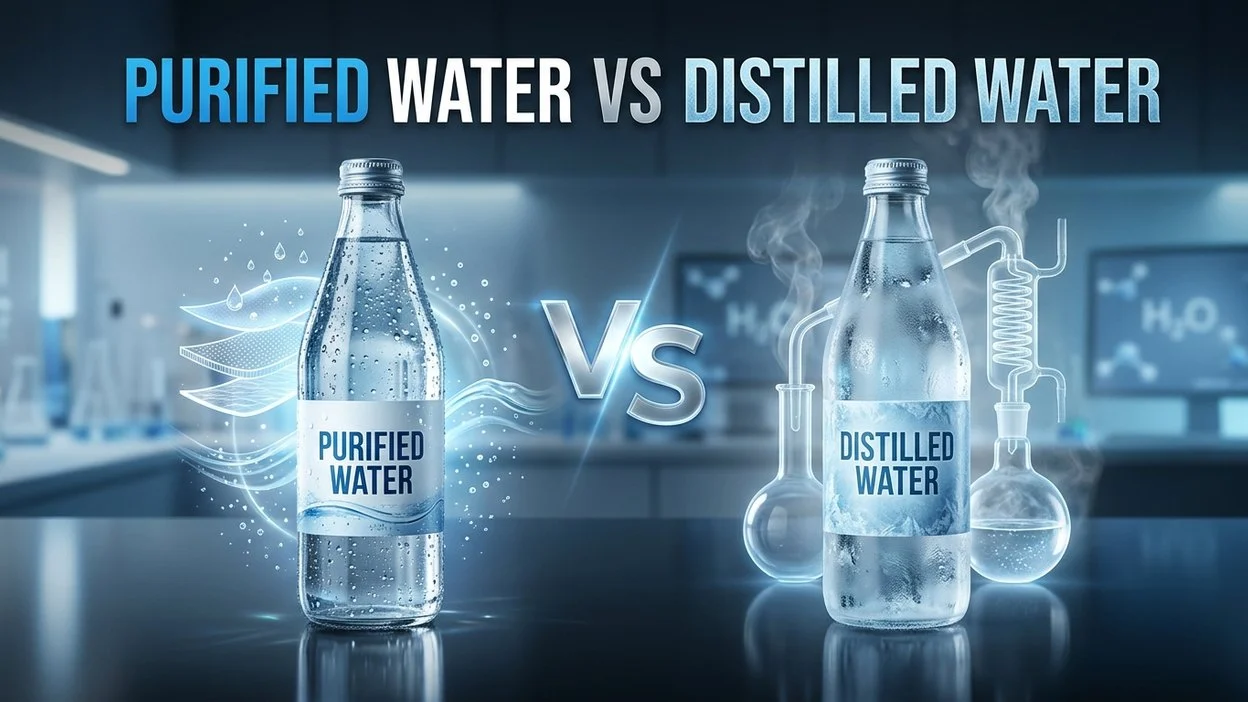
Water is essential for drinking, cooking, cleaning, and many everyday activities. However, not all types of water are processed in the same way. When shopping for bottled water or choosing water for a home appliance, you may come across two common terms: purified water and distilled water. Although both types are treated to remove unwanted substances, they are not exactly the same.
Understanding purified vs distilled water can help you choose the right option for your needs. Purified water is water that has been treated to remove impurities and meet specific purity standards. Distilled water is a type of purified water made through distillation, a process that involves boiling water and collecting the condensed steam. Other purification methods include reverse osmosis, deionization, and filtration. Each method works differently and may remove different substances. In this guide, you will learn the meaning of both terms, their key differences, when to use each type, common mistakes, and practical examples in simple English.
Quick Answer: Purified vs Distilled Water
Purified water is water treated to remove impurities through methods such as reverse osmosis, filtration, or distillation. Distilled water is made by boiling water and collecting the condensed steam, leaving many impurities behind. Therefore, distilled water is one type of purified water. Both can be suitable for drinking when produced and handled properly, but the best choice depends on the intended use.
Why Do People Confuse Purified and Distilled Water?
People often confuse these terms because both describe water that has undergone a treatment process. Both can look clear, taste relatively neutral, and contain fewer dissolved substances than untreated water.
However, the words describe different things.
- Purified describes the result of a water treatment process that removes impurities to a specified standard.
- Distilled describes water produced through a particular method called distillation.
Think of purified water as a broad category and distilled water as one member of that category.
For example, water treated with reverse osmosis may be called purified water without being distilled. Water produced through distillation can be called both distilled and purified water.
First Word: What Does Purified Water Mean?
Purified water is water that has been processed to remove impurities, such as dissolved minerals, particles, and certain chemical contaminants. The substances removed depend on the treatment method and the equipment used.
Common purification methods include:
- Reverse osmosis: Pushes water through a specialized membrane to reduce many dissolved substances.
- Filtration: Uses filters to remove particles and, depending on the filter, certain chemicals or microorganisms.
- Deionization: Uses ion-exchange materials to remove many dissolved ions.
- Distillation: Separates water from many nonvolatile impurities through evaporation and condensation.
Purified water is used for drinking, laboratory work, manufacturing, and other purposes. The required level of purity depends on the application.
Examples of Purified Water
- Bottled water labeled as purified water.
- Water treated by a household reverse osmosis system.
- Water processed for laboratory use.
- Water purified for certain industrial applications.
Simple meaning: Purified water is water that has been treated to remove impurities.
Second Word: What Does Distilled Water Mean?
Distilled water is water produced through distillation. During this process, water is heated until it becomes steam. The steam is then cooled and condensed back into liquid water.
Many dissolved salts, minerals, and other nonvolatile substances remain in the original container during this process. However, some volatile substances may travel with the steam, so distillation does not automatically remove every possible contaminant.
Distilled water generally contains very low levels of dissolved minerals. Its exact composition depends on the source water, equipment, and handling.
Examples of Distilled Water
- Water used in certain laboratory procedures.
- Water used in compatible steam irons.
- Water used in some humidifiers when the manufacturer recommends it.
- Water used in specific technical and industrial applications.
Distilled water can also be sold for drinking. However, not every product labeled distilled water is intended for every use.
Simple meaning: Distilled water is water purified by boiling it into steam and cooling the steam back into liquid.
Purified Water vs Distilled Water: Key Differences
| Feature | Purified Water | Distilled Water |
| Meaning | Water treated to remove impurities | Water produced through distillation |
| Production method | Reverse osmosis, filtration, deionization, distillation, or other suitable methods | Evaporation followed by condensation |
| Mineral content | Depends on the treatment method | Usually very low in dissolved minerals |
| Taste | Varies with mineral content and treatment | Often described as neutral or slightly flat |
| Drinking | Suitable when produced and handled safely | Suitable when sold or prepared for drinking and handled safely |
| Laboratory use | Depends on the required purity grade | Useful for applications that require distilled water |
| Appliance use | Depends on the appliance instructions | Often suitable for compatible appliances that require low-mineral water |
| Relationship | Broad category of treated water | A specific type of purified water |
The most important difference is the production method. Purified water is defined by its treatment and achieved purity, while distilled water is defined by how it is made.
When Should You Use Purified Water or Distilled Water?
The right choice depends on your purpose. Neither type is automatically better for every situation.
When to Use Purified Water
Purified water may be a suitable choice when you need water for:
- Everyday drinking: Choose water from a reliable source that meets applicable drinking-water standards.
- Cooking: Purified water can be used when its quality is appropriate for food preparation.
- Coffee and tea: The mineral content can affect flavor and equipment performance, so follow the appliance manufacturer’s guidance.
- General household use: Treated water can be useful when local water quality or personal preferences call for it.
- Laboratory work: Select the grade specified by the laboratory procedure rather than relying on the word purified alone.
When to Use Distilled Water
Distilled water may be appropriate for:
- Steam irons: Use it when the manufacturer’s instructions recommend or permit distilled water.
- Certain humidifiers: Follow the manual, especially if the appliance recommends distilled water to reduce mineral deposits.
- Laboratory procedures: Use it when the method specifically calls for distilled water.
- Technical equipment: Choose it when low mineral content is required and the equipment instructions approve it.
- Other specialized applications: Check the required water specification before use.
For medical equipment, including CPAP machines, always follow the manufacturer’s instructions. Water requirements can differ between the humidifier chamber and other components.
12 Examples of Purified vs Distilled Water in Sentences
These examples show how to use both expressions naturally in everyday English.
- Purified water: I buy purified water because I prefer its taste.
- Distilled water: The laboratory needs distilled water for this experiment.
- Purified water: This bottle contains purified water treated by reverse osmosis.
- Distilled water: She filled her steam iron with distilled water according to the manual.
- Purified water: The company uses purified water in its manufacturing process.
- Distilled water: Distilled water usually contains very little dissolved mineral matter.
- Purified water: Our filtration system produces purified water for drinking.
- Distilled water: The technician used distilled water for the specified procedure.
- Purified water: Is this purified water suitable for drinking?
- Distilled water: You can buy distilled water at some supermarkets and pharmacies.
- Purified water: The label explains how the water was treated.
- Distilled water: The instructions recommend distilled water for this particular appliance.
Examples in Everyday Conversations
Person A: Is distilled water the same as purified water?
Person B: Not exactly. Distilled water is one type of purified water, but purified water can be produced using other methods.
Person A: Which one should I buy for drinking?
Person B: Either can be suitable if it is intended for drinking and meets the relevant safety standards.
Common Mistakes When Comparing Purified and Distilled Water
Mistake 1: Thinking They Are Completely Different Types of Water
Distilled water belongs to the broader category of purified water. The terms are related rather than mutually exclusive.
Better understanding: All properly distilled water is purified by the distillation process, but not all purified water is distilled.
Mistake 2: Assuming Purified Water Always Contains Minerals
Purified water can contain different amounts of minerals depending on how it is treated. Reverse osmosis and deionization can remove many dissolved minerals, while other treatment systems may leave some behind.
Better understanding: Check the treatment method and product specifications.
Mistake 3: Believing Distilled Water Is Always Safer to Drink
Distillation removes many impurities, but safe drinking water also depends on production, storage, packaging, and handling. Distillation alone does not guarantee that a product is free from every contaminant.
Better understanding: Choose water that meets appropriate drinking-water standards.
Mistake 4: Thinking Clear Water Is Always Pure
Water may look clear while containing dissolved chemicals, salts, or microorganisms.
Better understanding: Appearance alone cannot establish water quality.
Mistake 5: Assuming Every Appliance Requires Distilled Water
Different appliances have different water requirements. Some permit tap water, while others recommend distilled or another type of low-mineral water.
Better understanding: Follow the manufacturer’s instructions.
Memory Trick: How to Remember the Difference
Use this simple memory trick:
- Purified = Processed. The water has been treated to remove impurities.
- Distilled = Steam. The water is boiled, turned into steam, and condensed back into liquid.
Remember the relationship with this sentence:
Distilled water is purified water made through distillation.
This short rule helps you distinguish the broad category from the specific method.
American vs British English
The expressions purified water and distilled water are used in both American and British English. Their basic meanings do not change significantly between the two varieties.
| Expression | American English | British English |
| Purified water | Common | Common |
| Distilled water | Common | Common |
| Water purification | Common | Common |
| Distillation | Common | Common |
In some British contexts, you may also encounter the term deionised water, particularly for technical and household applications. In American English, the usual spelling is deionized water.
Deionised or deionized water is not necessarily the same as distilled water. It is produced using a different process that removes many dissolved ions.
Similar Words and Related Terms
Several water-related terms sound similar but have different meanings.
1. Purified Water
Water treated to remove impurities through one or more suitable processes.
2. Distilled Water
Water produced by evaporating water and condensing the resulting steam.
3. Filtered Water
Water passed through a filter. What the filter removes depends on its design and performance. Filtered water is not automatically equivalent to highly purified water.
4. Deionized Water
Water treated to remove many dissolved ions, including ions associated with mineral salts. It is often used in laboratories and industrial processes.
5. Mineral Water
Water containing minerals and other dissolved substances. In some jurisdictions, the term has a specific regulatory definition.
6. Tap Water
Water supplied through a public or private distribution system. Its quality depends on the source, treatment, plumbing, and local standards.
7. Spring Water
Water obtained from an underground source that naturally flows to the surface or is collected at a spring, subject to applicable regulations.
These terms describe different sources, treatments, or characteristics. Understanding them helps you choose water according to its intended use.
Final Verdict: Which Is Better, Purified or Distilled Water?
Neither purified water nor distilled water is universally better. The right choice depends on what you need the water to do.
- For drinking: Both can be suitable when specifically intended for drinking and produced and handled safely.
- For low-mineral applications: Distilled water may be appropriate when the equipment or procedure calls for it.
- For general household use: Purified water may be a practical choice, depending on the treatment method and intended purpose.
- For specialized equipment: Follow the manufacturer’s water-quality requirements.
The key point is that purified describes water treated to remove impurities, while distilled describes water produced through a specific purification process.
FAQs:
1. Is purified water the same as distilled water?
No. Purified water is a broad category of treated water, while distilled water is produced by distillation. Distilled water is one type of purified water, but purified water can also be made using reverse osmosis, deionization, and other methods.
2. Can you drink distilled water every day?
Distilled water intended for drinking can generally be consumed daily as part of a normal diet. It contains very few dissolved minerals, but most dietary minerals come from food. Choose water that meets drinking-water standards and maintain a balanced diet.
3. Is purified water better than distilled water for drinking?
Neither is automatically better. Both can be suitable for drinking when they meet relevant safety standards. Taste, mineral content, product quality, availability, and personal preference can help determine which one you choose.
4. Does distilled water contain minerals?
Distilled water usually contains very low levels of dissolved minerals because many nonvolatile minerals remain behind during distillation. However, the exact composition depends on the process and any subsequent contamination or handling.
5. Can I use purified water instead of distilled water?
Sometimes, but not always. Purified water produced by reverse osmosis or another method may have low mineral content, yet it may differ from distilled water in its composition. Check the equipment manual or procedure to confirm whether a substitute is acceptable.
6. Which water is better for a steam iron?
Distilled water is often recommended for steam irons because its low mineral content can help reduce mineral deposits. However, some manufacturers permit tap water or recommend a different option. Always follow the instructions for your specific iron.
7. Is reverse osmosis water purified or distilled?
Reverse osmosis water is generally considered purified water when the treatment achieves the applicable purity requirements. It is not distilled because it is produced by passing water through a specialized membrane rather than by evaporation and condensation.
8. Which is better for a humidifier: purified or distilled water?
Distilled water is often a good choice for humidifiers that recommend low-mineral water because it can reduce mineral deposits and the release of mineral-containing particles into the air. However, the correct choice depends on the humidifier model and its instructions.
Remember This
- Purified water is water treated to remove impurities.
- Distilled water is made through boiling, evaporation, and condensation.
- Distilled water is one type of purified water.
- Reverse osmosis water can be purified without being distilled.
- Both types can be suitable for drinking when produced and handled safely.
- The best water depends on the intended use and the manufacturer’s requirements.
Conclusion:
Purified water and distilled water are closely related, but they are not identical. Purified water describes water treated to remove impurities, whereas distilled water describes water produced by a particular process involving evaporation and condensation. Other purification methods, such as reverse osmosis and deionization, can produce purified water without distillation.
For everyday drinking, either type can be suitable if it meets the appropriate safety standards. For laboratories, steam irons, humidifiers, and other equipment, the correct choice depends on the required water quality. Once you understand the difference between the treatment category and the production method, choosing between purified and distilled water becomes much easier.

Hadley Price creates heartfelt contemporary fiction exploring relationships, hope, resilience, and personal growth. Her emotionally rich storytelling connects with readers through memorable characters and inspiring life experiences worldwide.