
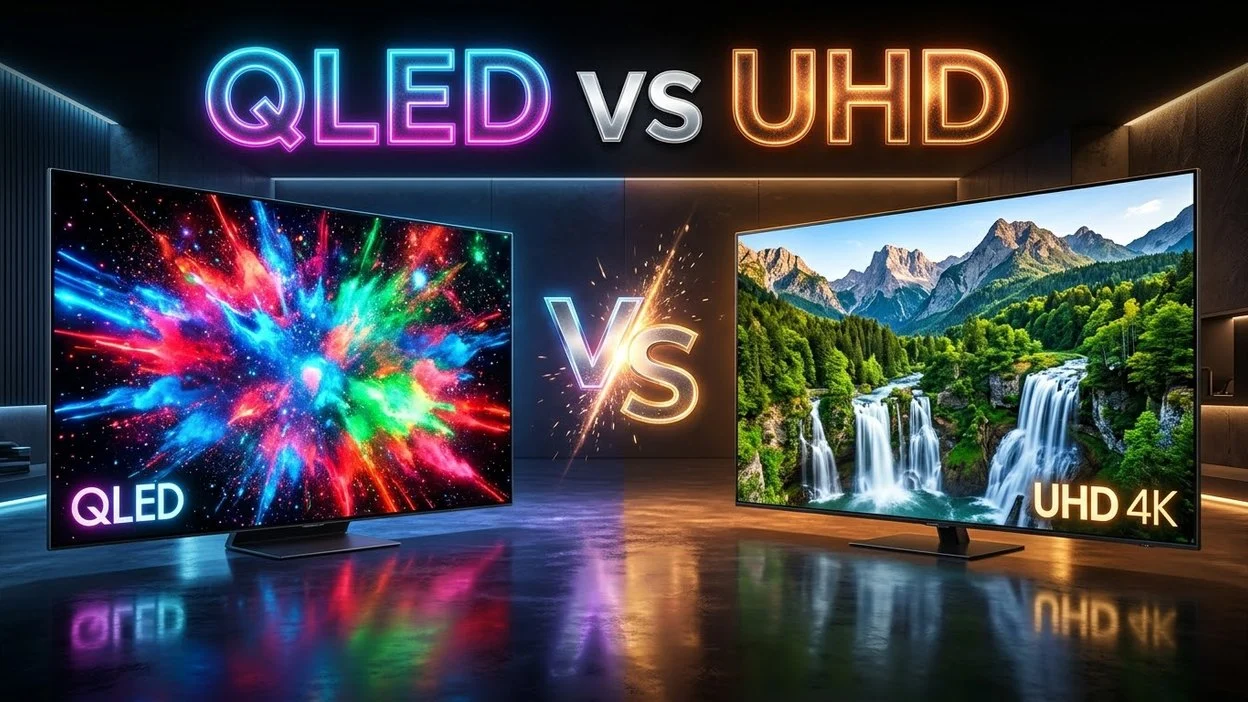
When shopping for a new television, you may see terms such as QLED and UHD on product labels. Both describe important features of modern TVs, but they do not mean the same thing. Understanding QLED vs UHD can help you compare televisions, understand picture quality, and choose a screen that fits your needs and budget.
The main difference is simple: QLED describes a display technology, while UHD describes screen resolution. QLED televisions use quantum dots to improve color reproduction, while UHD usually refers to Ultra High Definition resolution, commonly 3840 × 2160 pixels for a 4K television. Because these terms describe different features, a television can be both QLED and UHD at the same time. This distinction matters when comparing TVs for movies, sports, gaming, or everyday viewing. Once you understand what each term means, you can make a more informed choice without getting confused by technical specifications.
Quick Answer: QLED vs UHD
QLED and UHD are not direct competitors. QLED is a display technology that uses quantum dots to produce rich colors, while UHD refers to a high screen resolution, usually 4K. QLED TVs can offer UHD resolution, so the best choice depends on the display technology, resolution, brightness, contrast, and your budget.
Why Do People Confuse QLED and UHD?
People often confuse QLED and UHD because manufacturers use both terms when advertising televisions. They may appear together on packaging, shopping websites, and product descriptions.
However, each term answers a different question:
- QLED: What type of display technology does the TV use?
- UHD: How many pixels does the screen contain?
- 4K: What resolution does the television offer in common consumer TV specifications?
For example, a 55-inch QLED UHD television combines quantum-dot display technology with a 4K resolution. The two terms describe separate characteristics of the same product.
What Does QLED Mean?
QLED stands for Quantum Dot Light-Emitting Diode. In most consumer televisions, it refers to an LCD display that uses a quantum-dot layer to improve color performance.
Quantum dots are tiny semiconductor particles that emit specific colors when exposed to light. In a typical QLED TV, an LED backlight supplies the light, and the quantum dots help produce a wider range of vivid colors.
Main Features of QLED TVs
- Rich colors: Quantum dots can help produce bright, accurate, and vibrant colors.
- High brightness: Many QLED models can produce strong brightness, making them suitable for well-lit rooms.
- Different screen resolutions: QLED TVs are available in various resolutions, including Full HD on some models and 4K UHD on many others.
- Varied prices: Entry-level and premium models offer different levels of performance.
Is QLED Better Than UHD?
Neither is automatically better because QLED and UHD describe different things. QLED may improve color and brightness, while UHD provides more pixels than Full HD. A QLED UHD television combines both features.
Also, QLED does not guarantee perfect contrast or deep blacks. Those qualities depend on the backlight system, local dimming, panel design, and other display features.
What Does UHD Mean?
UHD stands for Ultra High Definition. In the television market, UHD commonly refers to a resolution of 3840 × 2160 pixels, also known as 4K UHD.
A pixel is a tiny picture element that helps form the image on your screen. A higher resolution means the display contains more pixels, which can help reveal finer details when the content and viewing conditions support them.
Main Features of UHD TVs
- High resolution: 4K UHD contains approximately 8.3 million pixels.
- Fine details: UHD can make textures, small objects, and detailed scenes appear sharper than they do at lower resolutions.
- Broad availability: UHD resolution is available in LED, QLED, OLED, and other television types.
- Content compatibility: The benefit depends on the resolution of the content you watch and how the TV processes it.
Is UHD the Same as 4K?
For most consumer televisions, UHD and 4K are used almost interchangeably. Strictly speaking, the common TV resolution of 3840 × 2160 pixels differs slightly from the 4096 × 2160 resolution used in some digital cinema applications.
When shopping for a television, a label such as 4K UHD generally means a resolution of 3840 × 2160 pixels.
QLED vs UHD: Comparison Table
| Feature | QLED | UHD |
| Full form | Quantum Dot Light-Emitting Diode | Ultra High Definition |
| Describes | Display technology | Screen resolution |
| Main purpose | Improve color performance and brightness potential | Provide more picture detail |
| Typical technology | LCD with a quantum-dot layer and backlight | Can be used with several display technologies |
| Pixel count | Depends on the model | Usually 3840 × 2160 for 4K UHD TVs |
| Color performance | Often a major strength | Does not specify color performance |
| Brightness | Depends on the particular TV | Does not specify brightness |
| Contrast | Depends on panel and backlight design | Does not specify contrast |
| Can they work together? | Yes | Yes |
| Best buying consideration | Color, brightness, and display performance | Resolution and available content |
When Should You Choose QLED or UHD?
Because QLED and UHD describe different features, you do not always need to choose one instead of the other. Your decision should depend on what matters most to you.
Choose a QLED TV When You Want Vivid Colors
A QLED television may suit you if you enjoy colorful movies, animated films, sports, or video games. Many QLED models also offer high brightness, which can be useful in rooms with plenty of daylight.
However, compare the individual models rather than assuming every QLED television performs equally well.
Choose a UHD TV When You Want More Picture Detail
UHD is important if you want a 4K television that can display more detail than a Full HD screen. It can be particularly useful for large screens, 4K movies, high-resolution streaming, and compatible gaming systems.
Remember that UHD is a resolution, not a complete description of picture quality.
Choose a QLED UHD TV When You Want Both
If your budget allows, a QLED UHD television combines quantum-dot display technology with 4K resolution. It may be a good option for people who want detailed images, vivid colors, and strong brightness.
For the best overall experience, also check contrast, local dimming, refresh rate, HDR support, and viewing angles.
12 Examples of QLED vs UHD in Everyday English
These examples show how to use QLED and UHD correctly when discussing television features.
- This television is QLED.
The sentence describes its display technology. - This television supports UHD resolution.
The sentence describes the screen’s resolution. - I bought a 4K UHD television for my living room.
The focus is on resolution. - The QLED screen produces vivid colors.
The sentence describes a potential benefit of quantum-dot technology. - This QLED TV also supports 4K UHD.
Both terms describe different features of the same television. - UHD makes compatible high-resolution content look more detailed.
The sentence explains a benefit of higher resolution. - We compared two QLED TVs before buying one.
The comparison concerns display technology and model performance. - My new television has a resolution of 3840 × 2160 pixels.
This is the standard resolution of a 4K UHD TV. - A UHD television is not necessarily a QLED television.
UHD resolution does not require quantum-dot technology. - A QLED television is not necessarily a 4K television.
QLED describes display technology, not a specific resolution. - The salesperson explained the difference between QLED and UHD.
The sentence refers to the distinction between display technology and resolution. - I chose a QLED UHD television for movies and gaming.
The television combines two separate features.
Common Mistakes When Comparing QLED and UHD
Understanding these common mistakes will help you compare televisions more accurately.
Mistake 1: Treating QLED and UHD as Opposites
Incorrect: “I must choose between QLED and UHD.”
Correct: “I can buy a QLED television with UHD resolution.”
Why? QLED and UHD describe different characteristics.
Mistake 2: Assuming Every UHD TV Has Quantum Dots
Incorrect: “Every UHD television is a QLED TV.”
Correct: “A UHD television can use LED, QLED, OLED, or another display technology.”
Why? Resolution does not determine the display technology.
Mistake 3: Assuming QLED Always Means 4K
Incorrect: “All QLED televisions have 4K resolution.”
Correct: “Many QLED televisions offer 4K resolution, but QLED does not define the pixel count.”
Why? A display technology and a resolution are separate specifications.
Mistake 4: Assuming More Pixels Guarantee Better Picture Quality
Incorrect: “Every UHD television has a better picture than every Full HD television.”
Correct: “UHD offers more pixels, but overall picture quality also depends on contrast, brightness, color accuracy, and content.”
Why? Resolution is only one part of the viewing experience.
Mistake 5: Confusing QLED With OLED
QLED and OLED are different display technologies. Most QLED TVs use an LCD panel with a backlight, while OLED pixels produce their own light. OLED can offer excellent black levels because individual pixels can turn off, although actual performance varies by model.
Memory Trick: How to Remember QLED vs UHD
Use this simple memory trick:
- QLED = Quantum dots and color.
- UHD = Ultra-high resolution and detail.
Think of a television as a photograph. QLED describes a technology that can help make the colors look rich and vivid, while UHD describes how many pixels are available to display the image.
Remember that these are simplified associations. QLED performance depends on the model, and UHD does not guarantee better color or contrast.
American vs British English: QLED and UHD
QLED and UHD are technical abbreviations used in both American and British English. Their meanings do not change between the two varieties.
The main difference is usually pronunciation or the surrounding vocabulary, not spelling.
For example:
- American English: “I bought a 4K UHD TV for my apartment.”
- British English: “I bought a 4K UHD television for my flat.”
Both sentences are correct. QLED remains QLED, and UHD remains UHD in both varieties.
Similar Words and Related TV Terms
Several other television terms appear alongside QLED and UHD. Understanding them makes product descriptions easier to read.
LED
LED stands for Light-Emitting Diode. In common television terminology, an LED TV is usually an LCD television that uses LEDs for its backlight.
OLED
OLED stands for Organic Light-Emitting Diode. Unlike conventional LCD-based QLED televisions, OLED displays use self-emissive pixels that can switch off individually, allowing very deep blacks.
4K
4K usually refers to a television resolution of 3840 × 2160 pixels. It is commonly used as another name for 4K UHD in consumer TV advertising.
Full HD
Full HD generally means 1920 × 1080 pixels. It has fewer pixels than 4K UHD and can still provide a good viewing experience, particularly on smaller screens or when viewed from farther away.
HDR
HDR stands for High Dynamic Range. It describes techniques for presenting a wider range of brightness and color in supported content. HDR is different from resolution and display technology.
Refresh Rate
Refresh rate is the number of times a screen updates its image each second, measured in hertz (Hz). A higher refresh rate can improve motion clarity and responsiveness in supported content and games.
Local Dimming
Local dimming allows sections of a TV’s backlight to change brightness independently. On suitable LCD-based TVs, it can improve contrast and make dark scenes look more convincing.
Final Verdict: Which Is Better, QLED or UHD?
QLED and UHD cannot be ranked directly against each other because they describe different television features.
- Choose QLED if you are comparing display technologies and care about vivid colors and brightness.
- Look for UHD if you want a 4K resolution with more picture detail than Full HD.
- Consider QLED UHD if you want both quantum-dot technology and 4K resolution in one television.
If you are comparing two actual televisions, evaluate their full specifications, price, size, contrast, brightness, refresh rate, and intended use. A well-designed television’s overall performance matters more than a single label.
FAQs:
1. Is QLED better than UHD?
QLED is not directly better than UHD because the terms describe different features. QLED refers to display technology, while UHD refers to resolution. A QLED UHD television combines both, giving you quantum-dot technology and 4K resolution.
2. Is UHD the same as 4K?
For most consumer televisions, yes. UHD usually means 3840 × 2160 pixels, the resolution commonly marketed as 4K. Digital cinema 4K uses a slightly wider resolution of 4096 × 2160 pixels.
3. Can a TV be both QLED and UHD?
Yes. Many televisions combine QLED display technology with 4K UHD resolution. QLED describes the display technology, while UHD describes the number of pixels.
4. Is a QLED TV good for gaming?
A QLED TV can be an excellent gaming option, especially if it offers high brightness, good color performance, low input lag, and a suitable refresh rate. Check for HDMI 2.1, variable refresh rate, and the gaming features supported by the specific model.
5. Is QLED better than LED?
QLED is a type of LCD-based television technology that adds a quantum-dot layer to improve color performance. Compared with a conventional LED-backlit LCD TV, a QLED model may offer a wider color range and greater brightness, but the results depend on the models being compared.
6. Is UHD better than Full HD?
UHD offers four times as many pixels as Full HD when comparing 3840 × 2160 with 1920 × 1080. This can produce more detailed images, particularly on larger screens and with native 4K content. The visible improvement depends on screen size, viewing distance, and content quality.
7. Should I buy a QLED UHD TV or an OLED TV?
Choose based on your priorities. QLED UHD models can offer high brightness and vivid colors, while OLED models are known for deep blacks and strong contrast. Consider your room lighting, viewing habits, budget, and the specific models before deciding.
8. Does UHD guarantee better picture quality?
No. UHD specifies resolution, not overall picture quality. Brightness, contrast, color accuracy, HDR performance, upscaling, and panel quality also influence how good a television looks.
Remember This
- QLED describes a display technology.
- UHD describes screen resolution.
- 4K UHD television resolution is usually 3840 × 2160 pixels.
- QLED and UHD can be combined in one television.
- Picture quality depends on more than resolution alone.
The easiest way to remember the difference is that QLED relates to how a television produces its colors, while UHD relates to how many pixels it uses to display an image.
Conclusion:
Understanding QLED vs UHD is easier when you remember that these terms do not describe the same thing. QLED is a display technology that uses quantum dots to improve color performance, while UHD refers to a high-resolution display, usually 4K. One term describes the technology; the other describes the picture’s resolution. Both can be present in the same television.
Before buying a TV, compare its full specifications instead of relying on one label. Consider the screen size, brightness, contrast, HDR capabilities, refresh rate, and price alongside QLED and UHD. If you want detailed images and vivid colors, a QLED UHD television may be a suitable choice, but the best option is the model that matches your room, viewing habits, and budget.

Nova Turner specializes in imaginative science fiction blending futuristic technology, thrilling adventures, and powerful human emotions. Her innovative storytelling inspires curiosity, creativity, and exploration among readers of every age.