Forgo and forego look almost identical, sound similar in some contexts, and are often treated as interchangeable. However, they traditionally have different meanings. If you want to say that someone chooses to give something up, forgo is the word you usually need. For example, “She decided to forgo dessert” means she chose not to have dessert. This distinction is especially useful in formal writing, professional communication, and academic English, where precise word choice matters.
The confusion becomes even greater because forego is a legitimate English word with its own meaning. It is most commonly a verb meaning “to go before” or “to precede,” although the related form foregone is much more familiar in everyday English, as in “a foregone conclusion.” Understanding the difference between forgo vs forego can help you avoid an easy vocabulary mistake and make your writing more accurate, natural, and polished.
Quick Answer
Forgo means to voluntarily give up or do without something. Forego means to go before or precede something. In modern English, use forgo when you mean “give up.” Use forego when you mean “precede,” although this second meaning is relatively uncommon.
Why People Confuse It
The confusion comes from several similarities:
- Both words are spelled almost the same way.
- Both begin with for/fore.
- Their pronunciations can be very similar.
- Forego looks like it should mean the same thing as forgo.
- The word foregone is common enough to make people familiar with “forego” without understanding its exact meaning.
There is also a historical reason for the confusion. English has changed over time, and dictionaries may record overlapping or older uses. In contemporary standard English, however, the clearest distinction is simple:
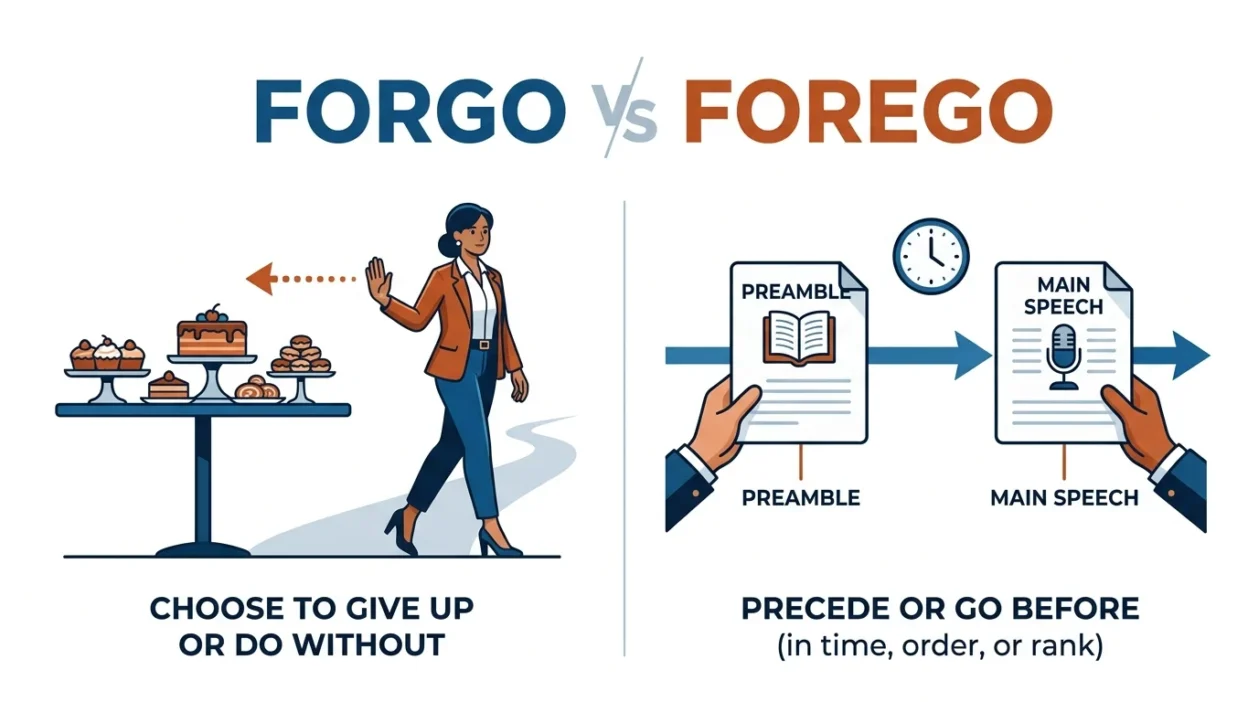
Forgo = give up
Forego = go before
If your intended meaning is “skip,” “avoid,” “give up,” or “do without,” forgo is generally the correct choice.
First Word: Forgo
Forgo is a verb meaning to voluntarily give up, do without, or refrain from something.
It often describes a conscious decision not to have or use something.
Examples of “forgo”
- I decided to forgo coffee this morning.
- She chose to forgo the expensive treatment.
- We had to forgo our vacation because of the unexpected expense.
- He agreed to forgo his usual break.
A useful way to understand forgo is to replace it mentally with give up or do without.
For example:
“They decided to forgo dessert.”
means:
“They decided to do without dessert.”
Common meanings of forgo
Forgo can mean:
- give up
- abstain from
- skip
- do without
- voluntarily surrender
- choose not to take advantage of something
It usually suggests a deliberate choice rather than simply failing to receive something.
Second Word: Forego
Forego is a verb that traditionally means to go before, precede, or come earlier than something else.
It is much less common in modern everyday English than forgo.
For example:
“A short introduction will forego the main discussion.”
Here, the intended meaning is that the introduction comes before the discussion.
However, this use is uncommon enough that many writers would choose precede instead because it is clearer.
What about “foregone”?
You may be much more familiar with foregone than with forego.
The phrase foregone conclusion means an outcome that is already considered certain or inevitable.
For example:
“Her victory seemed like a foregone conclusion.”
Here, foregone is related to the idea of something having gone before or being predetermined.
This is one reason people sometimes assume forego means “give up.” The spelling is deceptive, especially when you already know the expression “foregone conclusion.”
Comparison Table
| Word | Meaning | Commonness | Example |
| forgo | To give up or do without | Very common | She decided to forgo dessert. |
| forego | To precede or go before | Uncommon | The introduction foregoes the main discussion. |
| foregone | Past form/related form of forego; also used in “foregone conclusion” | Common in specific expressions | The result was a foregone conclusion. |
The biggest practical distinction is this:
If you mean “give up,” choose forgo.
When to Use Each
Use “forgo” when you mean “give up”
Choose forgo when someone intentionally decides not to have, use, experience, or take something.
Examples:
- forgo a meal
- forgo a purchase
- forgo an opportunity
- forgo a vacation
- forgo a benefit
- forgo convenience
Example:
“To save money, Maya decided to forgo eating at restaurants.”
Here, forgo means she chose to do without restaurant meals.
Use “forego” when you mean “precede”
Use forego when something comes before something else.
Example:
“A brief explanation will forego the detailed analysis.”
Because this meaning is uncommon, precede will often be the more natural choice:
“A brief explanation will precede the detailed analysis.”
A practical rule
If you are unsure, ask yourself:
Am I talking about giving something up?
- Yes → forgo
- No, I mean coming before something → forego
Examples
Here are several examples showing the difference in context.
- I decided to forgo dessert after dinner.
→ I chose not to have dessert. - She decided to forgo the expensive subscription.
→ She chose not to buy it. - We may have to forgo our weekend trip.
→ We may need to give up the trip. - He chose to forgo the opportunity in order to focus on his studies.
→ He voluntarily gave up the opportunity. - The athlete decided to forgo the competition because of his busy schedule.
→ He chose not to participate. - They agreed to forgo their usual privileges.
→ They agreed to give them up. - The introductory remarks forego the main presentation.
→ The remarks come before the presentation. - The opening chapter foregoes the events described later in the novel.
→ It comes before those events. - She decided to forgo buying a new phone.
→ She chose not to buy one. - To reduce expenses, the company decided to forgo several optional upgrades.
→ The company chose not to pay for them. - The ceremony foregoes the formal dinner that follows it.
→ The ceremony comes before the dinner. - He was willing to forgo comfort for the sake of convenience.
→ He was willing to give up comfort. - The introduction foregoes the detailed explanation.
→ The introduction comes first. - I would rather forgo the purchase than exceed my budget.
→ I would rather do without the purchase.
Common Mistakes
Mistake 1: Using “forego” to mean “give up”
Incorrect:
“She decided to forego dessert.”
In modern standard usage, the preferred spelling for this meaning is:
“She decided to forgo dessert.”
Mistake 2: Assuming “forego” is simply a longer spelling of “forgo”
The two words are not just spelling variants when used in their traditional senses.
- Forgo → give up
- Forego → precede
Mistake 3: Confusing “forgo” with “foregone”
The expression foregone conclusion is different from the everyday verb forgo.
Correct:
“The outcome was a foregone conclusion.”
But:
“She decided to forgo the opportunity.”
Mistake 4: Choosing “forego” because it looks formal
Some writers mistakenly assume that forego is a more sophisticated version of forgo.
It is not.
If your meaning is “give up,” using forego can make your writing less precise rather than more formal.
Memory Trick
Use this simple trick:
FORGO = GIVE UP
Think of forgo as choosing to go without something.
Forgo → go without
For forego, remember:
FORE = before
So:
Forego → go before
This gives you a quick mental shortcut:
Forgo = without
Forego = before
If you remember only one thing, remember that distinction.
American vs British English
The distinction between forgo and forego is generally relevant in both American and British English.
The spelling forgo is widely used when the meaning is “give up” or “do without.” The verb forego, meaning “precede,” is much less common in ordinary modern writing in both varieties of English.
There can be historical and dictionary differences in how these words are recorded, and older texts may contain usages that are uncommon today. For contemporary writing, however, the safest approach is straightforward:
- American English: use forgo for “give up.”
- British English: use forgo for “give up.”
- Forego: reserve it for the relatively uncommon meaning “precede.”
When clarity matters, precede is often preferable to forego because readers are less likely to misunderstand it.
Similar Words
Several words are closely related to the meanings of forgo and forego.
Give up
A common phrase meaning to stop having or doing something.
“He gave up smoking.”
Abandon
To leave something behind or stop supporting it.
“They abandoned the plan.”
Renounce
A more formal word meaning to give up or reject something deliberately.
“She renounced her claim.”
Relinquish
To voluntarily surrender something, often a right, responsibility, or possession.
“He relinquished control of the company.”
Abstain
To deliberately avoid something, especially food, drink, or an activity.
“She chose to abstain from alcohol.”
Precede
To come before something in time, position, or order.
“The introduction precedes the main argument.”
For many modern readers, precede is a clearer alternative to forego when you mean “come before.”
Final Verdict
The difference between forgo vs forego becomes much easier once you focus on meaning rather than spelling. Forgo means to voluntarily give something up or do without it. Forego traditionally means to precede or come before something, but this use is relatively rare in contemporary English.
For everyday writing, professional communication, and academic work, choose forgo whenever you mean “give up.” If you mean “come before,” precede will often be a clearer alternative to forego.
Remember This
Forgo = give up or do without.
Forego = go before or precede.
If you are writing a sentence such as “I decided to ___ dessert,” the correct choice is forgo.
FAQs
1. Is it “forgo” or “forego” when you mean give up?
Use forgo. It means to voluntarily give up, skip, or do without something.
2. What does “forego” mean?
Forego traditionally means to go before or precede something. It is uncommon in modern everyday English.
3. Is “forego” a spelling mistake?
Not necessarily. Forego is a legitimate word, but it has a different traditional meaning from forgo. It means “precede.”
4. Is “forgo” the same as “give up”?
Yes, in many contexts. Forgo means to voluntarily give something up or choose to do without it.
5. What is the difference between “forgo” and “foregone”?
Forgo is the verb commonly meaning “give up.” Foregone is associated with forego and is commonly seen in the phrase foregone conclusion, meaning an outcome considered certain or already determined.
6. Can I use “forego” instead of “forgo”?
Not when you mean “give up.” For that meaning, forgo is the standard choice.
7. What is an easy way to remember forgo vs forego?
Remember: forgo = go without, while forego = go before. The “fore” in forego can remind you of “before.”
Conclusion
Understanding forgo vs forego is a small but useful step toward more precise English. Although the words look nearly identical, their traditional meanings are different. Forgo is the word you want when someone deliberately gives something up, skips something, or chooses to do without it. Forego, by contrast, means to precede or come before something and is much less common in modern usage.
When in doubt, focus on the meaning of your sentence. If you can replace the word with “give up” or “do without,” choose forgo. If you mean “come before,” forego can work, although precede is often clearer. This simple distinction will help you avoid a common word choice error and make your English more confident and precise.

Hadley Price creates heartfelt contemporary fiction exploring relationships, hope, resilience, and personal growth. Her emotionally rich storytelling connects with readers through memorable characters and inspiring life experiences worldwide.