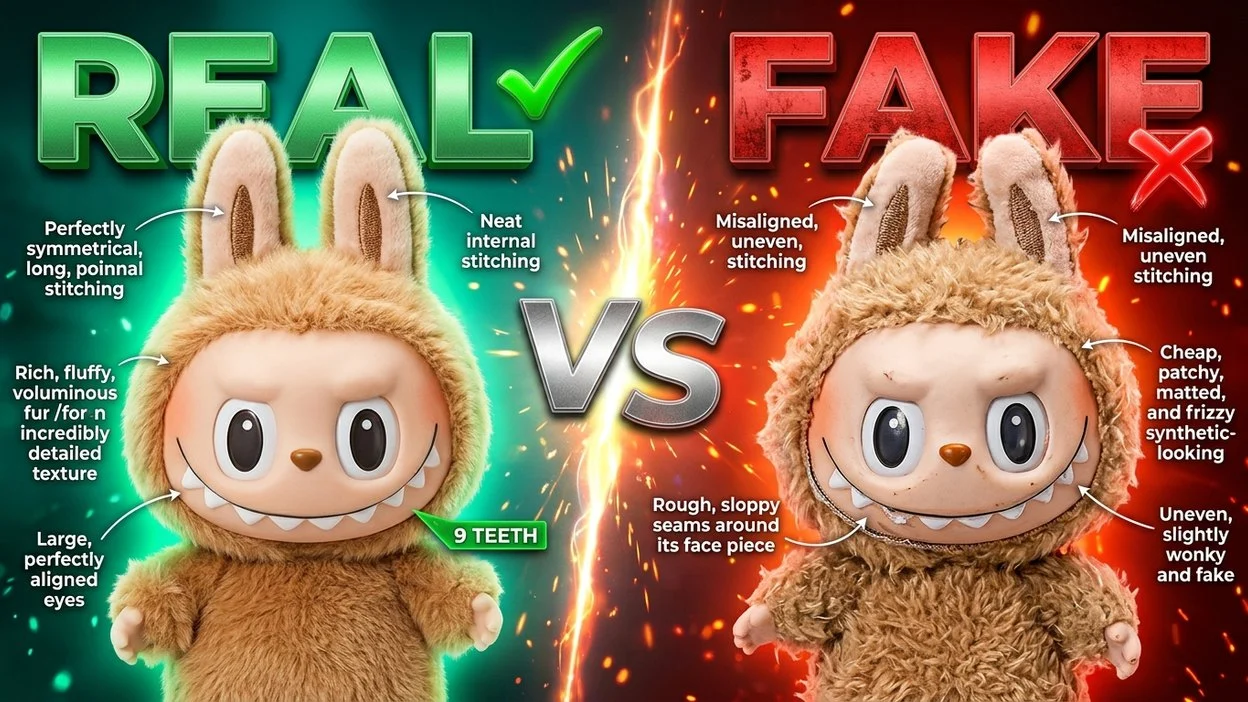
Labubu dolls have become popular collectibles because of their playful designs, pointed ears, toothy smiles, and colorful outfits. However, their popularity has also made it harder for buyers to know whether a Labubu doll is genuine or counterfeit. If you are planning to buy one, learning how to identify a real vs fake Labubu can help you make a more confident decision.
A genuine Labubu is an officially licensed collectible associated with artist Kasing Lung and the character series The Monsters, sold through authorized channels such as POP MART. A fake Labubu is an imitation that copies the character’s appearance without being an authentic product. Some imitations look convincing in photographs, so checking only the face, packaging, or price is not enough. You should examine several details together, including the product’s design, materials, labels, packaging, and purchase history. This guide explains the most useful differences in simple English, helping beginners, collectors, and gift buyers recognize warning signs before spending their money.
Quick Answer: Real vs Fake Labubu
A real Labubu is an authentic collectible produced or licensed through official channels, while a fake Labubu is an imitation. To tell them apart, check the face, teeth, ears, paint quality, packaging, product labels, and seller. Compare your doll with the exact official model, and remember that no single visual detail proves authenticity.
Why Do People Confuse Real and Fake Labubu Dolls?
Real and fake Labubu dolls can look similar because counterfeit makers often copy the original character’s most recognizable features. Online marketplaces also contain product photos that may not show the exact item a buyer receives.
Several factors make identification difficult:
- Similar designs: Counterfeit products may copy the original doll’s face, colors, clothing, and shape.
- Different collections: Genuine Labubu figures come in different sizes, styles, materials, and editions.
- Limited product knowledge: New collectors may not know which details belong to a particular release.
- Unclear product descriptions: Some sellers use words such as “inspired,” “replica,” or “designer toy” without clearly explaining that an item is not genuine.
- Unusually low prices: A suspiciously cheap listing may attract buyers who do not check other details.
The best approach is to compare several features against reliable information about the exact collection. A difference from one Labubu model does not automatically mean that the doll is fake.
First Word: What Does Real Labubu Mean?
Real Labubu means an authentic Labubu collectible associated with the official character and product line.
Labubu was created by artist Kasing Lung and belongs to The Monsters character universe. POP MART has produced and sold Labubu collectibles in different series, including blind boxes, plush toys, and other character figures.
A genuine product should match the specifications of its particular release. These may include the character’s facial design, materials, clothing, packaging, labels, and accessories.
Examples of Real Labubu
- An authentic Labubu figure purchased from an authorized retailer.
- A genuine plush Labubu from an officially released collection.
- An original blind-box figure with packaging that matches its specific series.
- A genuine collectible purchased secondhand with a credible history and matching product details.
Buying from a trusted source is an important first step, although checking the actual item is still useful.
Second Word: What Does Fake Labubu Mean?
Fake Labubu refers to a counterfeit or imitation product presented as an authentic Labubu when it is not genuine.
Fake products may copy the original character’s appearance, packaging, labels, or accessories. Their quality can vary. Some have obvious design problems, while others look similar enough to confuse inexperienced buyers.
Common Types of Fake Labubu
- Counterfeit dolls: Imitations sold or presented as authentic Labubu products.
- Look-alike toys: Toys that resemble Labubu but are not official products.
- Misrepresented collectibles: Products advertised as genuine despite lacking reliable evidence of authenticity.
- Replica products: Copies that imitate an original design, sometimes described openly as replicas.
Not every toy with pointed ears and a toothy smile is a counterfeit. An independently designed character may simply resemble Labubu. The key question is whether the seller falsely represents the product as authentic.
Real vs Fake Labubu: Key Differences
The following table summarizes common checks that can help you assess a Labubu doll.
| Feature | Real Labubu | Possible Fake Warning Sign |
| Face | Matches the official design for its series | Noticeably incorrect proportions or expression |
| Teeth | Shape and arrangement match the model | Uneven, poorly formed, or incorrectly arranged teeth |
| Ears | Shape and placement match the release | Unusual size, angle, or symmetry |
| Materials | Consistent with the official product specifications | Poor construction or unexpected materials |
| Paint and stitching | Generally neat and appropriate for the product type | Obvious smudges, loose threads, or careless finishing |
| Packaging | Matches the relevant official release | Misspellings, incorrect artwork, or inconsistent labels |
| Product information | Details correspond to the official model | Missing, inconsistent, or suspicious information |
| QR code or verification | Works as intended when supported by the product | Invalid or misleading verification information |
| Accessories | Match the particular collection | Incorrect or missing model-specific accessories |
| Seller | Offers credible sourcing and purchase information | Makes unsupported authenticity claims or avoids questions |
| Price | Consistent with the market for that edition and condition | Far below comparable listings without a clear explanation |
Important: These are warning signs, not absolute rules. Genuine products can have minor manufacturing imperfections, and counterfeit products can copy packaging or labels convincingly.
When Should You Use Each Term?
Use real Labubu when discussing an authentic collectible.
Examples:
- “I want to buy a real Labubu from an authorized store.”
- “How can I check whether my Labubu is genuine?”
Use fake Labubu when discussing a counterfeit or imitation.
Examples:
- “The seller may have sent me a fake Labubu.”
- “I am learning how to spot fake Labubu dolls before buying one.”
You can also use the more precise terms genuine Labubu, authentic Labubu, counterfeit Labubu, and Labubu imitation.
10+ Practical Ways to Spot a Real vs Fake Labubu
1. Check the Face Carefully
The face is one of the first things to examine. Compare the doll with official photographs of the exact collection.
Look at the eyes, nose, mouth, cheeks, and overall expression. Major differences in placement or proportions may indicate an imitation.
However, different Labubu releases can have different facial details, so do not compare your figure with a random model.
2. Count and Examine the Teeth
Labubu is known for its distinctive toothy smile. Check whether the number, arrangement, and shape of the teeth match the official design for your particular release.
A strange-looking smile can be a warning sign, but tooth count alone is not a universal authenticity test.
3. Inspect the Ears
Look at the shape, length, angle, and placement of both ears.
If the ears look noticeably different from the official reference images, investigate further. Still, remember that plush toys can have slightly different shapes because of their construction and handling.
4. Examine the Material Quality
Feel the material and inspect the construction.
For plush versions, check the fabric, stitching, filling, and clothing. For figures made from other materials, examine the surface finish and molded details.
Poor construction may raise concerns, but material quality varies across genuine product types and releases.
5. Compare the Packaging
Packaging can provide useful clues. Check the printed character artwork, collection name, spelling, logos, and other product information against reliable photographs of the same release.
Misspellings or clearly incorrect artwork are strong warning signs. However, attractive packaging does not guarantee that the item inside is authentic.
6. Check Labels and Product Information
Examine any tags, labels, or manufacturer information supplied with the collectible.
The information should be consistent with the product and its release. Missing or inconsistent details deserve attention, but label requirements can differ between product types and markets.
7. Verify QR Codes or Digital Authentication Features
Some products or packaging may include QR codes or other verification features.
If a verification feature is provided, use the official verification process associated with that product. Check that the result corresponds to the item you purchased.
A QR code that simply opens a website is not proof of authenticity. Counterfeiters may copy codes or print convincing-looking labels.
8. Compare the Price With Similar Listings
Check the price of the same collection, edition, and condition across reputable sellers.
An unusually low price may indicate a counterfeit product, a misleading listing, or a legitimate discount. Limited editions and discontinued releases may also cost more than their original retail prices.
Price should guide your investigation, not determine the result by itself.
9. Research the Seller
Check the seller’s history, reviews, return policy, and proof of purchase where available.
Be cautious if the seller refuses to provide clear photographs, gives inconsistent explanations, or pressures you to buy immediately.
A trustworthy seller is an important positive sign, but even reviews and seller profiles can be misleading.
10. Compare Accessories and Clothing
Some Labubu releases include specific outfits, charms, accessories, or other details.
Compare these features with the official product description for the exact series. Incorrect accessories may indicate that the product is not genuine, although secondhand items can also have missing or replaced parts.
11. Review the Purchase History
If possible, ask for a receipt or other credible evidence showing where the item was purchased.
An original purchase from an authorized retailer provides useful supporting evidence. A receipt alone is not conclusive because documents can be copied or misrepresented.
12. Look at Multiple Details Together
The safest approach is to combine your findings.
For example, suppose a plush Labubu has an unusual smile, inconsistent packaging, and no credible purchase history. These combined concerns justify further investigation.
By contrast, one loose thread on an otherwise consistent collectible does not automatically make it fake.
Common Mistakes When Comparing Real and Fake Labubu
New collectors often make quick judgments based on a single feature. Avoid these mistakes:
- Trusting the price alone: Cheap does not always mean fake, and expensive does not always mean genuine.
- Believing every QR code: A code is useful only when its verification process is credible and relevant.
- Comparing different collections: Genuine Labubu products do not all look identical.
- Assuming every imperfection proves counterfeiting: Small manufacturing differences can occur in authentic products.
- Trusting packaging without checking the toy: Packaging can be copied, replaced, or paired with a different item.
- Ignoring the seller: The source of the product matters as much as its appearance.
- Relying entirely on online photographs: Images can hide important details or show a different item from the one being sold.
A careful assessment uses several independent clues instead of relying on one popular internet test.
Memory Trick: How to Remember Real vs Fake Labubu
Use the simple word FACES to remember the main checks:
- F — Face: Compare the facial design.
- A — Accessories: Check clothing and included items.
- C — Code and packaging: Review labels and any official verification features.
- E — Ears and teeth: Examine the character’s distinctive details.
- S — Seller: Investigate the source, price, and purchase history.
The FACES method is a practical checklist, not an official authentication system. Use it to remember what to inspect before making a decision.
American vs British English: Real vs Fake Labubu
The terms real Labubu and fake Labubu are understood in both American and British English.
American English commonly uses “fake,” “counterfeit,” and “authentic.” British English uses the same terms, although “genuine” is also common in everyday product discussions.
Examples:
- American English: “Is this Labubu real or fake?”
- British English: “Is this Labubu genuine or counterfeit?”
Both versions are correct. “Authentic Labubu” and “genuine Labubu” sound more formal, while “real vs fake Labubu” is direct and easy for beginners to understand.
Similar Words and Related Terms
Understanding these related expressions helps you describe collectible toys accurately.
Real: Something that is genuine and not an imitation.
Fake: Something made to imitate another item, especially when it is falsely presented as genuine.
Authentic: Genuine and consistent with its claimed origin.
Genuine: Real, original, and not counterfeit.
Counterfeit: An imitation made or sold in a way that misrepresents its authenticity.
Replica: A copy or reproduction. The word does not always mean counterfeit because replicas can be openly identified as copies.
Imitation: Something designed to look like another product.
Bootleg: An unauthorized copy or product, often produced or distributed without permission.
These words are related, but they are not always interchangeable. For example, a clearly labeled imitation is not necessarily being fraudulently sold as an original, whereas a counterfeit product is misrepresented as genuine.
Final Verdict: Is Your Labubu Real or Fake?
The most reliable way to assess a Labubu doll is to compare its details with the official specifications for the exact release and consider where it came from.
Check the face, teeth, ears, materials, packaging, labels, accessories, and seller information. If several details appear inconsistent, treat the item with caution and seek further verification.
No single visual feature can guarantee authenticity in every case. If you remain uncertain, contact the manufacturer or retailer through an official channel and provide clear photographs and purchase information.
FAQs:
1. How can I tell if my Labubu is real or fake?
Compare your doll with official images of the exact collection. Inspect its face, teeth, ears, materials, packaging, labels, and accessories. Also consider the seller and purchase history. Use several clues together because no single visual check proves authenticity.
2. Does every real Labubu have nine teeth?
Labubu is commonly associated with a nine-tooth smile, but tooth count should not be treated as a universal authentication test for every product or release. Compare your item with official references for its specific model and examine other details as well.
3. Can a fake Labubu have a working QR code?
Yes. A counterfeit product may have a copied QR code or a code that leads to an ordinary website. Use the official verification process, if available, and check whether the result matches your item. A working code by itself does not establish authenticity.
4. Is a cheap Labubu always fake?
No. A low price may reflect a sale, a used item, or a seller’s pricing decision. However, a price far below comparable listings deserves extra attention, particularly when the seller cannot provide credible purchase information.
5. Are all Labubu dolls sold online genuine?
No. Online marketplaces can contain authentic collectibles, imitations, and counterfeit products. Check the seller’s reputation, product description, photographs, return policy, and purchase history before ordering.
6. Can I identify a fake Labubu from a photograph?
Sometimes a photograph reveals warning signs, such as incorrect facial details, poor printing, or inconsistent packaging. However, photographs cannot always establish authenticity because lighting, image quality, and the angle of the item can hide important details.
7. What should I do if I bought a fake Labubu?
Keep the item, packaging, receipt, listing, and seller communications. Contact the seller or marketplace and ask about the return or refund process. If you suspect fraud, use the marketplace’s reporting procedure and provide clear evidence.
Remember This
- A real Labubu is an authentic collectible; a fake Labubu is an imitation misrepresented as genuine.
- Compare the item with the exact official collection.
- Check multiple details rather than relying on one feature.
- A QR code, high price, or attractive box is not absolute proof.
- Buy from reputable sources and keep your purchase records.
Conclusion:
Learning the differences between real and fake Labubu dolls can help you avoid misleading listings and make better buying decisions. Start by checking the face, teeth, ears, materials, packaging, and product information. Then consider the seller’s reputation, price, and purchase history to build a clearer picture of the item’s authenticity.
Remember that genuine Labubu products come in different collections, so small differences do not automatically mean that a doll is fake. When the evidence is unclear, compare your collectible with reliable official references and seek confirmation through an appropriate official channel. A careful, informed approach is more dependable than judging a Labubu by its appearance alone.

Hadley Price creates heartfelt contemporary fiction exploring relationships, hope, resilience, and personal growth. Her emotionally rich storytelling connects with readers through memorable characters and inspiring life experiences worldwide.