If you’ve ever wondered whether to say “I have a day off” or “I have an off day,” you’re not alone. These two expressions look almost identical, but they describe different situations. The difference is especially important when talking about work schedules, school, sports, or how well someone is performing. Day off usually refers to a scheduled break from work or another regular activity, while off day often describes a day when someone is not performing as well as usual. Understanding this small distinction can make your everyday English sound much more natural.
The good news is that the rule is simple once you connect each expression with its main idea. If you mean a day when you do not have to work or attend your usual duties, use day off. If you mean a bad or less successful day, especially in terms of performance, use off day. In this guide, we’ll look at both expressions, compare their meanings, and explore practical examples so you can confidently choose the right one.
Quick Answer
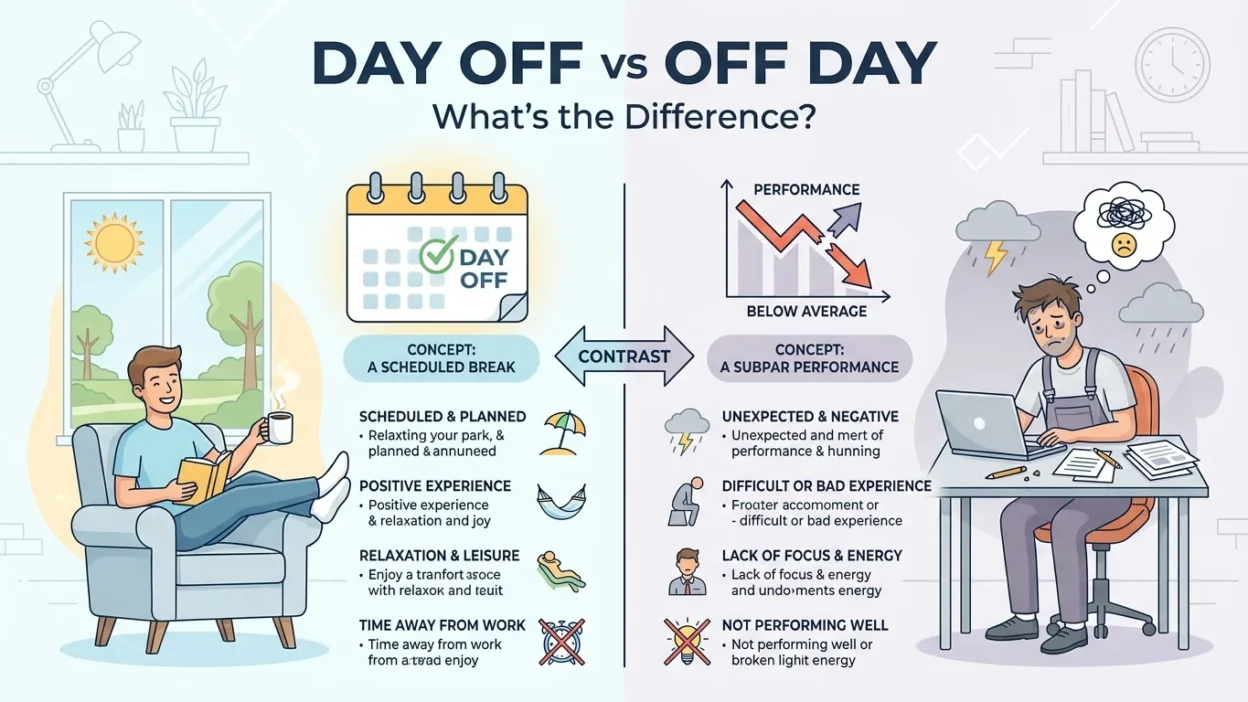
Day off means a scheduled or permitted break from work, school, or regular duties: “Friday is my day off.” Off day usually means a day when someone performs below their normal standard or simply has a bad day: “The player had an off day.”
Why People Confuse It
The confusion comes from the fact that both phrases contain day and off, and both can relate to taking a break or not functioning normally.
However, their meanings are different:
- Day off = a day when you are free from your normal duties.
- Off day = a day when your performance, mood, or results are below normal.
- Day off is commonly used for work schedules and time away.
- Off day is commonly used for performance, mood, or an unsuccessful day.
Compare these:
I have a day off tomorrow.
I don’t have to work tomorrow.
I’m having an off day today.
I’m not feeling or performing as well as usual today.
That distinction is the key to using these expressions correctly.
First Word: Day Off
Day off is a noun phrase meaning a day when you do not have to work or perform your usual duties.
It is especially common when discussing employment, school, vacations, or regular schedules.
Examples
- I have a day off tomorrow.
- Saturday is my day off.
- She took a day off work.
- Can I request a day off next week?
- We have two days off during the holiday.
You can also use days off for more than one day:
I have three days off next week.
Common phrases with “day off”
- take a day off
- have a day off
- get a day off
- request a day off
- enjoy a day off
- spend your day off
- work on your day off
For example:
I’m going to relax on my day off.
Here, day off clearly means a break from work or another regular obligation.
Second Word: Off Day
Off day is generally a noun phrase describing a day when someone performs poorly, feels unusually bad, or is not at their usual level.
It is often used for athletes, workers, students, performers, and anyone who normally performs well.
Examples
- The tennis player had an off day.
- I’m having an off day today.
- The team had an off day and lost badly.
- Everyone has an off day sometimes.
It can also describe a person’s mood or general state:
I’m sorry I’m so quiet today. I’m just having an off day.
This does not necessarily mean the person is taking a break from work. It means something feels or performs worse than normal.
Comparison Table
| Expression | Meaning | Typical Use | Example |
| day off | A day free from normal duties | Work, school, schedules | Monday is my day off. |
| off day | A day of poor performance or an unusually bad day | Sports, work, mood, performance | I’m having an off day. |
| days off | Multiple free days | Work or school schedules | I have two days off. |
| take a day off | Stop working for a day | Employment or personal reasons | I need to take a day off. |
| have an off day | Perform or feel worse than usual | Performance or mood | She’s having an off day. |
When to Use Each
A quick way to choose is to ask yourself what “off” means in the sentence.
Use “day off” when you mean “free from duties”
Use day off when someone is not scheduled to work or attend their normal responsibilities.
I have a day off on Friday.
He took a day off to visit his family.
My next day off is Wednesday.
Use “off day” when you mean “not at your best”
Use off day when someone is performing below their normal level or having an unusually difficult day.
The goalkeeper had an off day.
I’m having an off day at work.
She seems to be having an off day.
An easy test
If you can replace the phrase with “free day,” use day off.
If you can replace it with “bad day” or “below normal day,” off day may be appropriate.
Examples
- Friday is my day off.
→ I don’t have to work Friday. - I’m taking a day off work tomorrow.
→ I won’t be working tomorrow. - She has two days off this week.
→ She has two free days from work. - What are you doing on your day off?
→ What are you doing during your free day? - I need a day off after this busy week.
→ I need a break from work. - The basketball player had an off day.
→ He performed worse than usual. - I’m having an off day today.
→ I’m not feeling or functioning normally today. - The whole team had an off day.
→ The team’s performance was below its usual standard. - Everyone has an off day occasionally.
→ Everyone sometimes has a less successful day. - I’m not working today because it’s my day off.
→ Today is a scheduled break. - The singer had an off day during the performance.
→ The singer didn’t perform as well as usual. - She spent her day off reading at home.
→ She spent her free day relaxing. - Don’t worry about the mistake. You’re probably just having an off day.
→ Your performance is temporarily worse than usual. - I requested a day off for my appointment.
→ I asked for permission not to work.
Common Mistakes
1. Using “off day” for a scheduled holiday
❌ Tomorrow is my off day from work.
This can be understood, but day off is generally the clearer and more natural choice when you mean a scheduled break.
✅ Tomorrow is my day off from work.
2. Using “day off” to describe poor performance
❌ The player had a day off during the match.
That sounds like the player wasn’t working or participating.
If you mean the player performed badly:
✅ The player had an off day.
3. Confusing “take a day off” with “have an off day”
These expressions have different meanings:
- take a day off = deliberately take a break
- have an off day = experience a poor or unusual day
Compare:
I took a day off because I was tired.
I was having an off day because I was tired.
The first focuses on not working. The second focuses on how you were feeling or performing.
4. Assuming “off” always means “not working”
The word off has many meanings in English. In day off, it relates to being free from duties. In off day, it describes something being below its normal condition.
Memory Trick
Remember:
DAY OFF = OFF FROM WORK
OFF DAY = OFF YOUR USUAL FORM
Think of it this way:
Day off → your schedule is off.
Off day → your performance or mood is off.
If you’re relaxing because you don’t have to work, it’s your day off.
If you’re making unusual mistakes or simply aren’t feeling like yourself, you’re having an off day.
American vs British English
Both day off and off day are understood in both American and British English.
Day off is very common in both varieties when discussing time away from work or regular responsibilities.
I have Monday off.
Monday is my day off.
Off day is also used in both varieties, particularly when discussing performance or someone’s condition.
The team had an off day.
There can be regional differences in preferred wording, but the basic distinction between day off and off day remains useful in both American and British English.
Similar Words
Several expressions are related to day off and off day, but they aren’t interchangeable in every situation.
Day off vs. holiday
A holiday can refer to a public holiday or a period when someone takes time away from work, depending on the variety of English.
I have a day off on Monday.
Monday is a public holiday.
Day off vs. vacation
A day off is usually one free day. A vacation generally refers to a longer period away from work, especially in American English.
I have a day off tomorrow.
I’m going on vacation next month.
Off day vs. bad day
An off day often suggests that your performance or condition is below normal. A bad day is broader and can refer to unpleasant events or experiences.
I had an off day at work.
I had a bad day because my car broke down and I missed my meeting.
Off day vs. rest day
A rest day is a day intentionally reserved for recovery, particularly in fitness and sports.
Sunday is my rest day.
An off day, however, may simply mean you’re not performing well.
FAQs
Is it “day off” or “off day”?
Both are correct, but they have different meanings. Day off means a day free from work or regular duties. Off day usually means a day when someone performs poorly or doesn’t feel like themselves.
Is “day off” one word?
No. The standard expression is day off, written as two words.
Is “off day” grammatically correct?
Yes. Off day is a standard expression, especially when describing poor performance, an unusual mood, or a day that doesn’t go well.
Can I say “I have an off day tomorrow”?
Usually, if you mean you don’t have to work tomorrow, I have a day off tomorrow is clearer and more natural.
What does “I’m having an off day” mean?
It usually means you’re feeling, thinking, or performing worse than usual. It can describe a temporary bad mood, low energy, mistakes, or poor performance.
Is “take a day off” correct?
Yes. Take a day off means to stop working or performing your usual duties for a day.
I’m going to take a day off tomorrow.
What is the opposite of a day off?
Depending on context, you might say a workday, a working day, or simply a day when you work.
Final Verdict
The difference between day off and off day is simple: day off is about your schedule, while off day is about your condition or performance. When you aren’t required to work, you have a day off. When you’re having an unusually poor or difficult day, you’re having an off day.
So, say “Friday is my day off” when you’re talking about time away from work. Say “I’m having an off day” when you’re not feeling or performing normally. Once you connect day off with freedom from duties and off day with being below your usual form, the distinction becomes easy to remember.
Remember This
Day off = no work.
Off day = not your best day.

Nova Turner specializes in imaginative science fiction blending futuristic technology, thrilling adventures, and powerful human emotions. Her innovative storytelling inspires curiosity, creativity, and exploration among readers of every age.