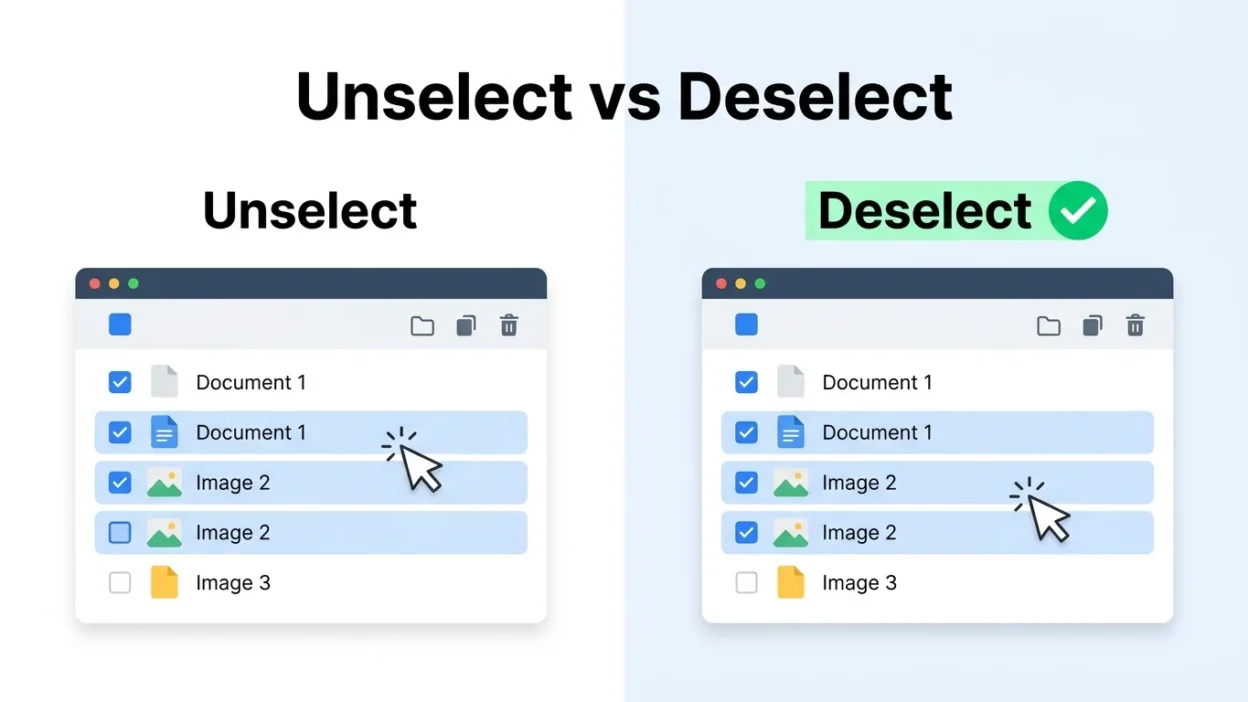
If you’ve ever worked with software, filled out online forms, or used editing tools, you’ve probably come across the words unselect and deselect. At first glance, they appear to mean exactly the same thing. Both describe the action of removing a selection, which makes many English learners and even native speakers wonder whether there’s any real difference.
The truth is that while both terms are understandable, deselect is the standard and widely accepted word in modern English, especially in technology, computing, and user interface (UI) documentation. Unselect is occasionally used, but it’s much less common and may sound informal or non standard in professional writing. Understanding when to use each term will help you communicate more naturally and accurately.
Quick Answer
Deselect is the preferred and standard English term for removing a selection from an item, especially in software and technology. Unselect carries the same meaning but is far less common and is generally avoided in professional writing, technical documentation, and user interface design.
Why People Confuse It
Many English verbs can be reversed using either the prefix un- or de-, making it easy to assume both versions are equally correct.
For example:
- Unlock → Lock
- Undo → Do
- Deactivate → Activate
- Decode → Encode
Since unselect seems to follow the same pattern as unlock, people naturally create or use it. However, English usage—not grammar alone—determines which form becomes standard.
In modern English, software developers, style guides, and dictionaries overwhelmingly favour deselect.
Unselect
Unselect means to remove something from a selected state.
Although many people understand the word, it is considered non standard or less preferred in most professional contexts.
Meaning
To cancel or remove a previous selection.
Usage
You may occasionally see unselect in:
- Informal conversations
- Older software interfaces
- User created documentation
- Online forums
Examples
- Please unselect the image before closing the editor.
- I accidentally unselected the text.
- You can unselect the checkbox if you change your mind.
While these sentences are understandable, replacing unselect with deselect is generally recommended.
Deselect
Deselect means to remove an item from a selected state.
It is the standard word used in:
- Software documentation
- Computer interfaces
- Technical writing
- User manuals
- Professional communication
Meaning
To remove an active selection from one or more items.
Examples
- Click anywhere outside the object to deselect it.
- Press Ctrl + Click to deselect individual items.
- The application automatically deselects inactive layers.
- You can deselect all from the Edit menu.
This is the term you’ll find in most operating systems and professional software.
Comparison Table
| Feature | Unselect | Deselect |
| Meaning | Remove a selection | Remove a selection |
| Standard English | No | Yes |
| Common in software | Rare | Very common |
| Used in technical writing | Rarely | Frequently |
| Professional choice | Not recommended | Recommended |
| Easily understood | Yes | Yes |
| Preferred by style guides | No | Yes |
When to Use Each
Choose deselect when:
- Writing technical documents
- Creating software tutorials
- Giving computer instructions
- Writing professional content
- Developing user interfaces
You might encounter unselect when:
- Reading informal discussions
- Using older applications
- Following user generated guides
Best Practice
If you’re unsure which word to use, choose deselect. It is recognised internationally and sounds more professional.
Examples
Here are practical examples showing the correct usage.
- Click outside the object to deselect it.
- Press Escape to deselect all items.
- The editor lets users deselect multiple images.
- You must deselect the current option before choosing another.
- The software automatically deselects completed tasks.
- I accidentally deselected the wrong file.
- You can deselect every checkbox with one click.
- Most design programs include a Deselect All command.
- Some users still say unselect, but deselect is more common.
- The tutorial recommends deselecting unused layers.
- Remember to deselect hidden objects before exporting.
- The application asks you to deselect the active tool.
Common Mistakes
Using unselect in professional documentation
Less natural:
Unselect the object.
Better:
Deselect the object.
Mixing terminology
Avoid switching between unselect and deselect in the same document.
Stay consistent.
Assuming both are equally standard
Although both communicate the same idea, deselect is the accepted standard in modern English.
Memory Trick
Think of deactivate, decode, and decompress.
Just as de- often means remove or reverse, deselect means remove the selection.
Remember:
De = remove
Deselect = remove the selection
This simple association makes the correct word easy to remember.
American vs British English
There is no significant difference between American and British English for these words.
Both varieties overwhelmingly prefer deselect.
| American English | British English |
| Deselect | Deselect |
Neither variety commonly prefers unselect in formal writing.
Similar Words
If you’re learning computer related English, you may also encounter:
- Select
- Highlight
- Uncheck
- Check
- Activate
- Deactivate
- Enable
- Disable
- Mark
- Unmark
- Choose
- Remove selection
Understanding these related terms helps you follow software instructions more confidently.
Final Verdict
Although unselect and deselect share the same basic meaning, deselect is the clear winner in standard English. It appears in operating systems, professional software, technical documentation, and style guides worldwide.
Unselect isn’t necessarily incorrect because many people understand it, but it’s much less common and may sound informal or inconsistent. For polished writing and clear communication, deselect is almost always the better choice.
Frequently Asked Questions
Is “unselect” a real English word?
Yes. It is occasionally used and understood by English speakers, but it is much less common than deselect and is generally not the preferred choice in professional writing.
Which is grammatically correct: unselect or deselect?
Both are grammatically possible, but deselect is the accepted standard in modern English.
Why do software programs use “deselect”?
Because deselect has become the conventional technical term used across operating systems, applications, and software documentation.
Can I use “unselect” in everyday conversation?
Yes. Most people will understand your meaning, although deselect sounds more natural.
Is “deselect all” correct?
Yes. Deselect All is the standard command used in many computer programs.
Do Microsoft and Adobe use “deselect”?
Yes. Most major software companies use deselect in their menus, documentation, and help guides.
Conclusion
The difference between unselect and deselect is mainly one of usage rather than meaning. Both describe removing a selection, but English has overwhelmingly standardised on deselect, especially in computing, technology, and professional communication.
Whenever you’re writing instructions, creating tutorials, or simply aiming for polished English, deselect is the safer and more natural choice. While unselect may occasionally appear in casual contexts, choosing deselect ensures your writing aligns with modern English conventions and industry standards.
Remember This
Both words mean “remove a selection,” but only deselect is the widely accepted standard in modern English. When in doubt, use deselect.

Hadley Price creates heartfelt contemporary fiction exploring relationships, hope, resilience, and personal growth. Her emotionally rich storytelling connects with readers through memorable characters and inspiring life experiences worldwide.