Have you ever typed “soo” instead of “so” and wondered if it was actually a real English word? You’re not alone. Many English learners and even native speakers occasionally come across so vs soo while texting, writing emails, or posting on social media. Because informal online conversations often ignore standard spelling rules, it’s easy to become confused.
The truth is that “so” is the correct English word in standard writing, while “soo” is usually a misspelling or an intentional stylistic spelling used to add emphasis in casual chats. Understanding the difference will help you write more confidently in school, business, and everyday communication. This guide explains everything you need to know, along with practical examples and common mistakes to avoid.
Quick Answer
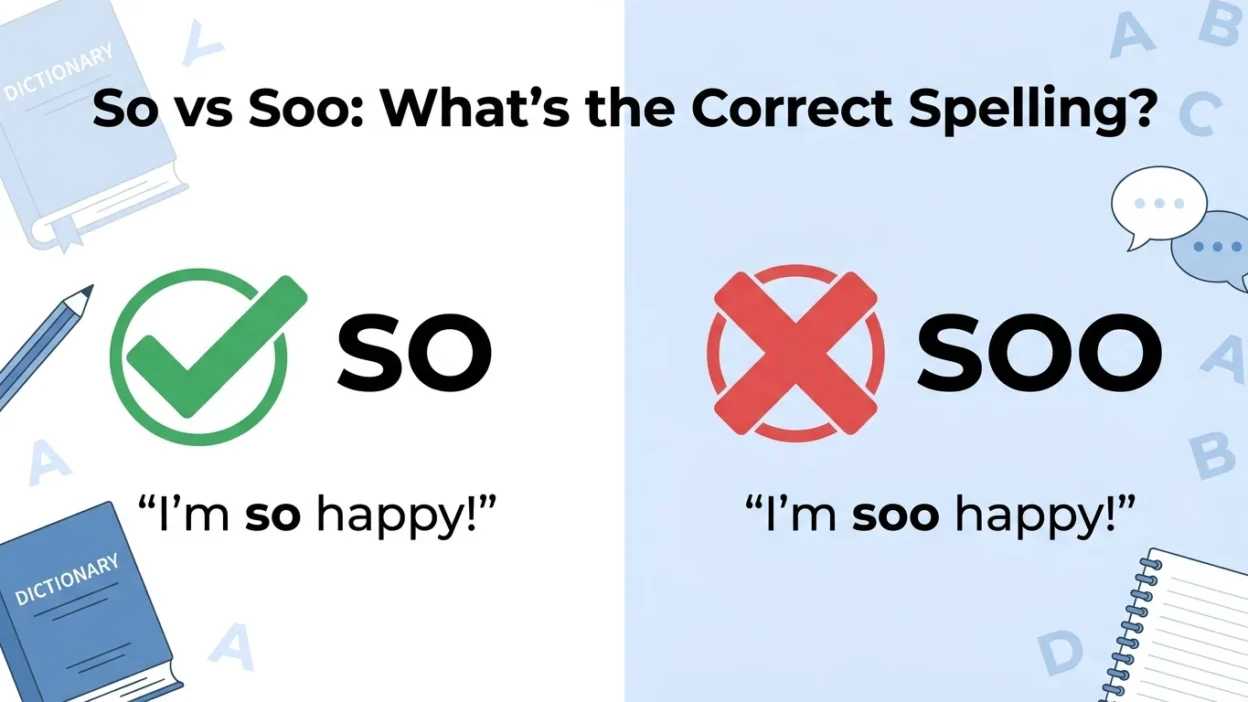
“So” is the correct English word and should be used in all formal and standard writing. “Soo” is generally an incorrect spelling unless someone intentionally stretches the word in casual texting or represents a proper noun, such as a surname or place name.
Why People Confuse It
People confuse so and soo for several reasons:
- Text messaging encourages playful spellings.
- Social media often stretches words for emphasis.
- English pronunciation can make both spellings sound similar.
- Beginners sometimes assume adding another vowel changes meaning.
- Autocorrect doesn’t always catch intentional spellings.
In standard English grammar, however, only so is considered correct in nearly every situation.
First Word: So
So is a common English adverb, conjunction, adjective, pronoun, and interjection depending on its use.
Meanings of “So”
- To such a degree
- Therefore or as a result
- Very or extremely
- Used to agree or continue a conversation
- Used for emphasis
Examples
- I am so happy today.
- She studied hard, so she passed.
- Is that so?
- It was so cold outside.
- Thank you so much.
Because it has several grammatical functions, so is one of the most frequently used words in English.
Second Word: Soo
Soo is not a standard English word.
It usually appears in three situations:
- A typing mistake for so
- A playful spelling in text messages (for example, “I’m sooo excited!” although people more commonly write sooo, not soo)
- A proper noun, such as a person’s name or geographical name
Examples
- ❌ I am soo tired. (Incorrect in formal English)
- ✅ I am so tired.
- Casual text: “That’s soo cute!” (Informal only)
Avoid using soo in essays, reports, emails, resumes, or professional writing.
So vs Soo Comparison Table
| Feature | So | Soo |
| Standard English word | ✅ Yes | ❌ No |
| Correct spelling | ✅ Yes | ❌ Usually no |
| Formal writing | ✅ Appropriate | ❌ Not appropriate |
| Informal texting | ✅ Yes | ✅ Sometimes for emphasis |
| Dictionary entry | ✅ Yes | ❌ Usually no |
| Common usage | Everyday English | Mostly typo or stylistic spelling |
When to Use Each
Use So when:
- Writing essays
- Sending professional emails
- Completing homework
- Writing articles
- Posting on professional platforms
- Expressing degree or result
Examples:
- She was so excited.
- It rained, so we stayed inside.
- Thank you so much.
Use Soo only when:
- Mimicking playful online speech
- Writing casual messages to friends
- Referring to a proper noun named “Soo”
It should not appear in academic or business writing.
Examples
Here are practical examples showing correct usage.
- I am so grateful for your help.
- The movie was so interesting.
- She arrived early, so we started.
- Thank you so much.
- It isn’t so difficult.
- Why are you so quiet today?
- I was so surprised by the news.
- The cake tasted so good.
- ❌ I am soo happy. (Formal writing: incorrect.)
- Casual text: “That’s soo funny!”
- We were so busy yesterday.
- He spoke so softly that nobody heard him.
Common Mistakes
Many learners accidentally make these errors:
- Writing soo in school assignments.
- Assuming soo is an alternative spelling.
- Copying social media spelling into formal writing.
- Forgetting that emphasis should be expressed with proper punctuation or wording instead.
Incorrect
- I am soo excited for class.
Correct
- I am so excited for class.
Memory Trick
Remember this simple rule:
“One ‘o’ is always enough.”
If you’re writing standard English, choose so.
Think of it this way:
So = Standard.
Soo = Social media or spelling mistake.
This makes the correct choice easy to remember.
American vs British English
There is no difference between American and British English regarding these words.
Both varieties use:
- ✅ so as the correct spelling.
- ❌ soo only as an informal or playful spelling, not in standard writing.
Whether you’re writing for readers in the United States, the United Kingdom, Canada, Australia, or elsewhere, so is the accepted form.
Similar Words
You may also confuse these similar spellings:
- Too vs To
- Then vs Than
- Your vs You’re
- Its vs It’s
- Accept vs Except
- Quite vs Quiet
- Already vs All Ready
- Affect vs Effect
Learning these pairs will improve your overall English writing skills.
Final Verdict
The answer is simple: so is the correct English word for everyday and professional writing. It functions in several grammatical roles and appears in countless English sentences.
On the other hand, soo is generally not a standard English spelling. It is usually either a typo, an intentional stylistic spelling in informal conversations, or part of a proper noun. When accuracy matters, always choose so.
Frequently Asked Questions
Is “soo” a real English word?
No. It is generally not recognized as a standard English word, although it may appear as a proper noun or playful internet spelling.
Which is correct: so or soo?
So is the correct spelling in standard English.
Can I use “soo” in an email?
No. Use so in all professional and academic writing.
Why do people write “soo”?
People often use it informally to add emphasis or emotion in text messages and social media posts.
Is “soo” acceptable in creative writing?
It can be used intentionally to represent informal dialogue or character speech, but not in standard narration unless stylistically justified.
Is “sooo” correct?
Sooo is also informal and used only to exaggerate emotion in casual conversations. It is not appropriate for formal writing.
Conclusion
Although so vs soo may seem like a small spelling issue, using the correct form makes your writing clearer and more professional. Since so serves many important grammatical purposes, mastering its usage will improve your overall English communication.
Whenever you’re writing an essay, email, report, or business message, stick with so. Reserve soo only for playful conversations or when it’s part of a proper name. Choosing the standard spelling helps readers understand your message and reflects strong writing skills.
Remember This
Use “so” in every standard English sentence. “Soo” is usually a typo or an informal spelling used only in casual texting not in professional or academic writing.

Willow Evans writes uplifting fantasy stories filled with magical worlds, courageous heroes, and meaningful life lessons. Her imaginative books encourage creativity, kindness, and hope in readers of all ages.