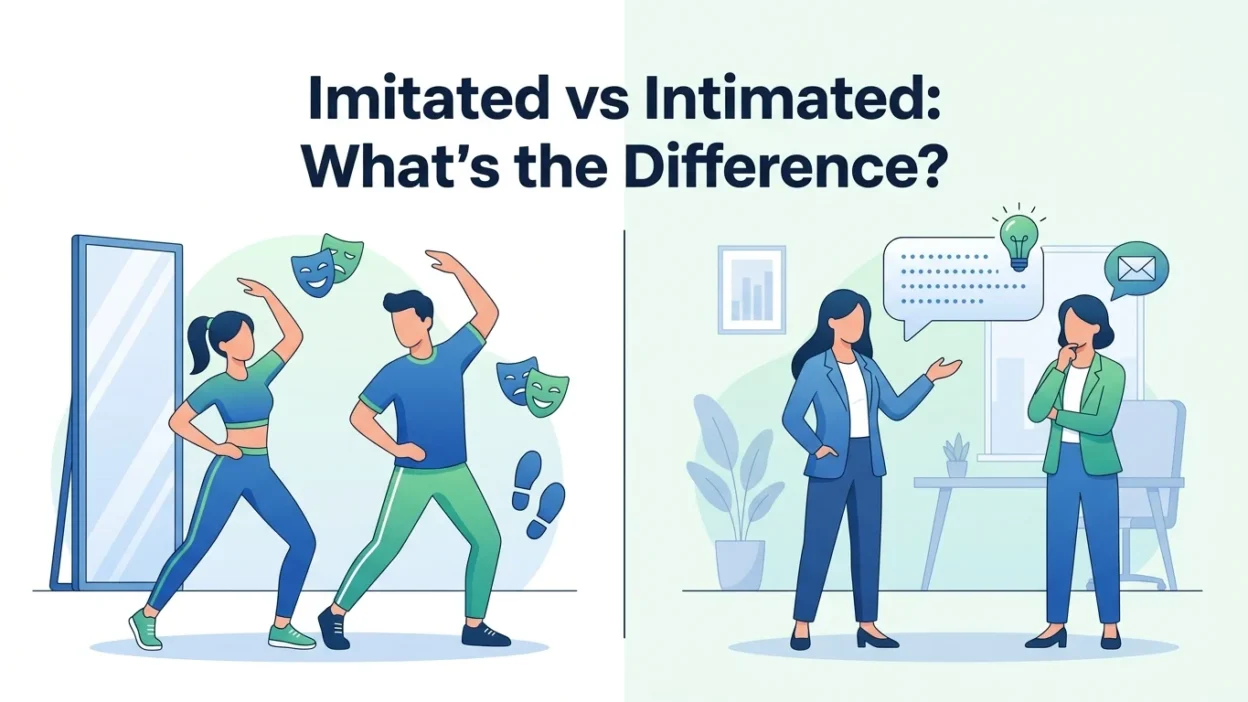
Some English word pairs look almost identical but carry completely different meanings. “Imitated” and “intimated” are a perfect example. One is tied to copying or reproducing something, while the other means to hint, suggest, or indirectly communicate an idea. Because they sound a little alike and share a similar ending, many writers mix them up in everyday writing, emails, and even professional content.
That confusion can quietly damage clarity. A sentence that should describe copying someone’s style may accidentally sound like a subtle hint instead. If you want to write with confidence, understand the difference between these two commonly confused words. This guide breaks down the meaning of each word, shows side by side examples, and gives you simple memory tricks so you can use imitated and intimated correctly every time.
Quick Answer
Imitated means copied or repeated in a similar way.
Intimated means hinted at or suggested indirectly.
Use imitated for copying an action, style, or sound. Use intimated for soft, indirect communication. They are not interchangeable.
Why People Confuse It
People confuse these words because they look and sound similar, especially in fast reading. Both end in -ated, both are past tense forms, and both can appear in formal writing. The problem gets worse when someone is reading quickly and not paying attention to context.
Another reason is that both words relate to communication or behavior in a broad sense. For example, someone might imitate a speech style, while another person might intimate a point without saying it directly. Since both can appear in conversations, articles, and professional documents, the mix up is easy to make.
First Word
Imitated
Imitated is the past tense of imitate. It means to copy someone or something, often in appearance, sound, action, or manner.
Examples of what it can mean:
- copied a voice
- repeated a gesture
- mimicked a style
- reproduced a behavior
Common uses:
- “The child imitated her teacher’s accent.”
- “The designer imitated a classic vintage look.”
- “He imitated the singer’s stage moves.”
In simple terms, if something was copied, mirrored, or replicated, imitated is usually the right word.
Second Word
Intimated
Intimated is the past tense of intimate when it means to suggest something indirectly or hint at it without saying it openly.
Common uses:
- hinted at a decision
- suggested a possibility
- communicated indirectly
- implied something politely or vaguely
Examples:
- “She intimated that the project might be delayed.”
- “The manager intimated his concerns without speaking directly.”
- “He intimated that he would not attend the meeting.”
Be careful: this is not the same as the more familiar adjective intimate meaning close or personal. In this pair, intimated is about indirect expression.
Comparison Table
| Word | Part of Speech | Main Meaning | Best Use | Example |
| Imitated | Verb (past tense) | Copied or mimicked | Behavior, style, sound, action | “She imitated the celebrity’s voice.” |
| Intimated | Verb (past tense) | Hinted or suggested indirectly | Soft, indirect communication | “He intimated that changes were coming.” |
When to Use Each
Use imitated when someone copies a person, pattern, movement, sound, or style. It often appears in descriptions of children, actors, students, performers, branding, and design.
Use intimated when someone implies something without stating it clearly. It often appears in formal writing, business communication, journalism, and literature.
A simple test helps:
- If the idea is copying, choose imitated.
- If the idea is hinting, choose intimated.
More examples:
- A comedian may imitate a politician’s voice.
- A speaker may intimate that a decision is near.
Examples
Here are clear examples to help you see the difference in real sentences.
Imitated
- The student imitated her teacher’s handwriting.
- The puppy imitated the older dog’s behavior.
- The actor imitated the president’s speaking style.
- The brand imitated a luxury perfume design.
- He imitated the sound of a car engine.
- The painter imitated a famous impressionist technique.
Intimated
- The CEO intimated that layoffs were possible.
- She intimated her frustration during the meeting.
- The lawyer intimated that the witness was hiding something.
- The email intimated that the deadline could change.
- He intimated his interest without saying it directly.
- The report intimated that the figures were incomplete.
Quick contrast examples
- She imitated her sister’s laugh, but she intimated that she was unhappy.
- The child imitated a dance move, while the coach intimated that practice would be extended.
- The ad imitated a classic style and intimated nostalgia.
Common Mistakes
One common mistake is using intimated when you mean imitated in a copying context. For example, “He intimated the singer’s style” is incorrect if you mean he copied the style. The correct word is imitated.
Another mistake is assuming intimated always means personal or emotional closeness because of the word intimate. In this comparison, intimated comes from a different usage and means to hint or suggest.
A third mistake is choosing the word based on sound alone. Since these are similar looking confused words, always check the meaning before writing. A simple context check can prevent spelling and vocabulary errors.
Memory Trick
Use this easy memory trick:
- Imitated = I copied it
- Intimated = I hinted it
You can also remember:
- Imitate has mimic energy.
- Intimate in this form has indirect message energy.
If you are writing about copying, think imitated.
If you are writing about a suggestion or hint, think intimated.
American vs British English
There is no major American vs British English difference in the meaning of imitated and intimated. Both forms are used in both varieties of English.
That said, readers in both regions may be more familiar with imitated in everyday speech, while intimated can sound a little more formal or literary. The spelling does not change, but the tone and frequency may feel slightly different depending on the context.
Similar Words
These words are often related to or confused with imitated and intimated:
- Mimicked — copied someone’s actions or voice
- Copied — reproduced something exactly or closely
- Suggested — put an idea forward indirectly
- Implied — expressed indirectly
- Hinted — gave a subtle clue
- Indicated — showed or pointed to something
These similar words can help you build stronger vocabulary and choose the most precise wording.
Final Verdict
Imitated means copied.
Intimated means hinted.
That is the core difference, and it is easy to remember once you tie each word to its function. When a sentence is about behavior, style, sound, or action that was copied, imitated is the correct choice. When a sentence is about indirect communication or a subtle suggestion, intimated is the better fit.
If you pause for one second and ask, “Was it copied or hinted?” you will usually choose the right word. That small habit improves clarity, accuracy, and confidence in your writing.
FAQs
1. What is the main difference between imitated and intimated?
Imitated means copied or mimicked. Intimated means hinted at or suggested indirectly.
2. Is intimated the same as intimate?
No. Intimated is a verb form meaning hinted. Intimate can also be an adjective meaning close or personal.
3. Can I use intimated when someone copied something?
No. For copying, use imitated.
4. Is imitated more common than intimated?
Yes, in everyday writing and speech, imitated is generally more common.
5. How do I remember the difference quickly?
Think: imitated = copied and intimated = hinted.
6. Are these words interchangeable in formal writing?
No. They have different meanings, so using one instead of the other can change the sentence completely.
7. What is a simple sentence with each word?
“She imitated her friend’s accent.”
“He intimated that the plan might change.”
Conclusion
Words like imitated and intimated show why careful reading matters. They may look similar on the page, but their meanings are very different. One points to copying, while the other points to indirect suggestions. Once you understand that contrast, the confusion disappears.
The best writers do not just know word meanings; they choose words with precision. Using imitated and intimated correctly helps your writing sound clearer, more professional, and more trustworthy. The next time you see this pair, slow down, check the context, and pick the word that matches the real meaning.
Remember This:
Imitated = copied. Intimated = hinted.

Hadley Price creates heartfelt contemporary fiction exploring relationships, hope, resilience, and personal growth. Her emotionally rich storytelling connects with readers through memorable characters and inspiring life experiences worldwide.