
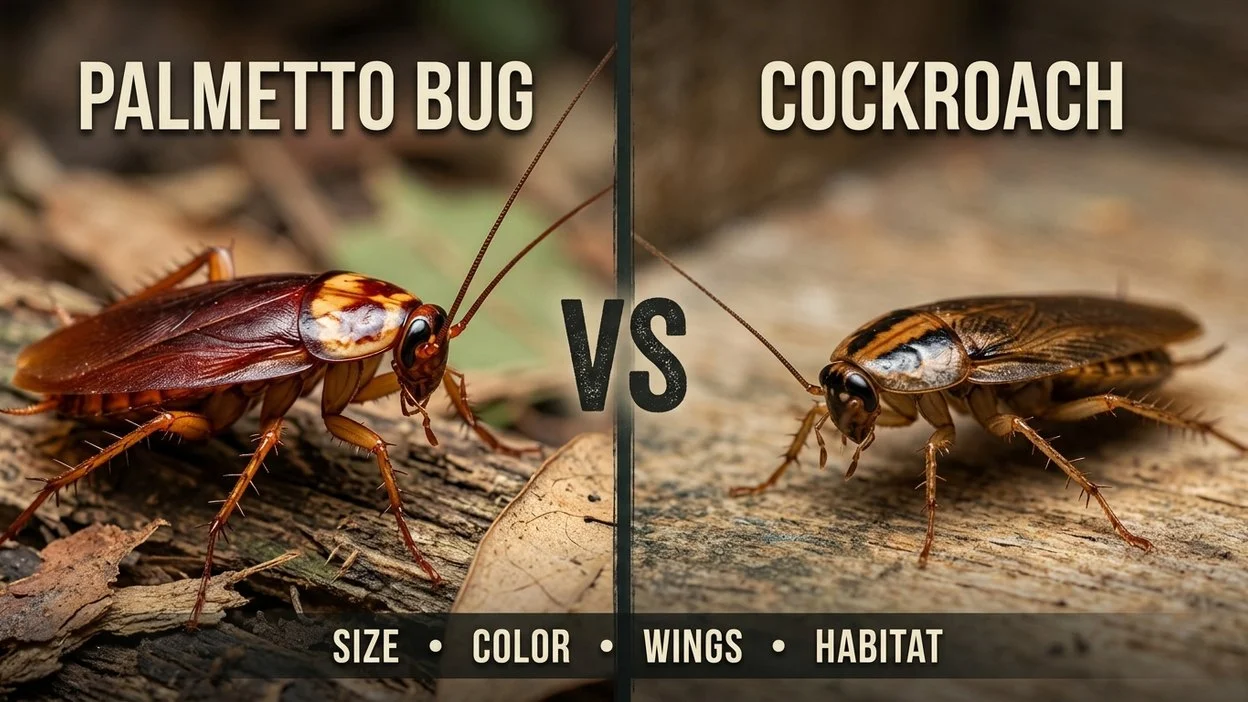
When comparing palmetto bug vs cockroach, the main difference is that a palmetto bug is a common name for certain cockroaches, not a completely separate type of insect. The term is especially common in the southern United States, where people often use it for large cockroaches that live outdoors or enter homes in warm, humid weather. A cockroach, on the other hand, is the general name for an insect belonging to the order Blattodea.
These two terms can be confusing because people sometimes use them as if they describe different insects. In everyday conversation, a person might call a large flying cockroach a palmetto bug, while another person might simply call it a cockroach. Both may be talking about the same insect. Understanding the meaning, regional usage, and examples of each term will help you use them correctly in speaking, writing, and everyday English.
Quick Answer: Palmetto Bug vs Cockroach
A palmetto bug is usually a large cockroach, especially the American cockroach, that people commonly identify by this name in the southern United States. Cockroach is the general name for the insect group. Therefore, a palmetto bug is a type of cockroach in common usage, but not every cockroach is called a palmetto bug.
Why Do People Confuse Palmetto Bugs and Cockroaches?
People confuse these terms because they describe overlapping categories rather than two completely different insects.
Here are the main reasons:
- Different names: People in different regions may use different names for the same insect.
- Different sizes: The name palmetto bug often refers to a large cockroach, while cockroaches can be small, medium-sized, or large.
- Different habitats: Palmetto bugs are often associated with outdoor environments, including damp areas and spaces around palm trees.
- Different impressions: Some people use palmetto bug because it sounds less unpleasant than cockroach.
- Different species: Several cockroach species exist, and their appearance, behavior, and preferred habitats vary.
For example, someone in South Carolina might say, “There is a palmetto bug in the bathroom.” Someone elsewhere might say, “There is a cockroach in the bathroom.” Both speakers may be referring to an American cockroach.
First Word: Palmetto Bug
What Does Palmetto Bug Mean?
A palmetto bug is a common, informal name for certain large cockroaches, particularly the American cockroach (Periplaneta americana). The name is widely associated with the southeastern United States, including Florida and South Carolina.
The word palmetto refers to a type of palm plant. Because some large cockroaches live outdoors around vegetation and damp places, the name became associated with these insects.
Characteristics of a Palmetto Bug
A palmetto bug commonly described in American English may have these features:
- A relatively large, reddish-brown body.
- Long antennae.
- Six legs.
- A flattened body that helps it hide in narrow spaces.
- The ability to fly or glide short distances under suitable conditions, depending on the species.
- A preference for warm, humid environments.
Palmetto bugs may live outdoors in mulch, leaf litter, drains, and other sheltered places. They can also enter buildings in search of food, moisture, or shelter.
Example: “I saw a huge palmetto bug near the back door after the rain.”
In this sentence, palmetto bug refers to a large cockroach commonly known by that regional name.
Second Word: Cockroach
What Does Cockroach Mean?
A cockroach is an insect belonging to the order Blattodea. Cockroaches are found in many parts of the world and include numerous species with different sizes, colors, and habits.
The word cockroach is the standard, widely understood term for this group of insects.
Characteristics of a Cockroach
Common cockroach characteristics include:
- Six legs and long antennae.
- A flattened body.
- A hard outer covering called an exoskeleton.
- The ability to hide in small cracks and crevices.
- Different colors and sizes depending on the species.
- Habitats ranging from forests and gardens to kitchens, basements, and commercial buildings.
Some cockroaches mainly live outdoors, while others are well adapted to living inside human buildings.
For example, the German cockroach is a relatively small species often associated with indoor infestations. The American cockroach is much larger and may be found both outdoors and indoors.
Example: “The restaurant hired a pest-control professional to deal with a cockroach infestation.”
Here, cockroach is the general term, and it does not identify a particular species.
Palmetto Bug vs Cockroach: Comparison Table
| Feature | Palmetto bug | Cockroach |
| Meaning | A common name for certain large cockroaches | General name for the insect group |
| Type of term | Regional or informal | Standard and widely used |
| Typical size | Often refers to larger species | Includes small, medium, and large species |
| Common location | Especially associated with the southeastern United States | Used worldwide |
| Habitat | Often associated with outdoor, humid environments | Outdoors or indoors, depending on species |
| Appearance | Commonly reddish-brown and relatively large | Varies by species |
| Flying ability | Some insects called palmetto bugs can fly or glide | Depends on the species |
| Scientific classification | Usually a cockroach species | Many species in the order Blattodea |
| Example | “A palmetto bug flew inside.” | “A cockroach was hiding under the sink.” |
Important: The name palmetto bug does not always refer to exactly the same species. The American cockroach is a common example, but regional naming can vary.
When Should You Use Palmetto Bug or Cockroach?
Choose the word that best fits your audience and situation.
Use “Palmetto Bug” When:
- You are talking about a large cockroach commonly known by this name in the southeastern United States.
- You are describing a local experience in Florida, South Carolina, or a nearby region.
- You are having an informal conversation with people who recognize the term.
- You want to reflect the regional name used by the speaker or community.
Example: “We found a palmetto bug on the porch last night.”
Use “Cockroach” When:
- You want to use a term that people understand internationally.
- You are writing a school assignment or educational article.
- You are discussing pest control or an indoor infestation.
- You do not know which cockroach species you have seen.
- You are explaining the insect in a scientific or general context.
Example: “Cockroaches can enter homes through small openings around doors and pipes.”
For most general writing, cockroach is the clearest choice. Use palmetto bug when the regional name is relevant.
12 Examples of Palmetto Bug and Cockroach in Sentences
The following examples show how each word works in natural English.
- Palmetto bug: “A palmetto bug was crawling across the patio.”
- Cockroach: “A cockroach ran behind the refrigerator.”
- Palmetto bug: “My cousin saw a large palmetto bug near the porch light.”
- Cockroach: “The kitchen needs cleaning because we found a cockroach near the sink.”
- Palmetto bug: “People in parts of South Carolina often call certain large cockroaches palmetto bugs.”
- Cockroach: “The biology teacher explained how a cockroach’s body is structured.”
- Palmetto bug: “I closed the window because a palmetto bug was flying nearby.”
- Cockroach: “The pest-control worker identified the insect as an American cockroach.”
- Palmetto bug: “After heavy rain, we noticed a palmetto bug near the front door.”
- Cockroach: “A cockroach can hide in a narrow crack during the day.”
- Palmetto bug: “She called the insect a palmetto bug because that is the name her family uses.”
- Cockroach: “If you cannot identify the species, cockroach is a useful general term.”
These examples show that both expressions can be correct. The best choice depends on the insect being discussed, the region, and the purpose of the conversation.
Common Mistakes to Avoid
Mistake 1: Thinking They Are Completely Different Insects
Incorrect: “A palmetto bug is not a cockroach.”
Correct: “A palmetto bug is a common name for certain cockroaches.”
The terms overlap because palmetto bug is a regional common name.
Mistake 2: Assuming Every Cockroach Is a Palmetto Bug
Incorrect: “Every cockroach is a palmetto bug.”
Correct: “Some cockroaches are commonly called palmetto bugs.”
The general category includes many species, and most are not routinely given this regional name.
Mistake 3: Believing Palmetto Bugs Always Live in Palm Trees
Incorrect: “Palmetto bugs only live on palmetto trees.”
Correct: “Cockroaches called palmetto bugs may live in several outdoor and indoor environments.”
The name is associated with palmetto plants, but these insects are not limited to palm trees.
Mistake 4: Assuming Every Palmetto Bug Can Fly
Incorrect: “All palmetto bugs fly.”
Correct: “Some cockroaches commonly called palmetto bugs can fly or glide.”
Flying ability depends on the species and other conditions.
Mistake 5: Using the Regional Name in Every Situation
Incorrect: “Palmetto bug is the only correct English word for this insect.”
Correct: “Cockroach is the general term, while palmetto bug is a regional name.”
If your audience comes from different countries, cockroach is usually easier to understand.
Memory Trick: How to Remember the Difference
Use this simple rule:
Palmetto bug = a regional name. Cockroach = the general name.
Think of it this way:
- Palmetto bug: Picture a large cockroach in a warm, humid southern US setting.
- Cockroach: Picture the entire group of insects, from small indoor species to large outdoor species.
A useful comparison is the relationship between a regional nickname and a general name. The nickname may describe a particular example, but the general term covers a broader category.
Remember that palmetto bug is not a formal scientific classification.
American vs British English: Is There a Difference?
The main difference is regional usage, not spelling.
American English
In the United States, cockroach is widely understood. Palmetto bug is especially familiar in parts of the Southeast, including Florida and South Carolina.
For example:
- “There is a cockroach in the kitchen.”
- “We saw a palmetto bug on the porch.”
Both sentences are natural American English.
British English
In British English, cockroach is the standard, widely understood term. Palmetto bug is much less common because it is associated with American regional usage.
A British English speaker would generally say:
“The cockroach was hiding behind the cupboard.”
There is no major American-versus-British spelling difference between these two expressions. The distinction is mainly about which name people commonly use.
Similar Words Related to Palmetto Bug and Cockroach
Learning related words can help you describe insects more precisely.
1. Roach
Roach is a shorter, informal version of cockroach.
Example: “There was a roach under the table.”
2. American Cockroach
The American cockroach is a relatively large, reddish-brown species often associated with the name palmetto bug in the United States.
Example: “The pest-control worker identified the insect as an American cockroach.”
3. German Cockroach
The German cockroach is a smaller species commonly associated with indoor infestations.
Example: “German cockroaches can spread quickly when conditions are favorable.”
4. Oriental Cockroach
The Oriental cockroach is a dark-colored species often associated with cool, damp places.
Example: “An Oriental cockroach was found in the damp basement.”
5. Insect
Insect is a broader biological term that includes cockroaches, ants, butterflies, beetles, and many other animals.
Example: “A cockroach is an insect with six legs.”
6. Pest
Pest describes an organism that causes harm, damage, contamination, or other unwanted problems. Not every insect is a pest in every situation.
Example: “The homeowner contacted a professional to control the pests.”
7. Bug
In everyday English, bug is often used informally for insects and similar small creatures. In scientific classification, however, a true bug belongs to a more specific group of insects.
Example: “There is a bug near the window.”
FAQs:
1. Is a palmetto bug the same as a cockroach?
Yes, in common usage, a palmetto bug is a type of cockroach. The name usually refers to certain large cockroaches, especially the American cockroach in parts of the southeastern United States.
2. Are palmetto bugs bigger than cockroaches?
Not necessarily. Palmetto bug commonly refers to larger cockroach species, but cockroaches vary considerably in size. The comparison depends on which species you mean.
3. Can palmetto bugs fly?
Some cockroaches called palmetto bugs, including American cockroaches, can fly or glide under suitable conditions. Their flying behavior can vary with the individual insect and environmental conditions.
4. Why are cockroaches called palmetto bugs?
The name is associated with palmetto plants and regional use in the southeastern United States. It became a familiar common name for certain large cockroaches found around homes and outdoor environments.
5. Are palmetto bugs dangerous?
Palmetto bugs are generally not aggressive toward people and do not usually bite. However, cockroaches can carry contaminants on their bodies and may contribute to allergies and asthma symptoms. Avoid direct contact, keep food covered, and address recurring infestations.
6. Do palmetto bugs come into clean homes?
Yes. A clean home can still attract cockroaches if they find water, shelter, or an entry point. Outdoor cockroaches may enter through gaps around doors, windows, drains, or pipes. Reducing moisture and sealing openings can help.
7. What is the best word to use: palmetto bug or cockroach?
Cockroach is generally the best choice for schoolwork, international communication, and formal writing because it is widely understood. Palmetto bug is appropriate when discussing the regional name used for certain large cockroaches in the southeastern United States.
8. Are palmetto bugs the same as German cockroaches?
Not necessarily. Palmetto bug usually refers to certain larger cockroaches, while German cockroach identifies a particular, generally smaller species. Both belong to the broader cockroach group, but they differ in appearance, typical habitat, and behavior.
Remember This
- A palmetto bug is commonly a type of cockroach.
- Cockroach is the general name for the insect group.
- Palmetto bug is a regional, informal name used especially in the southeastern United States.
- American cockroaches are often associated with the name palmetto bug.
- Not every cockroach is called a palmetto bug.
- Use cockroach when you want clear, widely understood English.
Conclusion:
The difference between a palmetto bug and a cockroach is mainly a difference in naming. Palmetto bug is a regional name for certain large cockroaches, while cockroach is the general term for the entire group. Although the two expressions can describe the same insect, they are not interchangeable in every context because palmetto bug has a more specific regional association.
For students, beginners, and ESL learners, the easiest rule is to remember that cockroach is the general word and palmetto bug is a local name. When you are unsure which species you have seen, use cockroach. When discussing the regional name used in the southern United States, palmetto bug is also correct.

Willow Evans writes uplifting fantasy stories filled with magical worlds, courageous heroes, and meaningful life lessons. Her imaginative books encourage creativity, kindness, and hope in readers of all ages.