
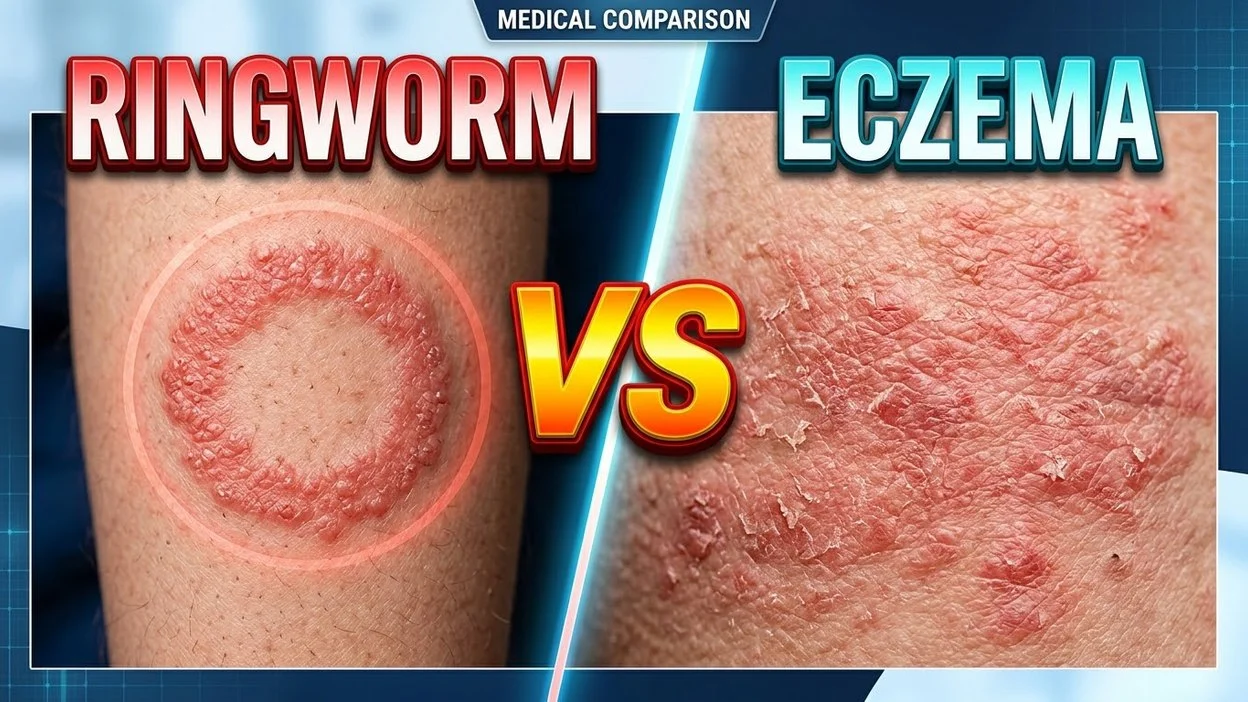
Have you ever noticed a red, itchy patch on your skin and wondered whether it was ringworm or eczema? These two skin conditions can look similar, but they have different causes, symptoms, and treatments. Knowing the difference can help you understand what is happening to your skin and when to seek medical advice.
Ringworm is a fungal skin infection that often causes a ring-shaped, itchy rash. Eczema is a group of skin conditions that cause inflammation, dryness, itching, and irritation. Although both conditions can make your skin uncomfortable, ringworm is caused by a fungus, while eczema is not contagious and is often linked to skin sensitivity, genetics, and environmental triggers.
In this guide, you will learn how to tell ringworm vs eczema apart, understand their common symptoms, explore treatment options, and discover practical examples. The explanations use simple English to help students, ESL learners, beginners, and general readers understand these commonly confused skin conditions.
Quick Answer: Ringworm vs Eczema
Ringworm is a contagious fungal infection that often creates a circular, scaly rash with a clearer center. Eczema is a noncontagious inflammatory skin condition that causes dry, itchy, irritated skin. Ringworm usually needs antifungal medicine, while eczema is commonly managed with moisturizers and anti-inflammatory treatments.
Why Do People Confuse Ringworm and Eczema?
People often confuse ringworm and eczema because both can cause:
- Red or irritated skin
- Itching and discomfort
- Dryness or scaling
- Cracked or inflamed skin
- Rashes that appear on different parts of the body
The biggest difference is the cause.
Ringworm develops when certain fungi grow on the skin. Eczema develops when the skin’s protective barrier becomes weakened or inflamed.
For example, a person may notice a red, itchy patch on their arm. If the patch slowly forms a circular shape with a raised edge, ringworm may be responsible. If the skin becomes dry, rough, and irritated after contact with soap, eczema may be more likely.
However, appearance alone cannot always provide a reliable diagnosis. Some fungal infections look like eczema, and some eczema patches can have circular shapes.
First Word: What Does Ringworm Mean?
Ringworm is a fungal infection of the skin. It is also called dermatophytosis or tinea.
Despite its name, ringworm is not caused by a worm. The name comes from the ring-like shape that the rash often develops.
Common Symptoms of Ringworm
Ringworm may cause:
- A circular or ring-shaped rash
- A raised, red, or darker outer border
- A scaly or flaky surface
- Itching
- A lighter or clearer center in some cases
- Gradually spreading patches
The rash may appear on the arms, legs, body, scalp, feet, or groin.
Ringworm on the scalp can cause hair loss or broken hairs. When it affects the feet, it is commonly known as athlete’s foot.
What Causes Ringworm?
Ringworm is caused by fungi that grow on the outer layer of the skin.
It can spread through:
- Direct contact with an infected person
- Contact with infected animals
- Sharing towels, clothing, or bedding
- Touching contaminated surfaces or objects
For example, a person may develop ringworm after close contact with an infected pet or by sharing a towel with someone who has the infection.
How Is Ringworm Treated?
Ringworm is generally treated with antifungal medicine.
Depending on the location and severity, treatment may include:
- Antifungal creams for many skin infections
- Antifungal sprays or powders
- Prescription oral antifungal medicine for scalp infections or certain severe cases
Common topical antifungal ingredients include clotrimazole and terbinafine.
Steroid creams should not be used on a suspected fungal rash without medical advice. Steroids can hide symptoms and allow a fungal infection to worsen.
Second Word: What Does Eczema Mean?
Eczema is a group of inflammatory skin conditions that cause the skin to become dry, itchy, irritated, and sometimes swollen.
The most common type is atopic dermatitis.
Unlike ringworm, eczema is not caused by a fungus and cannot spread from one person to another.
Common Symptoms of Eczema
Eczema may cause:
- Dry or rough skin
- Persistent itching
- Redness or darker patches
- Cracked skin
- Small bumps
- Thickened skin after repeated scratching
- Inflammation or swelling
The appearance of eczema can vary depending on a person’s skin tone, age, and the type of eczema.
In lighter skin, eczema may appear red or pink. In darker skin, it may appear brown, purple, gray, or darker than the surrounding skin.
What Causes Eczema?
Eczema is often associated with a weakened skin barrier and an overactive inflammatory response.
Several factors may contribute to eczema, including:
- Genetics
- Dry weather
- Harsh soaps and detergents
- Fragrances
- Certain fabrics
- Sweat and heat
- Stress
- Allergens or irritants
For example, a person with eczema may notice that their hands become dry and itchy after frequent washing with strong soap.
How Is Eczema Treated?
Eczema treatment focuses on reducing inflammation, protecting the skin barrier, and controlling itching.
Common approaches include:
- Regular use of fragrance-free moisturizers
- Gentle skin cleansers
- Avoiding known triggers
- Prescription or over-the-counter topical corticosteroids when appropriate
- Other prescription anti-inflammatory treatments for more severe cases
Unlike ringworm, eczema does not require antifungal medicine unless a separate fungal infection is also present.
Ringworm vs Eczema: What Is the Difference?
The following table highlights the main differences between ringworm and eczema.
| Feature | Ringworm | Eczema |
| Main cause | Fungal infection | Skin inflammation |
| Contagious? | Yes, often contagious | No |
| Common appearance | Ring-shaped, scaly rash | Dry, irritated, inflamed patches |
| Rash border | Often raised and defined | Often less clearly defined |
| Center of rash | May look clearer | Usually remains irritated or dry |
| Itching | Common | Common, sometimes intense |
| Skin dryness | May occur | Very common |
| Common locations | Body, feet, groin, scalp | Hands, face, elbows, knees, body |
| Typical treatment | Antifungal medicine | Moisturizers and anti-inflammatory medicine |
| Main concern | Preventing fungal spread | Controlling inflammation and protecting skin |
Important: These are common patterns, not absolute rules. Ringworm may not form a classic ring, and eczema may sometimes appear circular. A healthcare professional can examine the rash and perform a skin scraping test if needed.
When Should You Use Each Term?
The words ringworm and eczema refer to different medical conditions. Use them according to the condition being described.
When to Use Ringworm
Use the word ringworm when talking about a fungal skin infection.
Examples:
- The doctor diagnosed ringworm on my arm.
- Ringworm can spread through infected towels.
- My cat has ringworm.
- The pharmacist recommended an antifungal cream for ringworm.
When to Use Eczema
Use the word eczema when talking about an inflammatory skin condition.
Examples:
- My eczema gets worse in cold weather.
- Eczema can make the skin very itchy.
- She uses moisturizer to manage her eczema.
- The doctor prescribed a cream for my eczema.
Do not use these terms interchangeably. A fungal infection and an inflammatory skin condition require different treatment approaches.
12 Examples of Ringworm vs Eczema in Sentences
Here are practical examples to help you understand the difference.
- Ringworm: The child developed a circular rash after playing with an infected kitten.
- Eczema: Her eczema became worse after she used a scented body wash.
- Ringworm: The doctor prescribed an antifungal cream for the ringworm on his leg.
- Eczema: My hands become dry and itchy whenever I wash dishes without gloves.
- Ringworm: Ringworm can spread when people share infected towels.
- Eczema: Eczema is not contagious, so you cannot catch it by touching someone.
- Ringworm: The rash had a raised, scaly border and a clearer center.
- Eczema: The skin around her elbows became rough, dry, and irritated.
- Ringworm: The athlete developed a fungal infection on his feet.
- Eczema: The baby developed itchy patches on her cheeks.
- Ringworm: The pharmacist advised him to use an antifungal treatment.
- Eczema: Regular moisturizing helped reduce the dryness and irritation.
These examples show how the two words describe different skin conditions, even when their symptoms seem similar.
Common Mistakes When Comparing Ringworm and Eczema
Mistake 1: Thinking Ringworm Is Caused by a Worm
Incorrect: Ringworm is a skin disease caused by a worm.
Correct: Ringworm is a fungal skin infection.
Mistake 2: Assuming Every Circular Rash Is Ringworm
Incorrect: A circular rash always means ringworm.
Correct: Ringworm often forms a ring, but eczema and other skin conditions can also cause circular patches.
Mistake 3: Thinking Eczema Is Contagious
Incorrect: Eczema spreads from one person to another.
Correct: Eczema is not contagious.
Mistake 4: Using Steroid Cream for Every Itchy Rash
Incorrect: Any itchy rash can be treated with a steroid cream.
Correct: Some itchy rashes are fungal infections. Steroid treatment without an accurate diagnosis may worsen ringworm.
Mistake 5: Assuming Moisturizer Cures Ringworm
Incorrect: Moisturizer alone will eliminate ringworm.
Correct: Moisturizers can help dry skin, but ringworm generally requires antifungal treatment.
Memory Trick: How to Remember Ringworm vs Eczema
Use this simple memory trick:
Ringworm = Ring + Fungus
- Ring: The rash may form a circular shape.
- Fungus: The infection is caused by a fungus.
Eczema = Extremely Itchy, Easily Irritated Skin
- Extremely itchy: Itching is a common symptom.
- Easily irritated: Triggers such as soap, heat, or dry weather may worsen the condition.
Remember: Ringworm is an infection, while eczema is inflammation.
American vs British English
The words ringworm and eczema have the same meanings in American and British English.
| Word | American English | British English |
| Ringworm | Ringworm | Ringworm |
| Eczema | Eczema | Eczema |
| Pronunciation of eczema | Commonly /ˈɛk.sɪ.mə/ | Commonly /ˈɛk.sɪ.mə/ |
| Common spelling | Eczema | Eczema |
There is no important spelling difference between American and British English for these terms.
Both words are used in medical conversations, educational materials, and everyday English.
Similar Words Related to Ringworm and Eczema
Some related medical terms may help you understand skin conditions more clearly.
| Word | Simple Meaning |
| Dermatitis | Inflammation of the skin |
| Atopic dermatitis | A common type of eczema |
| Fungal infection | An infection caused by fungi |
| Dermatophytosis | Another medical term for ringworm |
| Rash | An area of irritated or changed skin |
| Itching | An uncomfortable feeling that makes you want to scratch |
| Inflammation | The body’s response that can cause redness, swelling, heat, or discomfort |
| Antifungal | A medicine that treats fungal infections |
| Moisturizer | A product that helps keep the skin hydrated |
| Contagious | Able to spread from one person to another |
These terms are useful when reading medical information or discussing skin symptoms with a healthcare professional.
Final Verdict: Ringworm vs Eczema
Ringworm and eczema may look similar, but they are different skin conditions.
Ringworm is a contagious fungal infection that often creates a circular, scaly rash. Eczema is a noncontagious inflammatory condition that commonly causes dry, itchy, and irritated skin.
The most important difference is their cause and treatment. Ringworm generally requires antifungal medicine, while eczema is managed with moisturizers, trigger avoidance, and anti-inflammatory treatments.
If a rash is spreading, painful, persistent, or difficult to identify, consult a healthcare professional rather than relying only on its appearance.
FAQs:
1. How can I tell the difference between ringworm and eczema?
Ringworm often forms a circular rash with a raised, scaly edge and sometimes a clearer center. Eczema usually causes dry, itchy, inflamed patches. However, both conditions can look similar, so a medical examination may be needed.
2. Is ringworm more serious than eczema?
Neither condition is always more serious than the other. Most cases of ringworm and eczema can be managed with appropriate treatment. However, untreated fungal infections can spread, while severe eczema can cause skin damage and increase the risk of infection.
3. Can eczema turn into ringworm?
No. Eczema does not turn into ringworm because the conditions have different causes. However, a person with eczema can develop a separate fungal infection, including ringworm.
4. Is ringworm contagious but eczema not contagious?
Yes. Ringworm can spread through contact with infected people, animals, objects, or surfaces. Eczema is an inflammatory skin condition and cannot spread through physical contact.
5. Can ringworm look like eczema?
Yes. Ringworm may appear as a dry, itchy, red, or scaly patch that resembles eczema. Some fungal infections do not form a clear ring. A healthcare professional may use a skin scraping test to help distinguish them.
6. What happens if ringworm is treated with eczema cream?
Some eczema creams contain corticosteroids that reduce inflammation. These medicines may hide the symptoms of ringworm without treating the fungus. This can allow the infection to spread or become harder to recognize.
7. Can you have ringworm and eczema at the same time?
Yes. A person can have eczema and develop a separate fungal infection on the same or a different area of the body. A healthcare professional can help identify both conditions and recommend suitable treatments.
8. When should I see a doctor for a skin rash?
Seek medical advice if the rash spreads quickly, causes significant pain, develops pus, affects the scalp, causes hair loss, or does not improve with appropriate treatment. Seek urgent care if you develop fever with rapidly spreading redness, severe swelling, or other signs of a serious infection.
Remember This
- Ringworm is a fungal infection.
- Eczema is an inflammatory skin condition.
- Ringworm is often contagious.
- Eczema is not contagious.
- Ringworm usually needs antifungal treatment.
- Eczema is commonly managed with moisturizers and anti-inflammatory medicine.
- Both conditions can cause itching, redness, and scaling.
The simplest way to remember the difference is: Ringworm is caused by a fungus; eczema is caused by skin inflammation.
Conclusion:
Understanding ringworm vs eczema helps you recognize why two similar-looking rashes may need different treatments. Ringworm often produces a circular, scaly rash and can spread between people or animals. Eczema commonly causes dry, itchy, inflamed skin and may worsen because of environmental triggers, irritants, or a weakened skin barrier.
Although these differences can help you understand common symptoms, they cannot replace a medical diagnosis. If you are unsure whether a rash is ringworm or eczema, consult a healthcare professional for an accurate diagnosis and suitable treatment. Using the correct treatment can help protect your skin, reduce discomfort, and prevent complications.

Hadley Price creates heartfelt contemporary fiction exploring relationships, hope, resilience, and personal growth. Her emotionally rich storytelling connects with readers through memorable characters and inspiring life experiences worldwide.