
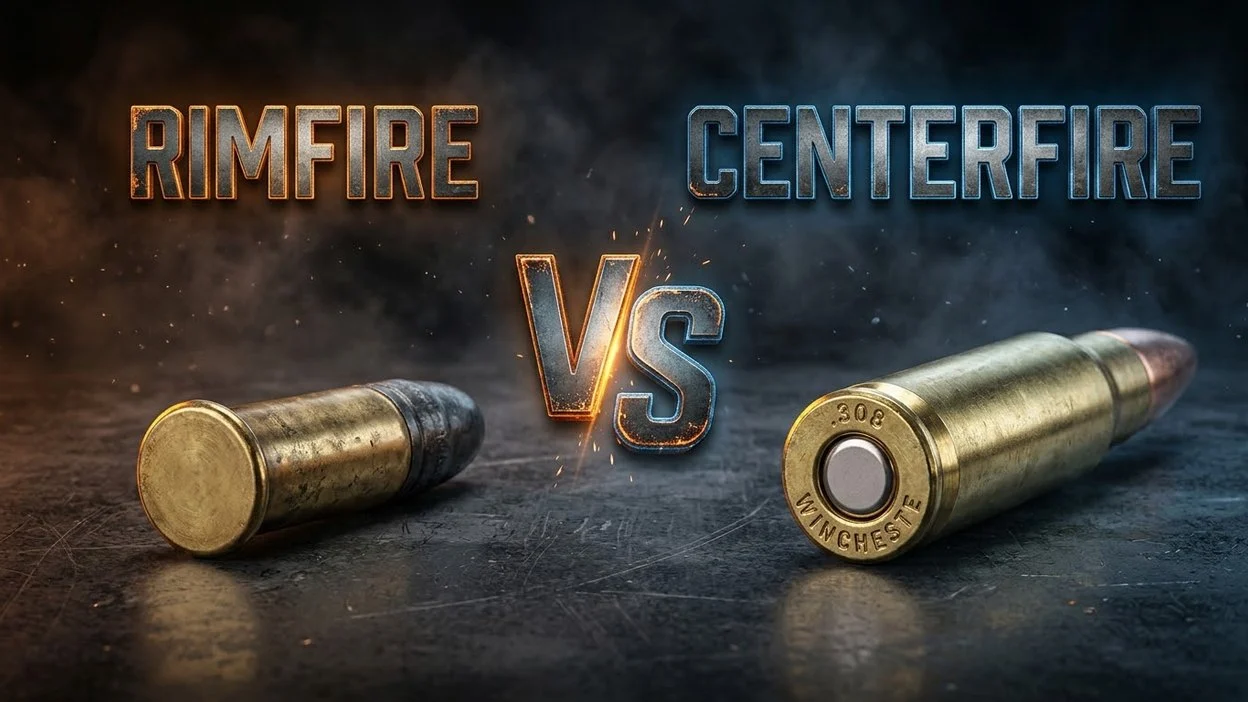
The terms rimfire vs centerfire describe two different types of firearm ammunition. Although both use a small amount of explosive material to ignite the powder inside a cartridge, they differ in how the ignition system works. Understanding this difference helps students, beginners, and general readers learn basic firearm terminology.
Rimfire and centerfire ammunition are commonly discussed in shooting sports, hunting, firearm education, and ammunition manufacturing. The main difference is the location of the primer, which is the component responsible for starting the ignition process. Rimfire cartridges have their priming compound inside the rim of the cartridge case, while centerfire cartridges have a separate primer in the center of the case head. This simple distinction affects how the ammunition is designed, manufactured, and used. In this guide, you will learn what rimfire and centerfire mean, how they compare, and how to remember the difference easily.
Quick Answer: Rimfire vs Centerfire
Rimfire and centerfire are two types of ammunition ignition systems. cartridges contain priming material inside the rim of the cartridge case, while centerfire cartridges have a separate primer in the center of the case head. Rimfire ammunition is commonly associated with .22 LR, while centerfire ammunition includes cartridges such as 9mm and .223 Remington.
Why Do People Confuse Rimfire and Centerfire?
People often confuse rimfire and centerfire because both terms describe ammunition that performs the same basic function.
Both types of cartridges contain:
- A cartridge case
- A primer or priming compound
- Propellant powder
- A projectile, commonly called a bullet
The difference is not the bullet’s shape or size. It is the location and design of the ignition system.
For example, .22 LR is a rimfire cartridge, while 9mm Luger is a centerfire cartridge. Both are ammunition, but their ignition systems are different.
The words can also be confusing because they share the word “fire.” However, the first part of each word tells you where the ignition system is located.
What Does Rimfire Mean?
The word rimfire refers to a cartridge in which the priming compound is distributed inside the hollow rim of the cartridge case.
When the cartridge is fired, the firearm’s firing mechanism strikes the rim. This action activates the priming compound and starts the ignition process.
What Is a Rimfire Cartridge?
A rimfire cartridge is a type of ammunition that uses its rim as part of the ignition system.
The cartridge case usually has a thin, hollow rim that contains the priming compound. Unlike centerfire ammunition, it does not have a separate primer located in the center of the case head.
The .22 Long Rifle (22 LR) is one of the most widely recognized examples of rimfire ammunition.
What Are the Main Features of Rimfire Ammunition?
- The priming compound is located inside the rim.
- The cartridge does not use a separate central primer.
- The rim is an important part of the ignition system.
- Rimfire ammunition is commonly used in recreational shooting and small-game hunting.
- Many popular rimfire cartridges are relatively small and lightweight.
Rimfire ammunition is particularly familiar to beginners because .22 LR is widely used in introductory shooting activities.
What Does Centerfire Mean?
The word centerfire refers to a cartridge that has a separate primer positioned in the center of the cartridge case head.
The primer is a small component that contains a sensitive priming compound. When activated by the firearm’s firing mechanism, it starts the ignition process.
Centerfire ammunition is widely used in modern handguns, rifles, and many other firearms.
What Is a Centerfire Cartridge?
A centerfire cartridge is ammunition that uses a centrally located primer.
The primer is usually fitted into a pocket in the cartridge case head. This design separates the primer from the main cartridge case and allows it to be manufactured as an individual component.
Examples include:
- 9mm Luger
- .45 ACP
- .223 Remington
- .308 Winchester
- .30-06 Springfield
Centerfire ammunition is available in many different sizes and designs, making it suitable for a broad range of sporting and professional applications.
What Are the Main Features of Centerfire Ammunition?
- The primer is located in the center of the case head.
- The primer is a separate component.
- The cartridge case has a dedicated primer pocket.
- Centerfire ammunition is available in many handgun and rifle calibers.
- Many centerfire cartridge designs can be reloaded, depending on the case and primer system.
The centerfire design is especially common in ammunition intended for a wide variety of firearm applications.
Rimfire vs Centerfire: Comparison Table
The following table explains the main differences between rimfire and centerfire ammunition.
| Feature | Rimfire | Centerfire |
| Primer location | Inside the rim | In the center of the case head |
| Primer design | Priming compound inside the rim | Separate central primer |
| Common example | .22 LR | 9mm Luger |
| Cartridge construction | Rim contains priming compound | Case has a primer pocket |
| Typical applications | Recreational shooting, small-game hunting | Sporting, hunting, and professional applications |
| Ammunition variety | More limited | Very wide |
| Reloading | Generally not practical | Often possible with suitable components |
| Manufacturing | Priming compound is integrated into the rim | Primer is installed separately |
| Common firearm types | Rimfire rifles and some handguns | Centerfire rifles and handguns |
The most important difference is the primer location. Other differences, such as cost, power, and availability, depend on the specific cartridge.
When Should You Use Rimfire or Centerfire?
The choice between rimfire and centerfire depends on the firearm, cartridge design, and intended activity.
When Is Rimfire Ammunition Commonly Used?
Rimfire ammunition is commonly used for:
- Recreational target shooting
- Beginner shooting education
- Small-game hunting where legally permitted
- Training activities
- Certain sporting competitions
The .22 LR cartridge is especially popular because it is widely available and is commonly used in lightweight firearms.
When Is Centerfire Ammunition Commonly Used?
Centerfire ammunition is commonly used for:
- Handgun shooting sports
- Rifle competitions
- Hunting, where legally permitted
- Professional applications
- Long-range shooting disciplines
The wide variety of centerfire cartridges allows them to serve many different purposes.
Important: Rimfire and centerfire cartridges are not interchangeable. Ammunition must match the firearm’s specified cartridge type and caliber.
12 Examples of Rimfire and Centerfire Ammunition
Here are common examples that help explain the difference.
| Cartridge | Type |
| .22 Long Rifle | Rimfire |
| .22 Short | Rimfire |
| .22 WMR | Rimfire |
| .17 HMR | Rimfire |
| .17 Mach 2 | Rimfire |
| 9mm Luger | Centerfire |
| .45 ACP | Centerfire |
| .40 S&W | Centerfire |
| .223 Remington | Centerfire |
| .308 Winchester | Centerfire |
| .30-06 Springfield | Centerfire |
| .38 Special | Centerfire |
These examples show that rimfire and centerfire are categories of ammunition design rather than individual cartridge sizes.
Common Mistakes About Rimfire vs Centerfire
Beginners sometimes make mistakes when learning these terms. Here are some common misunderstandings.
Mistake 1: Thinking Rimfire Means the Bullet Is Fired From the Rim
The term refers to the ignition system, not the projectile’s position.
The rim contains the priming compound, which starts the ignition process.
Mistake 2: Thinking Centerfire Means the Bullet Is in the Center
Centerfire describes the primer’s location.
The bullet is positioned at the front of the cartridge in both rimfire and centerfire ammunition.
Mistake 3: Assuming All Rimfire Ammunition Is Weak
Rimfire cartridges are often associated with smaller cartridges, but the term itself describes the ignition system.
Cartridge performance depends on the specific ammunition design.
Mistake 4: Assuming All Centerfire Ammunition Is Powerful
Centerfire ammunition comes in many different sizes and performance levels.
A small centerfire cartridge and a large centerfire cartridge can have very different characteristics.
Mistake 5: Believing Rimfire and Centerfire Are Interchangeable
They are different cartridge designs.
A firearm is designed for a particular cartridge specification. Using the wrong ammunition can cause serious injury or firearm damage.
Memory Trick: How to Remember Rimfire vs Centerfire
A simple memory trick makes the difference easy to remember.
Rimfire = Rim
Think of the word “rim” as the outer edge of a circle.
The priming compound is located inside the cartridge’s rim.
Centerfire = Center
Think of the word “center” as the middle of a circle.
The primer is located in the center of the cartridge case head.
Remember this simple rule:
- Rimfire: Primer material is in the rim.
- Centerfire: Separate primer is in the center.
This trick works well for students and beginners learning ammunition terminology.
American vs British English: Rimfire and Centerfire
The terms rimfire and centerfire are primarily used in American English firearm terminology.
In British English, the terms are also understood, particularly in technical discussions about ammunition.
There is no major difference in meaning between American and British English.
| Term | American English | British English |
| Rimfire | Common technical term | Also used |
| Centerfire | Common technical term | Also used |
| Centre-fire | Less common spelling | Alternative British spelling |
The British spelling “centre” may appear in some technical writing, but “centerfire” is widely recognized internationally.
Similar Words Related to Rimfire and Centerfire
Understanding related terms can make the subject easier to learn.
Cartridge
A cartridge is a complete unit of ammunition that contains the case, primer, propellant, and projectile.
Primer
A primer is the component that initiates the ignition process in a cartridge.
Bullet
A bullet is the projectile that travels out of the firearm when the cartridge is fired.
Case
The case is the container that holds the cartridge’s components.
Caliber
Caliber generally refers to the approximate internal diameter of a firearm’s barrel or the nominal diameter associated with a cartridge.
Ammunition
Ammunition is the general term for cartridges or other materials designed to be fired from a firearm.
These terms are related, but they do not mean the same thing.
Final Verdict: Rimfire vs Centerfire
The difference between rimfire and centerfire is simple once you understand the primer location.
Rimfire ammunition contains priming compound inside the rim of the cartridge case. Centerfire ammunition uses a separate primer positioned in the center of the case head.
Both designs are used in modern ammunition, but they differ in construction, manufacturing, and typical applications.
For beginners, the easiest way to remember the difference is to focus on the words “rim” and “center.
FAQs:
1. What is the main difference between rimfire and centerfire?
The main difference is the primer location. Rimfire ammunition contains priming compound inside the rim, while centerfire ammunition has a separate primer in the center of the cartridge case head.
2. Is .22 LR rimfire or centerfire?
.22 Long Rifle, commonly called .22 LR, is rimfire ammunition. Its priming compound is located inside the rim of the cartridge case.
3. Is 9mm rimfire or centerfire?
9mm Luger is centerfire ammunition. It uses a separate primer positioned in the center of the cartridge case head.
4. Can rimfire and centerfire ammunition be used in the same firearm?
No. Rimfire and centerfire ammunition have different ignition systems. A firearm must use the cartridge type specified by its manufacturer.
5. Why is rimfire ammunition often used by beginners?
Rimfire ammunition, especially .22 LR, is commonly used in beginner training and recreational shooting because it is widely available and is often used in lightweight firearms.
6. Can centerfire ammunition be reloaded?
Many centerfire cartridges can be reloaded using suitable equipment and components. However, not all cases or primer designs are suitable for reloading.
7. Is centerfire ammunition more powerful than rimfire ammunition?
Not necessarily. Centerfire cartridges include a wide range of sizes and performance levels. The ignition system alone does not determine a cartridge’s power.
8. Which is more common: rimfire or centerfire?
Both are common. Rimfire ammunition is especially associated with .22 LR, while centerfire ammunition is widely used in handguns and rifles across many different applications.
Remember This
- Rimfire = priming compound inside the rim.
- Centerfire = separate primer in the center.
- .22 LR = rimfire.
- 9mm Luger = centerfire.
- The primer location determines the cartridge type.
The words describe how ammunition is designed, not the bullet’s position or the firearm’s overall power.
Conclusion:
Rimfire and centerfire are two important terms in firearm and ammunition education. Although both types of ammunition use an ignition system to start the firing process, they differ in how the primer is positioned. Rimfire cartridges contain priming compound inside the rim, while centerfire cartridges use a separate primer in the center of the case head. Learning this difference makes ammunition terminology easier to understand.
For students, ESL learners, and beginners, the best approach is to remember the meaning of each word and connect it with a familiar example. The .22 LR is a common rimfire cartridge, while 9mm Luger is a common centerfire cartridge. Once you understand these examples, recognizing the difference between rimfire and centerfire becomes much easier.

Willow Evans writes uplifting fantasy stories filled with magical worlds, courageous heroes, and meaningful life lessons. Her imaginative books encourage creativity, kindness, and hope in readers of all ages.