If you have ever paused while writing a sentence such as “Are you alright?” or “Is everything all right?”, you are not alone. Alright vs all right is one of those English language questions that can make even confident writers hesitate. Both forms are widely encountered, and both can communicate the idea of being okay, satisfactory, or acceptable. However, their history, grammatical status, and level of acceptance are not exactly the same. Understanding the distinction can help you choose the form that fits your audience and writing situation.
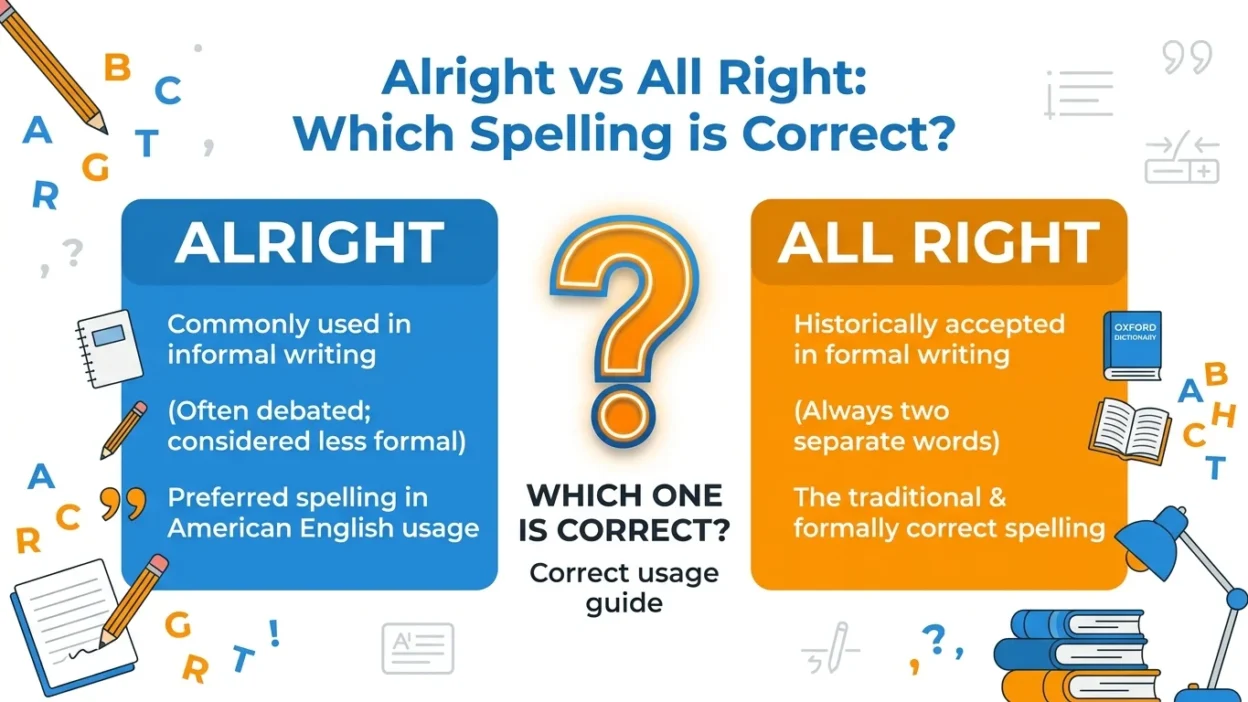
The main issue is that all right is the traditional and widely accepted standard form, while alright is a newer one word variant that is common in informal writing and everyday communication. Many style guides and editors still prefer all right, especially in formal or academic writing. In this guide, we will examine the difference between alright and all right, explain when to use each, and give practical examples you can use with confidence.
Quick Answer
All right is the traditional and safest form, especially in formal writing. Alright is also widely used and understood, particularly in informal English, but some editors and style guides still consider it less standard. When in doubt, choose all right.
Why People Confuse It
The confusion comes from the fact that alright and all right usually have the same meaning.
Both can describe:
- Something that is satisfactory: “The movie was all right.”
- Someone who is okay: “She is alright.”
- Agreement or acceptance: “All right, let’s go.”
- A situation without problems: “Everything is alright.”
The difference is primarily about standard usage, style, and formality, rather than meaning.
The two word form all right has a much longer history in standard English. The one word spelling alright developed later and became especially common in informal communication.
That means you may see both forms in books, websites, messages, advertisements, and everyday conversations.
First Word: Alright
Alright is a one word spelling that functions as an adjective, adverb, or interjection depending on the sentence.
It generally means:
- okay
- satisfactory
- acceptable
- safe or well
- yes or agreed
Examples
- “Are you alright?”
- “The food was alright, but nothing special.”
- “Alright, let’s begin.”
- “Everything will be alright.”
- “I think he’s alright now.”
Is “alright” grammatically correct?
This question has a slightly complicated answer.
Alright is widely used and understood in modern English, particularly in informal contexts. However, some traditional grammar authorities and professional style guides continue to prefer all right.
So, if you are writing an academic essay, formal report, professional document, or application, all right is usually the safer choice.
In casual writing, texting, dialogue, and informal online communication, alright is generally accepted by many readers.
Second Word: All Right
All right is the traditional two word form and remains the safest choice in edited English.
It can mean:
- satisfactory
- acceptable
- unharmed
- correct
- satisfactory in quality
- agreement or acceptance
Examples
- “Are you all right?”
- “Everything is all right.”
- “The plan sounds all right to me.”
- “All right, let’s get started.”
- “She was all right after the accident.”
Because all right is accepted across formal and informal contexts, it is an excellent default choice.
If you are unsure whether your audience accepts alright, simply use all right.
Comparison Table
| Feature | Alright | All Right |
| Spelling | One word | Two words |
| Meaning | Okay, satisfactory, well | Okay, satisfactory, well |
| Traditional standard | Less traditional | Traditional |
| Formal writing | Sometimes discouraged | Preferred |
| Informal writing | Very common | Also common |
| Everyday speech | Common | Common |
| Academic writing | Better avoided by some style guides | Recommended |
| Meaning difference | Usually none | Usually none |
| Safest overall choice | Depends on context | Yes |
When to Use Each
Use “all right” when:
- You are writing an academic paper.
- You are preparing a formal report.
- You are writing professionally.
- You want the most universally accepted form.
- You are unsure which spelling your audience prefers.
Example:
“The revised proposal is all right for submission.”
Use “alright” when:
- You are writing informal dialogue.
- You are texting or messaging.
- You are writing casual online content.
- You want a conversational tone.
- You are intentionally reflecting modern informal usage.
Example:
“Alright, I’ll meet you at eight.”
A useful rule
If you want to eliminate the debate completely, choose all right.
It is understood everywhere and remains fully acceptable in both formal and informal English.
Examples
Here are practical examples showing how both forms are used.
- Are you all right?
- Are you alright?
- Everything will be all right.
- Everything will be alright.
- All right, let’s move on.
- Alright, let’s move on.
- The movie was all right.
- The movie was alright.
- She looked all right after resting.
- She looked alright after resting.
- Is it all right if I leave early?
- Is it alright if I leave early?
- The meal was all right, but the dessert was excellent.
- Alright, I understand your point.
Notice that in most of these examples, changing all right to alright does not significantly change the meaning. The important difference is the level of acceptance associated with the spelling.
Common Mistakes
1. Assuming “alright” is always wrong
This is an outdated oversimplification.
Alright is widely used in contemporary English. Although some formal style guides prefer all right, calling alright universally incorrect does not accurately describe modern usage.
2. Assuming both forms are equally appropriate everywhere
They are not necessarily equal in every context.
For formal writing, all right is the safer option.
3. Using “alright” in formal academic writing
If your professor, employer, publisher, or style guide expects traditional standard English, all right is the better choice.
4. Thinking “all right” always means “all correct”
Not necessarily.
Depending on context, all right can mean:
- okay
- satisfactory
- safe
- acceptable
- agreed
For example:
“Are you all right?”
Here, it means “Are you okay?” rather than “Are all your answers correct?”
Memory Trick
Think:
ALL RIGHT = the traditional two word choice.
If you want the form that is least likely to be questioned by an editor, remember:
When in doubt, write it all right.
The phrase all right is the safer choice because it works comfortably in formal and informal contexts.
American vs British English
Both alright and all right appear in American and British English, so this is not simply a case of “American versus British spelling.”
The important distinction is register and editorial preference.
In both varieties of English, all right remains the traditional standard form. Alright is also common, particularly in informal contexts and contemporary writing.
British English may sometimes use alright quite naturally in casual writing and dialogue, while American English speakers also encounter and use it frequently. Nevertheless, writers in either variety who want a conservative, formal choice should use all right.
Similar Words
Several expressions are related to alright and all right, but they are not interchangeable in every sentence.
Okay / OK
These are extremely common alternatives.
“Are you okay?”
Fine
“Fine” can mean satisfactory or well.
“I’m fine, thanks.”
Acceptable
This is more formal.
“The proposed solution is acceptable.”
Good
“Good” is broader and often stronger than “all right.”
“The movie was good.”
Well
“Well” often describes someone’s condition.
“I hope you’re well.”
Choosing among these words depends on the exact meaning and tone you want.
FAQs
1. Is “alright” or “all right” correct?
All right is the traditional and safest standard form. Alright is widely used in modern informal English but may be rejected by some formal style guides.
2. Is “alright” grammatically incorrect?
Not universally. Alright is established in contemporary usage and is widely understood, although some editors and style guides still prefer the traditional all right.
3. Is “all right” more formal than “alright”?
Generally, yes. All right is the better choice for academic, professional, and formal writing because it has broader traditional acceptance.
4. Can I use “alright” in an essay?
You can encounter it in published writing, but all right is usually the safer choice for an academic essay unless your instructor or style guide says otherwise.
5. Is “Are you alright?” correct?
Yes, it is widely used and understood. However, “Are you all right?” is the more traditionally standard version.
6. Does “alright” have a different meaning from “all right”?
Usually, no. Both generally mean okay, satisfactory, safe, or acceptable. The main distinction concerns spelling, convention, and formality.
7. Should I always write “all right”?
If you want the safest option, yes. All right is appropriate in both formal and informal writing, so it is a reliable default.
Final Verdict
The simplest answer to “alright vs all right” is this: all right is the safest and most traditionally accepted form, while alright is a widely used modern variant, especially in informal English.
If you are writing a formal email, academic paper, business document, or professional article, choose all right. If you are writing dialogue, a text message, or casual online content, alright can sound perfectly natural.
Remember This
All right = safest choice everywhere.
Alright = common modern variant, especially in informal English.
When you are unsure, use all right. You will rarely go wrong with the traditional two word spelling.
Conclusion
The debate over alright vs all right is less about meaning and more about convention. Both forms communicate the idea of being okay, acceptable, or satisfactory, and both appear in modern English. However, all right has the advantage of being traditionally accepted across virtually every writing context.
For everyday conversation and informal communication, you will frequently see alright, and readers generally understand it without difficulty. For formal or carefully edited writing, however, all right remains the strongest choice. Remember that English evolves, but when clarity and broad acceptance matter most, the two word all right is your safest option.

Adam Aaron writes engaging mystery and adventure novels featuring intelligent characters, unexpected twists, and emotional storytelling. His creative imagination and compelling narratives have earned admiration from readers across generations.