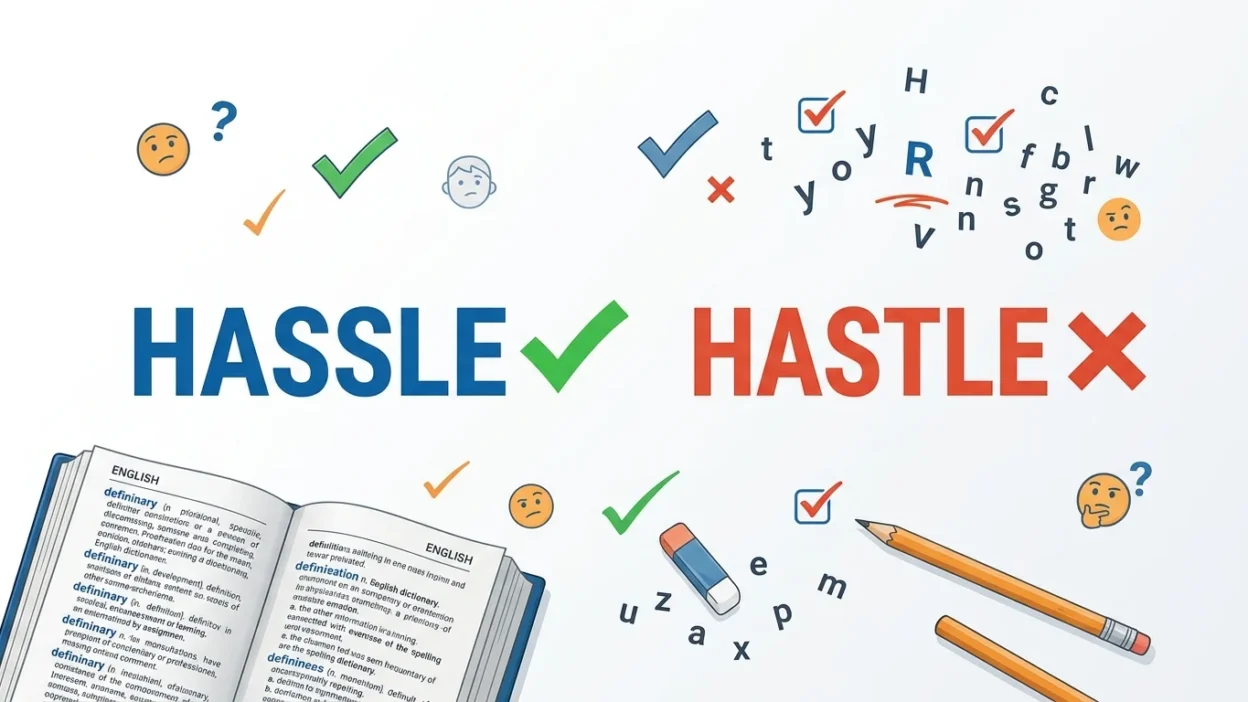
If you have ever written “hastle” instead of “hassle,” you are not alone. These two spellings look almost identical, and the difference is easy to miss when typing quickly. However, there is an important distinction: hassle is the standard English word, while hastle is generally a misspelling. The confusion usually happens because the pronunciation of hassle can make the spelling less obvious, especially for English learners.
In everyday English, hassle can be used as both a noun and a verb. It refers to an annoying difficulty, inconvenience, or situation that causes unnecessary trouble. You can also hassle someone, meaning to bother, pressure, or repeatedly annoy them. Learning the correct spelling will help you write more accurately in emails, school assignments, professional communication, and casual messages. In this guide, we will explain hassle vs hastle, their meanings, examples, common mistakes, and an easy memory trick.
Quick Answer
Hassle is the correct standard English spelling. Hastle is generally incorrect and should not be used in formal or standard writing. Hassle means an annoying problem, inconvenience, or unnecessary trouble. It can also mean to bother or pressure someone.
Why People Confuse It
The confusion between hassle and hastle mainly comes from their similar appearance.
Both spellings seem plausible because English contains many words ending in -stle, such as castle and whistle. This can make hastle look like a reasonable spelling at first glance.
Another reason is pronunciation. In hassle, the ss is pronounced like /s/, so there is no obvious sound that reminds you to write two s letters.
Common examples of the confusion include:
- “What a hastle!” ❌
- “What a hassle!” ✅
- “I don’t want the hastle.” ❌
- “I don’t want the hassle.” ✅
The key point is simple: hassle is the spelling to remember.
First Word: Hassle
Hassle is the correct word.
It can function as both a noun and a verb.
Hassle as a noun
As a noun, hassle means an annoying difficulty, inconvenience, or troublesome situation.
Examples:
- The paperwork was such a hassle.
- Traveling with three children can be a hassle.
- I don’t need the hassle of changing flights.
- Parking downtown is always a hassle.
In these sentences, hassle describes something that creates inconvenience or frustration.
Hassle as a verb
As a verb, hassle means to annoy, bother, pressure, or repeatedly trouble someone.
Examples:
- The salesperson kept hassling me.
- Don’t hassle your brother while he is studying.
- Customers were hassled by aggressive vendors.
So, depending on context, hassle can mean either an inconvenience or to bother someone.
Second Word: Hastle
Hastle is generally a misspelling of hassle in standard English.
It is not the spelling you should use when you mean an annoying problem, inconvenience, or act of bothering someone.
For example:
- “The delay was a huge hastle.” ❌
- “The delay was a huge hassle.” ✅
If you are writing an essay, email, report, application, article, or other formal text, use hassle.
What about “hastle”?
You may occasionally encounter hastle online, particularly in user generated content. Seeing it in informal writing does not make it the standard spelling.
For ordinary English usage, remember:
hassle = correct
hastle = misspelling
Comparison Table
| Feature | Hassle | Hastle |
| Standard spelling | ✅ Yes | ❌ No |
| Meaning | Annoying difficulty or inconvenience; to bother someone | Generally none in standard English |
| Part of speech | Noun and verb | Not normally used |
| Formal writing | Appropriate | Avoid |
| Example | “Moving house is a hassle.” | “Moving house is a hastle.” ❌ |
| Correct choice | ✅ Use this | ❌ Avoid this |
When to Use Each
In standard English, there is really only one choice when you mean trouble or inconvenience: hassle.
Use “hassle” when:
- Something is inconvenient.
- A task causes unnecessary trouble.
- A situation is annoying or difficult.
- Someone is bothering or pressuring another person.
Examples:
Getting a refund was a hassle.
Stop hassling me about the deadline.
Avoid “hastle” when:
You are trying to write the standard English word hassle. Replace it with hassle instead.
A useful editing habit is to search your document for hastle before submitting it. If you find it, it is almost certainly supposed to be hassle.
Examples
Here are more examples showing how hassle works naturally in everyday English.
- Getting a visa can be a hassle.
- I don’t want the hassle of returning the product.
- Finding parking in the city is such a hassle.
- The broken printer has been a real hassle.
- Moving to a new apartment was more of a hassle than I expected.
- She hates the hassle of dealing with paperwork.
- Don’t hassle me while I’m working.
- The customer complained that the staff had hassled him.
- Online shopping saves me the hassle of visiting several stores.
- It was a hassle to arrange transportation at the last minute.
- We decided to stay home to avoid the hassle of traveling.
- He kept hassling his friend for an answer.
- The new system should reduce the hassle for customers.
- Why go through all that hassle when there is an easier option?
Notice that hassle can describe either the problem itself or the action of bothering someone.
Common Mistakes
1. Writing “hastle” instead of “hassle”
This is the most common mistake.
❌ The whole process was a hastle.
✅ The whole process was a hassle.
2. Assuming the spelling follows the pronunciation
English spelling is not always predictable from pronunciation. The sound of hassle does not clearly indicate that it contains ss.
3. Treating “hastle” as an alternative spelling
Unlike some words with accepted spelling variants, hastle is not a standard alternative spelling of hassle.
4. Confusing “hassle” with “hustle”
Hassle and hustle are different words.
- Hassle = trouble, inconvenience, or bother
- Hustle = energetic activity, movement, or effort; it can also mean to push or hurry someone
For example:
Getting the documents was a hassle.
We had to hustle to catch the bus.
Memory Trick
Here is a simple way to remember the correct spelling:
HASSLE has SS because it causes Stress.
Think:
HASSLE → SS → Stress
When something causes you unnecessary stress, it can be a hassle.
Another quick reminder:
A hassle is annoying, so don’t let the spelling hassle you.
If you remember the double S, you are much less likely to write hastle by mistake.
American vs British English
There is no major American versus British spelling difference between hassle and hastle.
Both American English and British English use hassle as the standard spelling.
For example, speakers on both sides of the Atlantic can naturally say:
- “It’s such a hassle.”
- “I don’t want the hassle.”
- “Stop hassling me.”
The word is widely understood in both varieties of English.
So, whether you are writing for an American, British, Australian, Canadian, or international audience, hassle is the safe standard spelling.
Similar Words
Several words are related to hassle but have different meanings.
Trouble
Trouble is a broad word for difficulty or problems.
We had trouble finding the address.
Inconvenience
Inconvenience emphasizes something that causes difficulty or disruption.
The delay was an inconvenience.
Nuisance
A nuisance is something or someone that is annoying or troublesome.
The constant noise was a nuisance.
Annoy
Annoy means to irritate or bother someone.
The constant questions annoyed me.
Bother
Bother can mean to annoy someone or cause inconvenience.
Don’t bother me while I’m studying.
Hassle
Hassle is especially useful for describing unnecessary difficulty, inconvenience, or annoying effort.
Dealing with all that paperwork was a hassle.
FAQs
Is “hastle” a correct English word?
Generally, no. If you mean an annoying problem, inconvenience, or act of bothering someone, the correct standard spelling is hassle.
Is it “hassle” or “hastle”?
It is hassle. The spelling hastle is generally a misspelling.
What does “hassle” mean?
As a noun, hassle means an annoying difficulty, inconvenience, or troublesome situation. As a verb, it can mean to bother, annoy, or pressure someone.
Is “hassle” formal or informal?
Hassle is common in everyday English and is somewhat conversational. It is widely understood and can appear in many types of writing, although more formal contexts may sometimes use alternatives such as inconvenience or difficulty.
What is the difference between “hassle” and “hustle”?
Hassle means trouble, inconvenience, or bother. Hustle generally refers to energetic activity, hurried movement, or effort. They are separate words with different meanings.
How do you pronounce “hassle”?
Hassle is commonly pronounced approximately HASS-uhl, with the first syllable stressed.
What is the plural of “hassle”?
The plural is hassles.
For example:
Traveling often involves unexpected hassles.
Final Verdict
The correct spelling is hassle.
If you mean an annoying problem, inconvenience, or troublesome situation, write hassle, not hastle. If you mean bothering or pressuring someone, the verb hassle is also correct.
Hastle may appear because of spelling mistakes, but it should not be treated as the standard spelling. When in doubt, remember the double S in hassle.
Remember This
Hassle = correct ✅
Hastle = misspelling ❌
Think HASSLE → SS → Stress. If something causes unnecessary stress, it may be a hassle.
Conclusion
Understanding hassle vs hastle is straightforward once you know that only hassle is the standard spelling for this meaning. Whether you are describing an inconvenient task, an annoying situation, or someone bothering another person, hassle is the word you want.
The easiest way to avoid this spelling mistake is to remember the double S: hassle. Once that spelling becomes familiar, you will be able to recognize and correct hastle quickly in your writing.

Willow Evans writes uplifting fantasy stories filled with magical worlds, courageous heroes, and meaningful life lessons. Her imaginative books encourage creativity, kindness, and hope in readers of all ages.