Many English learners get confused about swept vs sweeped because both words seem like they should work. English has many verbs that simply add -ed to make the past tense, so it is natural to think that sweeped follows the same pattern. However, English also has many irregular verbs, and sweep is one of them.
If you have ever wondered whether you should write I swept the floor or I sweeped the floor, you are not alone. This guide explains the difference in simple English with clear examples, an easy comparison table, and practical tips. By the end, you will know which word is correct, when to use it, and how to avoid this common grammar mistake in everyday writing and speaking.
Quick Answer
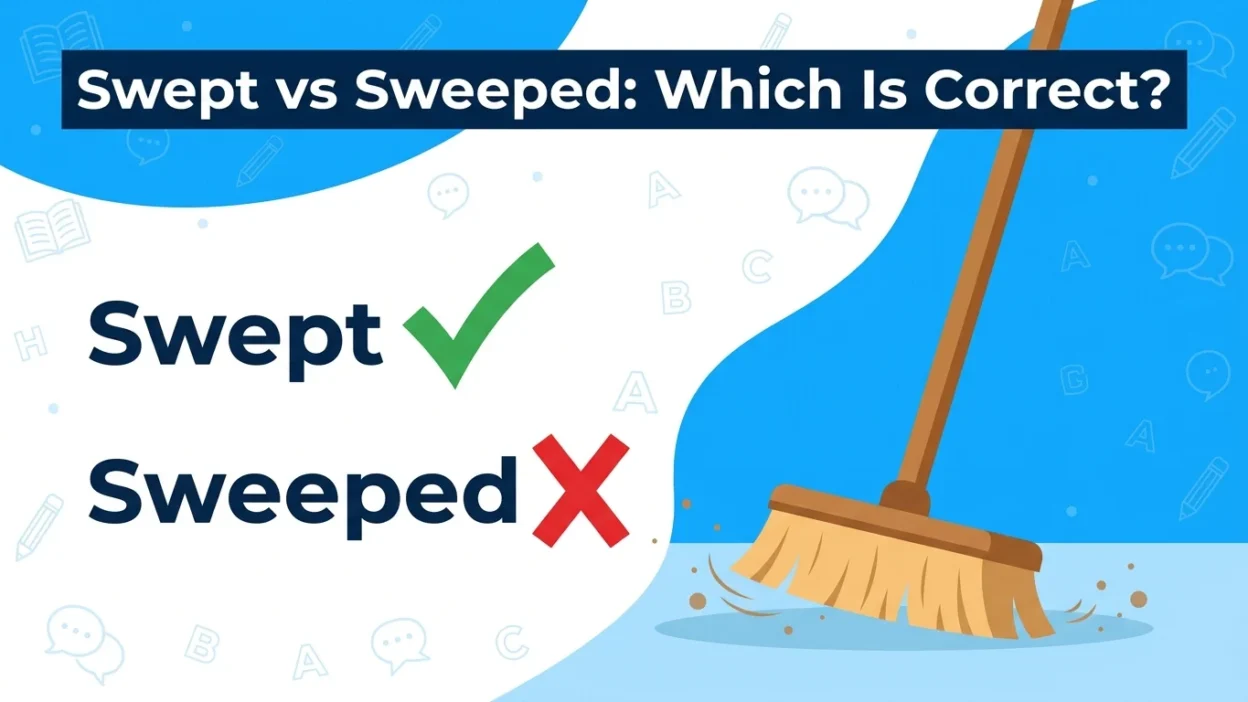
Swept is the correct past tense and past participle of sweep. Sweeped is not considered correct in standard English. Whenever you talk about cleaning or moving something with a sweeping action in the past, use swept.
Why People Confuse It
Many English verbs form the past tense by adding -ed.
For example:
- Walk → Walked
- Jump → Jumped
- Clean → Cleaned
Because of this pattern, some learners think:
- Sweep → Sweeped ❌
However, sweep is an irregular verb, so it changes differently:
- Sweep → Swept ✅
This is the same pattern as several other irregular English verbs.
Swept
Swept is the correct past tense and past participle of sweep.
It is used when talking about something that already happened.
Meaning:
- Cleaned a surface with a broom
- Moved something away with a sweeping motion
- Won completely in sports or competitions
- Moved quickly across an area
Examples
- She swept the kitchen before dinner.
- The wind swept the leaves across the yard.
- Our team swept the series.
- He swept the dust into a pile.
Sweeped
Sweeped is not a correct word in standard English.
Although it may sound logical because many verbs end with -ed, native speakers and grammar guides use swept instead.
Incorrect examples
- I sweeped the floor yesterday. ❌
- She sweeped the porch. ❌
Correct versions
- I swept the floor yesterday. ✅
- She swept the porch. ✅
Comparison Table
| Feature | Swept | Sweeped |
| Correct English | ✅ Yes | ❌ No |
| Past tense of sweep | ✅ Yes | ❌ No |
| Past participle | ✅ Yes | ❌ No |
| Used by native speakers | ✅ Yes | ❌ No |
| Suitable for writing and speaking | ✅ Yes | ❌ No |
When to Use Each
Use swept when:
- Talking about cleaning in the past
- Describing something moved away
- Writing school assignments
- Sending emails
- Writing stories
- Speaking in everyday conversations
- Referring to complete victories in sports
Do not use sweeped
It is considered a grammar mistake in standard English.
Examples
Here are everyday examples using swept correctly.
- I swept the floor this morning.
- She swept the classroom after school.
- The wind swept across the beach.
- He swept the dirt outside.
- We swept the garage before guests arrived.
- They swept the hallway together.
- The team swept all three games.
- Heavy rain swept through the city.
- She swept the broken glass into a dustpan.
- The cleaner swept every room carefully.
- A smile swept across his face.
- The storm swept trees onto the road.
Common Mistakes
People often make these mistakes:
❌ I sweeped the floor.
✅ I swept the floor.
❌ She has sweeped the room.
✅ She has swept the room.
❌ They sweeped the porch yesterday.
✅ They swept the porch yesterday.
Memory Trick
Remember this simple sentence:
Sweep becomes swept, not sweeped.
Think of these similar irregular verbs:
- Keep → Kept
- Sleep → Slept
- Sweep → Swept
The ending changes to -pt, not -ed.
American vs British English
There is no difference between American and British English for this verb.
Both varieties use:
- Sweep → Swept
Neither uses sweeped in standard English.
Similar Words
Here are other irregular verbs that learners often confuse.
| Base Verb | Correct Past Tense |
| Sweep | Swept |
| Keep | Kept |
| Sleep | Slept |
| Leave | Left |
| Meet | Met |
| Feel | Felt |
| Build | Built |
| Teach | Taught |
Learning these together makes them easier to remember.
Final Verdict
If you are choosing between swept vs sweeped, the answer is simple.
Use swept every time.
Sweeped is not accepted in standard English and should be avoided in speaking, writing, exams, emails, and professional communication.
Frequently Asked Questions
Is swept or sweeped correct?
Swept is correct. Sweeped is incorrect in standard English.
Why isn’t sweeped a real word?
Because sweep is an irregular verb, its past tense changes to swept instead of adding -ed.
Is swept the past participle too?
Yes. Swept is both the past tense and the past participle of sweep.
Can I use sweeped in casual conversation?
No. Native speakers use swept, even in informal conversations.
Is there any difference between American and British English?
No. Both use swept.
How can I remember the correct form?
Think of this pattern:
- Keep → Kept
- Sleep → Slept
- Sweep → Swept
Is “has swept” correct?
Yes. For example:
- She has swept the floor.
Conclusion
The confusion between swept and sweeped comes from the fact that many English verbs simply add -ed to form the past tense. However, sweep is an irregular verb, so it follows a different rule. The correct form is swept, and it is used in both American and British English.
Whenever you write or speak about cleaning, moving something with a broom, or describing a sweeping action that happened in the past, choose swept. Remembering this one irregular verb will help you sound more natural and avoid a common grammar mistake.
Remember This
Sweep → Swept ✅
Never use “sweeped” in standard English.

Nova Turner specializes in imaginative science fiction blending futuristic technology, thrilling adventures, and powerful human emotions. Her innovative storytelling inspires curiosity, creativity, and exploration among readers of every age.