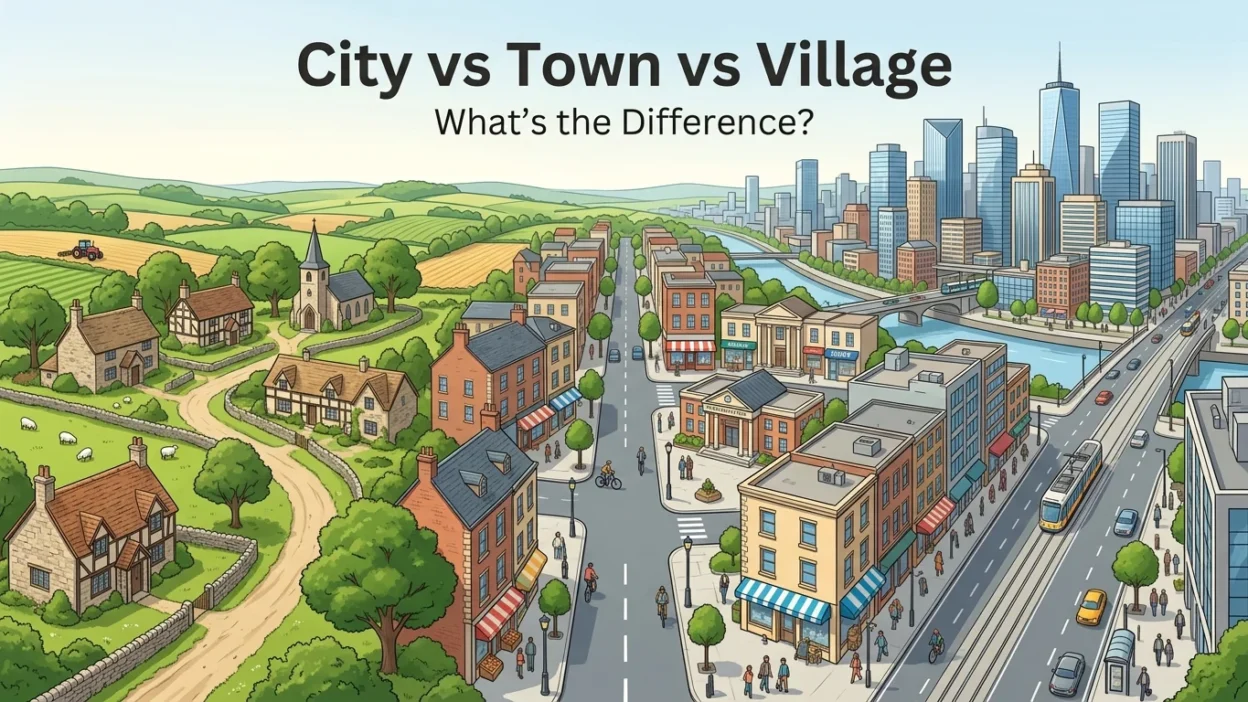
Have you ever wondered whether a place should be called a city, town, or village? These three words all describe human settlements, but they are not interchangeable. The main difference usually relates to size, population, services, infrastructure, and legal or administrative status. A city is generally larger and more developed, while a village is usually smaller and has fewer facilities. A town sits somewhere between the two.
However, the distinction is not always as simple as population size. Different countries—and sometimes different regions within the same country—use these terms according to different legal definitions and local traditions. A place that is officially a town in one country might be considered a city elsewhere. Understanding these differences will help you choose the right word when speaking or writing about places, settlements, communities, and urban areas.
Quick Answer
A city is generally a large, densely populated settlement with extensive services and infrastructure. A town is usually smaller and less urbanized, while a village is typically a small settlement with fewer residents and services. Exact definitions vary by country and official status.
Why People Confuse It
People often confuse city, town, and village because there is no single worldwide population limit that determines which term must be used.
For example, one country may officially designate a settlement as a city because of its administrative importance, even if another place with a larger population is officially classified as a town.
The words can also overlap in everyday conversation. People may use them based on:
- Population
- Physical size
- Number of buildings
- Available services
- Economic importance
- Historical status
- Government classification
- Local usage
So, while there is a useful general distinction, official definitions depend on the country or region.
First Word: City
A city is generally a large and highly developed human settlement.
Cities tend to have a high population density and a wide range of public and private services. They commonly contain:
- Hospitals and specialist medical centers
- Universities and colleges
- Major shopping areas
- Public transportation
- Government offices
- Large businesses
- Industrial or commercial districts
- Cultural and entertainment venues
For example:
Karachi is a major city in Pakistan.
Here, city tells us that Karachi is a large, important urban settlement.
The word can also be used more broadly in expressions such as city life, city center, city government, and city population.
Second Word: Town
A town is generally a settlement that is smaller than a city but larger or more developed than a village.
Towns often have many everyday facilities, such as schools, shops, banks, restaurants, markets, clinics, and local government offices.
For example:
We moved to a small town near the coast.
A town may feel less crowded than a major city while still providing most basic services.
The boundary between a town and a city can be difficult to define because official classifications vary considerably.
Third Word: Village
Although not listed among the required headings, the third term is essential to understanding the comparison.
A village is generally a small settlement, often with a relatively small population and fewer services than a town or city.
Villages are frequently associated with rural areas, agriculture, traditional communities, or countryside living. However, not every village is agricultural, and some villages can be surprisingly large.
For example:
My grandparents live in a quiet village surrounded by farmland.
The word village often creates an image of a smaller, more closely connected community, although its exact meaning depends on local usage.
Comparison Table
| Feature | City | Town | Village |
| Typical size | Large | Medium | Small |
| Population | Usually high | Usually moderate | Usually low |
| Density | Often high | Moderate | Usually lower |
| Services | Extensive | Many basic and local services | Fewer services |
| Infrastructure | Highly developed | Moderately developed | Usually simpler |
| Common setting | Urban | Urban or semi urban | Often rural |
| Examples of facilities | Universities, major hospitals, airports | Schools, markets, banks, clinics | Local shops, schools, small services |
| General impression | Major urban center | Smaller community | Small settlement |
Important: This table describes common usage, not a universal legal rule. A country’s official classification may differ.
When to Use Each
Use “city” when:
- You are talking about a large urban center.
- The place has extensive infrastructure and services.
- The settlement is officially recognized as a city.
- You are discussing major urban life or administration.
Example:
She works in the city but lives outside the urban center.
Use “town” when:
- The settlement is smaller than a major city.
- It has a developed local commercial or administrative center.
- You want to describe a medium sized community.
- The place is officially called a town.
Example:
The town has a busy market and several schools.
Use “village” when:
- The settlement is relatively small.
- It is commonly associated with a rural or countryside setting.
- It has fewer facilities than a town.
- The place is officially or traditionally known as a village.
Example:
The village is surrounded by green fields.
Examples
Here are practical examples showing how these words work in everyday English:
- London is a major city with millions of residents.
- They moved from the city to a quiet town.
- My uncle owns a shop in a small village.
- The town has a large market every Saturday.
- The village has only a few hundred residents.
- Many young people leave the village to study in the city.
- We spent three days exploring the historic city.
- There is a hospital in the nearby town.
- The village school serves children from several nearby communities.
- City traffic can be much heavier than traffic in a village.
- She prefers town life because it is quieter than city life.
- The small village is surrounded by mountains.
- The town has grown rapidly over the past decade.
- He travels from his village to the city for work.
These examples also show that the words can describe differences in lifestyle, transportation, employment, population, and access to services.
Common Mistakes
1. Assuming population alone decides everything
A larger population does not automatically make a place a city. Legal and administrative definitions matter too.
2. Treating “town” and “village” as exact synonyms
They can both describe settlements, but a village is generally smaller and less developed than a town.
3. Assuming every village is agricultural
A village may be rural, but farming is not a requirement for using the word.
4. Assuming every city is enormous
Some places officially classified as cities may be relatively small compared with famous global cities.
5. Thinking the definitions are identical worldwide
They are not. The classification system used in the United Kingdom, United States, Pakistan, and other countries can differ.
6. Using “city” simply because a place has many buildings
Physical development is one factor, but official status, history, population, and administrative importance can also influence classification.
Memory Trick
Think of the three words as a simple size and development ladder:
Village → Town → City
Remember:
- Village = small settlement
- Town = middle sized settlement
- City = large urban settlement
A quick memory sentence is:
“Village is small, town is in the middle, city is bigger.”
This is a useful general rule, even though official classifications can vary.
American vs British English
The basic meanings of city, town, and village are broadly understood in both American and British English.
However, the official classification of settlements can differ.
In British English, the word city can have a specific formal status. A settlement does not necessarily become a city simply because it has a large population. Historical and official recognition can matter.
In American English, city, town, and other terms such as village may be used according to state or local government systems. The legal meaning can therefore vary from one location to another.
So, when discussing a particular place, it is safest to use the settlement’s official designation when accuracy matters.
Similar Words
Several other words are related to city, town, and village.
Settlement
Settlement is a broad term for a place where people live. It can include cities, towns, villages, and smaller communities.
The area contains several historic settlements.
Community
Community focuses more on the people living in an area than on the physical size or legal classification of the place.
The local community organized a festival.
Municipality
A municipality is an administrative area governed by a local authority. It is more formal and does not simply mean “city” or “town.”
Suburb
A suburb is generally a residential area located near or within the influence of a larger city.
They bought a house in a suburb outside the city center.
Hamlet
A hamlet usually refers to a very small settlement, often smaller than a village.
The historic hamlet has only a handful of houses.
Metropolis
A metropolis is a very large and important city or urban area.
Tokyo is one of the world’s major metropolises.
FAQs
1. What is the main difference between a city, town, and village?
Generally, a city is larger and more urbanized, a town is smaller and moderately developed, and a village is a smaller settlement with fewer services.
2. Is a town bigger than a village?
Usually, yes. In ordinary English usage, a town is generally larger or more developed than a village. However, exact classifications vary by location.
3. Is a city always bigger than a town?
Not necessarily. In everyday usage, cities are generally larger, but official classifications do not follow one universal population rule.
4. Can a village become a town?
Yes. A settlement can grow, develop new infrastructure, and receive a different administrative classification. The process depends on the country or local government.
5. Can a town become a city?
Yes, in places where official city status exists. The requirements differ between countries and jurisdictions.
6. Is a village always in the countryside?
No. Villages are often associated with rural areas, but the word’s official or local meaning can vary.
7. Which is correct: “city life” or “town life”?
Both are correct. City life usually refers to living in a larger urban environment, while town life generally suggests a smaller community.
8. What is smaller than a village?
A hamlet is a common word for a very small settlement, although terminology varies by country.
Final Verdict
The simplest distinction is city → town → village, moving from larger and more urbanized settlements toward smaller communities. A city generally offers more extensive infrastructure and services, a town occupies a middle position, and a village is usually smaller with fewer facilities.
However, do not treat these definitions as universal laws. Government classifications, history, population, and local traditions can change how a place is officially described. When you’re writing about a specific location, check its official designation if precision matters. For everyday English, though, the size and development distinction is a reliable starting point.
Remember This
City = large urban settlement
Town = medium sized settlement
Village = small settlement
The key is that these are general meanings, not universal legal definitions.
Conclusion
Understanding city vs town vs village becomes much easier when you think about settlement size, population, services, infrastructure, and urban character. In general, cities are the largest and most developed, towns occupy the middle ground, and villages are smaller communities that are often associated with rural areas.
Still, English does not impose one worldwide rule for classifying settlements. Different countries use different administrative systems, so the official status of a particular place may not perfectly match its population or appearance. When in doubt, use the local or official designation; otherwise, the simple village → town → city progression will help you communicate clearly and naturally.

Nova Turner specializes in imaginative science fiction blending futuristic technology, thrilling adventures, and powerful human emotions. Her innovative storytelling inspires curiosity, creativity, and exploration among readers of every age.