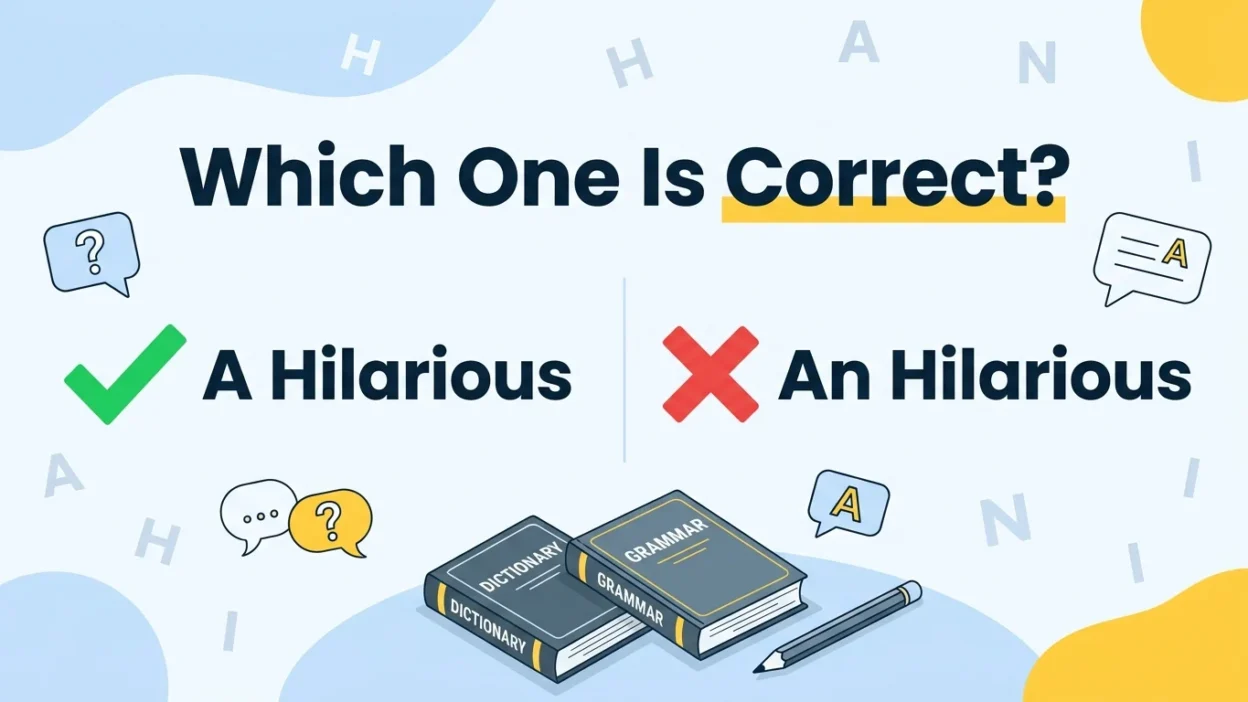
Have you ever paused before writing “a hilarious joke” or “an hilarious joke” and wondered which one is correct? You’re not alone. This tiny grammar choice confuses English learners, writers, and even native speakers because the answer depends on pronunciation, not simply the first letter of a word.
The good news is that the rule is easier than it looks. Once you understand how the article a or an works with words beginning with H, you’ll never second guess yourself again. In this guide, you’ll learn the correct usage, discover why people make this mistake, compare British and American English, and see plenty of real life examples to help you remember the difference.
Quick Answer
“A hilarious” is correct in modern English because hilarious begins with a pronounced /h/ sound (“hi-LAIR-ee-us”). Since the first sound is a consonant sound, use a, not an. Although you may occasionally encounter “an hilarious” in older or highly formal British writing, it is considered uncommon today.
Why People Confuse It
The confusion comes from a simple grammar rule that many people misunderstand.
Some believe the choice between a and an depends on the first letter of a word. In reality, it depends on the first sound.
Since hilarious starts with the letter H, some assume an should come before it. Others have seen phrases like “an hour” or “an honest person,” where the H is silent. Because of these examples, learners sometimes incorrectly write “an hilarious.”
The key difference is pronunciation.
A Hilarious
“A hilarious” is the standard and correct choice.
The word hilarious begins with a clearly pronounced H sound:
hilarious → /hɪˈleəriəs/
Since the word starts with a consonant sound, English grammar requires the indefinite article a.
Examples:
- A hilarious movie made everyone laugh.
- She shared a hilarious story during dinner.
- That was a hilarious mistake.
- We watched a hilarious comedy last night.
This form is accepted in modern American English and modern British English.
An Hilarious
“An hilarious” is uncommon in today’s English.
Historically, some British speakers dropped the H sound in certain words, making “an hilarious” sound natural. Today, however, most English speakers pronounce the H, making “a hilarious” the preferred and grammatically correct form.
You may still find “an hilarious” in:
- Older literature
- Historical texts
- Very formal or stylistic writing
- Rare British usage
For everyday communication, choose “a hilarious.”
Comparison Table
| Feature | A Hilarious | An Hilarious |
| Grammar | Correct | Rare and generally outdated |
| Pronunciation | H is pronounced | Assumes silent H |
| Modern American English | Standard | Incorrect in most contexts |
| Modern British English | Standard | Occasionally seen, but uncommon |
| Recommended for writing | Yes | No |
When to Use Each
Use A Hilarious when:
- The H is pronounced.
- Writing modern English.
- Speaking naturally.
- Creating academic, business, or casual content.
Examples:
- We heard a hilarious joke.
- It was a hilarious performance.
- She has a hilarious sense of humor.
Use An Hilarious only when:
- Quoting historical writing.
- Preserving the original wording of older texts.
- Mimicking an older literary style.
Examples
Here are practical examples using the correct form.
- That was a hilarious joke.
- We watched a hilarious comedy.
- She told a hilarious story.
- He gave a hilarious speech.
- My friend shared a hilarious meme.
- It became a hilarious misunderstanding.
- They had a hilarious conversation.
- The children enjoyed a hilarious puppet show.
- That’s a hilarious idea.
- We experienced a hilarious moment at work.
- She wrote a hilarious caption online.
- Everyone remembered a hilarious vacation story.
Common Mistakes
Avoid these common errors.
❌ An hilarious movie
✅ A hilarious movie
❌ An hilarious joke
✅ A hilarious joke
❌ Choosing articles based only on spelling.
✅ Choose the article based on pronunciation.
Memory Trick
Remember this simple rule:
If you hear the H, use “a.”
Examples:
- A hilarious story ✅
- A happy child ✅
- A historic building (modern usage) ✅
If the H is silent, use an:
- An hour
- An honest answer
- An honor
Think about sound, not spelling.
American vs British English
Although both varieties now overwhelmingly use “a hilarious,” there are slight historical differences.
American English
- Almost always uses a hilarious.
- The H is always pronounced.
British English
- Modern usage also prefers a hilarious.
- Older British texts occasionally use an hilarious, reflecting earlier pronunciation patterns.
Today, style guides and dictionaries generally recommend a hilarious for both varieties of English.
Similar Words
These words follow the same pronunciation rule.
| Correct | Incorrect |
| A happy day | An happy day |
| A huge success | An huge success |
| A historic event | An historic event (less common today) |
| An honest person | A honest person |
| An hour later | A hour later |
| An honorable judge | A honorable judge |
Final Verdict
The correct expression in modern English is “a hilarious.”
Although “an hilarious” has historical roots and occasionally appears in older British writing, it is no longer the standard choice. Since hilarious begins with a pronounced H sound, the correct indefinite article is a.
Whenever you’re writing emails, essays, blogs, or everyday conversations, confidently choose “a hilarious.”
Frequently Asked Questions
Is “a hilarious” grammatically correct?
Yes. It is the correct and standard form because hilarious starts with a pronounced H sound.
Is “an hilarious” ever correct?
It may appear in older British or literary writing, but it is uncommon in modern English.
Why isn’t it “an hilarious”?
Because English articles depend on pronunciation, and hilarious begins with a consonant sound.
Do Americans use “an hilarious”?
No. American English almost always uses “a hilarious.”
What is the rule for using “a” and “an”?
Use a before consonant sounds and an before vowel sounds, regardless of spelling.
Is “a historic” or “an historic” correct?
Modern English generally prefers “a historic.” Some older British sources still use “an historic.”
What are other examples like “hilarious”?
Words such as happy, helpful, huge, and historic all typically take a because the H is pronounced.
Conclusion
Choosing between “a hilarious” and “an hilarious” becomes simple once you focus on pronunciation instead of spelling. Because hilarious starts with a clearly pronounced H sound, modern English requires the article a. This rule applies across everyday conversation, academic writing, and professional communication.
While you might occasionally spot “an hilarious” in historical or literary works, it reflects older pronunciation patterns rather than current standard usage. By remembering that articles follow sounds rather than letters, you’ll make the right choice with confidence every time.
Remember This
Use “a hilarious” because you can hear the H sound.
Rule: A + consonant sound | An + vowel sound
If the H is pronounced, choose a. If the H is silent, choose an.

Quinn Mitchell is celebrated for historical fiction that combines authentic settings, unforgettable characters, and compelling narratives. His thoughtful writing brings history alive while inspiring curiosity and deeper understanding among readers.