Have you ever come across the words bespectacled and bespeckled and wondered whether they mean the same thing? At first glance, they look remarkably similar, which is why many English learners and even native speakers mix them up. However, these two words describe completely different things and belong in different contexts.
Understanding the distinction between bespectacled vs bespeckled can improve your vocabulary, sharpen your writing, and help you avoid embarrassing mistakes. In this guide, you’ll learn the meaning of each word, when to use it, practical examples, common errors, and an easy trick to remember the difference. Whether you’re writing professionally, preparing for exams, or simply improving your English, this comparison will make the choice crystal clear.
Quick Answer
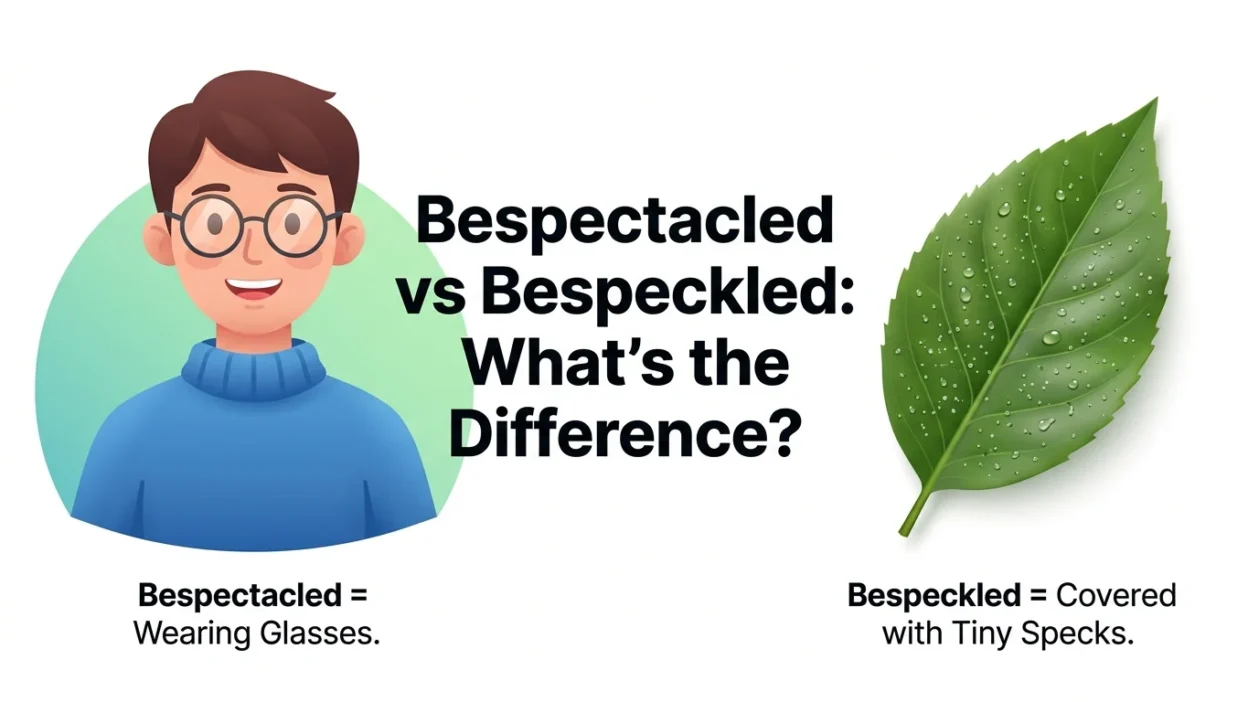
Bespectacled describes someone who wears glasses, while bespeckled means covered or marked with small spots, specks, or dots. Although the words look alike, they have entirely different meanings and should never be used interchangeably.
Why People Confuse It
There are several reasons these words are commonly confused:
- Both begin with the prefix be-.
- They share a similar spelling and pronunciation.
- Both are uncommon in everyday conversation.
- They each function as descriptive adjectives.
- Many readers mistake spect and speck as variations of the same root.
The key difference is simple:
- Bespectacled = wearing spectacles (glasses).
- Bespeckled = covered with specks or tiny spots.
Bespectacled: Meaning and Usage
Bespectacled is an adjective that means wearing spectacles or eyeglasses.
The word comes from spectacles, an older term for glasses. It often appears in books, journalism, biographies, and descriptive writing.
Examples
- The bespectacled professor welcomed the new students.
- A bespectacled detective carefully examined the evidence.
- The bespectacled librarian smiled warmly.
- She recognized the bespectacled man from the conference.
- The cartoon featured a cheerful bespectacled scientist.
Common Contexts
- Character descriptions
- Literature
- News articles
- Academic writing
- Storytelling
LSI Keywords: glasses, spectacles, eyewear, person wearing glasses, eyeglasses.
Bespeckled: Meaning and Usage
Bespeckled is an adjective meaning covered with small spots, dots, flecks, or specks.
It describes the appearance of an object, surface, animal, or landscape rather than a person’s eyewear.
Examples
- The leaves were bespeckled with raindrops.
- A bespeckled trout swam through the stream.
- The window became bespeckled with dust.
- Her dress was bespeckled with glitter.
- The sky appeared bespeckled with stars.
Common Contexts
- Nature writing
- Descriptive fiction
- Photography
- Art descriptions
- Scientific observations
LSI Keywords: spotted, speckled, dotted, flecked, covered with spots.
Bespectacled vs Bespeckled: Comparison Table
| Feature | Bespectacled | Bespeckled |
| Meaning | Wearing glasses | Covered with small spots or specks |
| Part of Speech | Adjective | Adjective |
| Refers To | People | Objects, animals, places, surfaces, or sometimes people with spots |
| Root Word | Spectacles | Speck |
| Common Context | Appearance of a person | Appearance of a surface or object |
| Example | A bespectacled teacher | A bespeckled window |
When to Use Each
Choose bespectacled when:
- Referring to someone wearing glasses.
- Describing a person’s appearance.
- Writing character descriptions.
Choose bespeckled when:
- Talking about tiny spots or marks.
- Describing patterns in nature.
- Referring to dust, paint, stars, snow, or similar specks.
Examples
Here are more examples showing the correct usage.
- The bespectacled lawyer presented a convincing argument.
- Our bespectacled neighbor enjoys reading mystery novels.
- The bespectacled student answered every question correctly.
- The child drew a bespectacled owl.
- A bespectacled gentleman greeted everyone politely.
- The countertop was bespeckled with flour.
- The butterfly had bespeckled wings.
- The windshield became bespeckled with mud.
- The mountains looked bespeckled with patches of snow.
- The painting featured a bespeckled background.
- The old photograph showed a bespectacled inventor.
- The marble floor was naturally bespeckled with gray minerals.
Common Mistakes
Many writers accidentally replace one word with the other.
❌ The bespeckled teacher explained the lesson.
✔ The bespectacled teacher explained the lesson.
❌ The wall was bespectacled with paint.
✔ The wall was bespeckled with paint.
Remember that glasses belong to people, while specks belong to surfaces or objects.
Memory Trick
Here’s a simple way to remember the difference:
- Bespectacled contains spect, reminding you of spectacles (glasses).
- Bespeckled contains speck, reminding you of tiny specks or spots.
Think:
Spect = Spectacles = Glasses
Speck = Specks = Spots
This quick association makes choosing the correct word much easier.
American vs British English
Both bespectacled and bespeckled are recognized in American and British English.
The difference is not regional but stylistic.
- Bespectacled is slightly more common in British writing because spectacles remains a familiar term there.
- In American English, people usually say wearing glasses, although bespectacled still appears in literature and journalism.
- Bespeckled has the same meaning and usage in both varieties of English.
Similar Words
If you’re expanding your vocabulary, these related words are also useful.
Similar to Bespectacled
- Wearing glasses
- Four eyed (informal)
- Spectacled
- Eyeglass wearing
Similar to Bespeckled
- Speckled
- Spotted
- Flecked
- Dotted
- Mottled
- Freckled (when describing skin)
Final Verdict
Although bespectacled and bespeckled differ by only a few letters, they describe completely different ideas.
Use bespectacled when someone is wearing glasses.
Use bespeckled when something is covered in tiny spots or specks.
Remembering the connection between spectacles and specks is usually enough to keep these words straight.
Frequently Asked Questions
Is bespectacled a real English word?
Yes. It is a standard English adjective meaning wearing glasses or spectacles.
Is bespeckled the same as speckled?
They are very similar. Bespeckled emphasizes being covered with specks, while speckled is the more commonly used form in everyday English.
Can bespeckled describe a person?
Yes. It can describe someone whose clothing or skin is covered with small spots, although it more commonly describes objects or surfaces.
Which word is more common?
Bespectacled appears more often in descriptions of people, while speckled is generally more common than bespeckled in modern English.
Can I use bespectacled instead of wearing glasses?
Yes. Bespectacled is simply a more formal and literary alternative.
Why are these words often confused?
Their similar spelling and pronunciation cause many learners to assume they have related meanings, even though their roots are completely different.
Conclusion
Learning the difference between bespectacled and bespeckled is easier than it first appears. One describes a person wearing glasses, while the other describes something marked with tiny spots or flecks. Once you understand the different root words, the meanings become much more intuitive.
The next time you encounter these adjectives, you’ll know exactly which one fits the context. Using the correct word not only improves your vocabulary but also makes your writing clearer, more precise, and more professional.
Remember This
Bespectacled = Wearing spectacles (glasses).
Bespeckled = Covered with tiny specks or spots.
Keeping this simple distinction in mind will help you use both words confidently every time.

Hadley Price creates heartfelt contemporary fiction exploring relationships, hope, resilience, and personal growth. Her emotionally rich storytelling connects with readers through memorable characters and inspiring life experiences worldwide.