
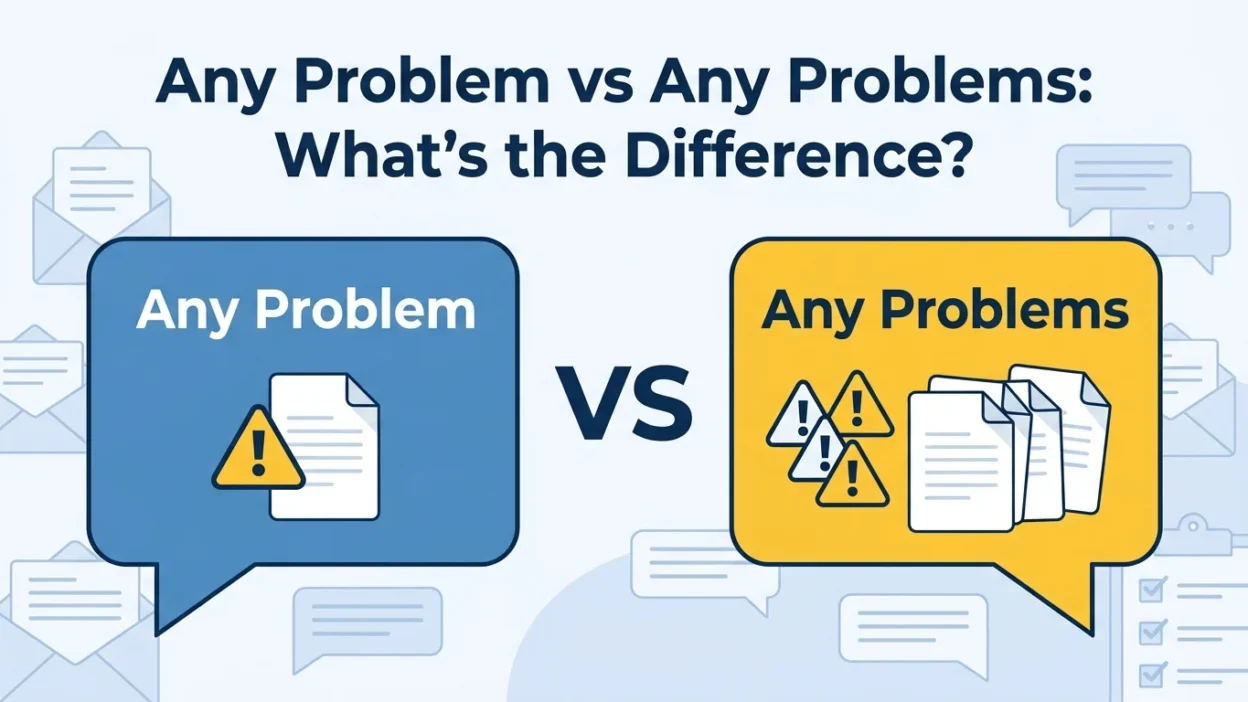
English learners often wonder whether they should write any problem or any problems. Both expressions are grammatically correct, but they are used in different situations. The choice depends on whether you’re referring to a single possible issue or multiple possible issues.
Understanding this small grammar rule can make your English sound much more natural in conversations, emails, academic writing, and professional communication. In this guide, you’ll learn when to use each phrase, common mistakes to avoid, easy memory tips, and plenty of real life examples to help you master the difference.
Quick Answer
Use any problem when referring to one possible issue or when the context is singular. Use any problems when asking or talking about multiple possible issues in a general sense. In everyday English, any problems is more common because people usually refer to more than one possible difficulty.
Why People Confuse It
The confusion comes from the word any.
Many learners assume any must always be followed by a plural noun. In reality, any can be used with both singular and plural countable nouns, depending on the meaning.
For example:
- Do you have any problem understanding this rule?
- Do you have any problems with the software?
Both are correct, but they express slightly different ideas.
Any Problem
Any problem is a singular noun phrase.
It refers to one possible issue or treats the idea of a problem as a single concept.
Use “any problem” when:
- Talking about one possible issue
- Referring to a specific situation
- Speaking in a more formal way
- The context clearly points to a single problem
Examples
- If you have any problem, call me immediately.
- Let me know if there’s any problem with your order.
- We will solve any problem that appears.
- Report any problem to the manager.
- Is there any problem with the payment?
Any Problems
Any problems uses the plural noun and refers to multiple possible issues.
This is the more natural choice in everyday English because people often don’t know how many issues may exist.
Use “any problems” when:
- Asking general questions
- Referring to multiple possible issues
- Speaking naturally in conversation
- Writing informal or professional emails
Examples
- Are there any problems with the project?
- Did you encounter any problems during installation?
- Let me know if you have any problems.
- Have you noticed any problems recently?
- We didn’t experience any problems on our trip.
Comparison Table
| Feature | Any Problem | Any Problems |
| Number | Singular | Plural |
| Meaning | One possible issue | Multiple possible issues |
| Common in conversation | Less common | More common |
| Formal writing | Often used | Frequently used |
| General questions | Less natural | More natural |
| Example | If you have any problem, call me. | Let me know if you have any problems. |
When to Use Each
Choose any problem when:
- You’re thinking about one possible issue.
- The sentence focuses on a single event.
- A formal tone is appropriate.
Choose any problems when:
- Asking broad questions.
- Referring to unknown or multiple issues.
- Speaking naturally in everyday English.
- Writing customer service messages or workplace communication.
Examples
Here are practical examples showing both expressions.
- If you have any problem, please contact us.
- Let me know if there’s any problem with the document.
- Report any problem immediately.
- Is there any problem with the machine?
- We can solve any problem together.
- Do you have any problems with your internet connection?
- Have you experienced any problems lately?
- Please tell us about any problems you find.
- We haven’t had any problems so far.
- Did the students face any problems during the exam?
- Are there any problems with your account?
- Customers reported no problems after the update.
Common Mistakes
Many learners make these mistakes:
- ❌ Do you have any problemS? (Correct if asking generally.)
- ❌ Is there any problems? (Incorrect because there is requires a singular noun.)
- ✅ Is there any problem?
- ✅ Are there any problems?
Another mistake is assuming one form is always correct. Both are correct when matched with the intended meaning.
Memory Trick
Here’s an easy way to remember it:
- One possible issue = any problem
- Unknown or multiple issues = any problems
If you’re asking someone generally whether something went wrong, any problems will usually sound more natural.
American vs British English
Both American English and British English accept any problem and any problems.
However, in everyday speech, speakers in both varieties more commonly say:
- Do you have any problems?
- Let me know if you have any problems.
Some formal notices or customer support messages may still use the singular form:
- Report any problem immediately.
The difference is based more on grammar and style than regional English.
Similar Words
If you’re learning English grammar, you may also find these word pairs useful:
- Any issue vs any issues
- Any question vs any questions
- Any concern vs any concerns
- No problem vs no problems
- Every problem vs all problems
- Issue vs problem
- Difficulty vs challenge
Learning these patterns helps improve both spoken and written English.
Final Verdict
Both any problem and any problems are grammatically correct.
Use any problem when referring to one possible issue or a single situation. Use any problems when speaking generally about multiple or unknown issues. Since everyday conversations usually involve general questions, any problems is the expression you’ll hear most often.
Choosing the correct form depends on context rather than a strict grammar rule. Understanding this difference will help your English sound clearer, more natural, and more professional.
Frequently Asked Questions
Is “any problem” grammatically correct?
Yes. It is correct when referring to one possible problem or a singular situation.
Which is more common, “any problem” or “any problems”?
Any problems is more common in everyday English because it refers to possible issues in general.
Should I say “Do you have any problem?” or “Do you have any problems?”
In natural conversation, Do you have any problems? sounds more idiomatic.
Why do customer service messages sometimes use “any problem”?
Some businesses use the singular form because they refer to any single issue a customer might experience.
Can “any” be used with singular nouns?
Yes. Any can be followed by singular or plural countable nouns depending on the intended meaning.
Is “If you have any problem, call me” correct?
Yes, although many native speakers would naturally say If you have any problems, call me.
Conclusion
The difference between any problem and any problems is small but important. While both forms are grammatically correct, they communicate slightly different meanings. The singular focuses on one possible issue, while the plural refers to multiple or unknown issues.
In daily conversations, workplace communication, and customer support, you’ll usually hear any problems because it’s more natural when discussing possible difficulties. By understanding this distinction, you’ll improve your grammar, write more confidently, and communicate like a fluent English speaker.
Remember This
Use “any problem” for one possible issue. Use “any problems” for general or multiple possible issues. When in doubt during everyday conversation, “any problems” is usually the more natural choice.

Adam Aaron writes engaging mystery and adventure novels featuring intelligent characters, unexpected twists, and emotional storytelling. His creative imagination and compelling narratives have earned admiration from readers across generations.