If you have ever written “per say” and wondered whether it looks right, you are not alone. Per se and per say sound almost identical when spoken, but only one is the standard English expression. The correct form is per se, a Latin phrase meaning “in itself,” “by itself,” or “intrinsically.” It is commonly used when you want to separate something from its surrounding circumstances and discuss its essential nature.
The confusion usually comes from pronunciation. In everyday speech, per se can sound very much like “per say,” so it is easy to choose the wrong spelling when writing. Understanding the meaning behind the expression makes the distinction much easier to remember. In this guide, we will explain per se vs per say, show how to use per se naturally, examine common mistakes, and provide practical examples you can use in formal and everyday English.
Quick Answer
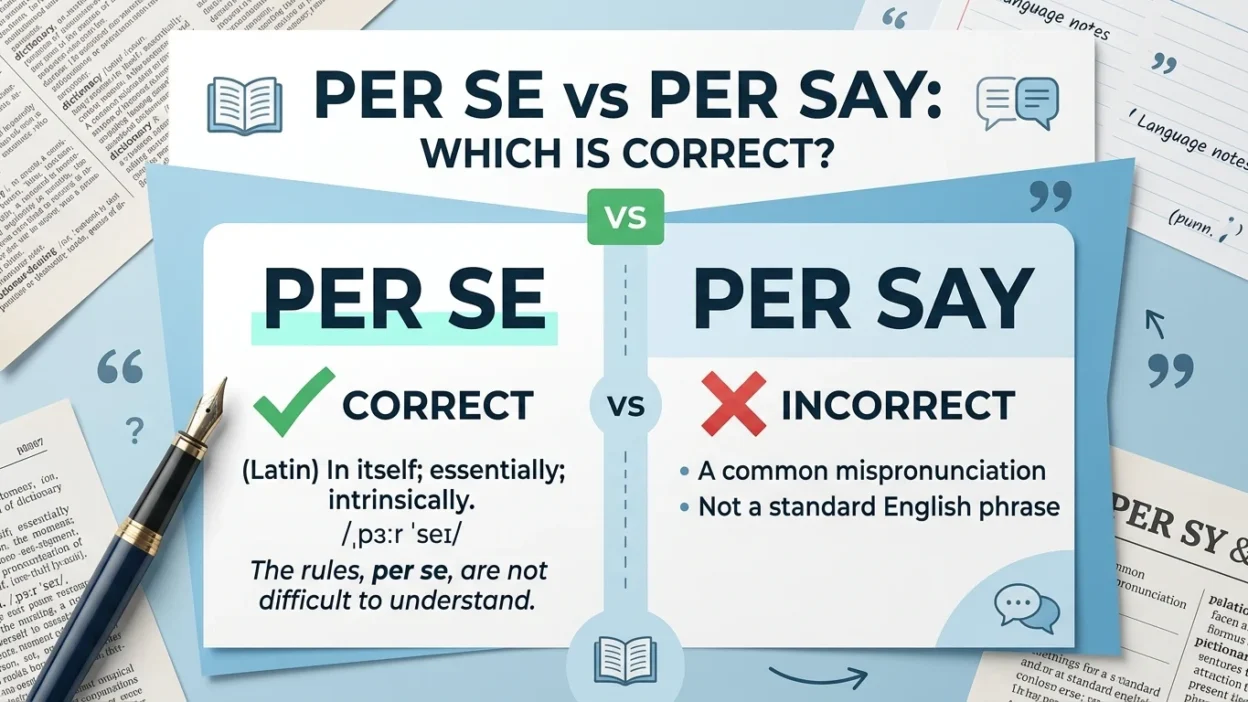
Per se is the correct expression. It means “in itself” or “by itself” and comes from Latin. Per say is a common spelling mistake because both forms sound similar. If you mean “in itself,” always write per se.
Why People Confuse It
The main reason people confuse per se with per say is pronunciation.
When spoken naturally, per se is generally pronounced something like “per say.” This makes the incorrect spelling feel logical, especially for people who have heard the phrase many times but have rarely seen it written.
There is another reason for the confusion: English contains many expressions where spelling does not perfectly match pronunciation. Writers may therefore spell per se phonetically as per say.
Remember that per se is an expression, not two ordinary English words that can be freely respelled.
First Word: Per Se
Per se is the correct spelling.
It is a Latin phrase that literally means “by itself” or “in itself.” In modern English, it is used to focus on the inherent nature of something rather than its related circumstances.
For example:
“The job is not difficult per se, but the long hours make it exhausting.”
Here, the speaker means that the job itself is not difficult. The problem is the long working hours.
What does “per se” mean?
Depending on context, per se can mean:
- in itself
- by itself
- intrinsically
- considered independently
- in its own nature
It is especially common in formal writing, academic discussions, journalism, business communication, and thoughtful conversation.
Second Word: Per Say
Per say is not the standard spelling of this expression.
It is generally considered a misspelling of per se, caused by the way the phrase sounds when spoken.
For example:
❌ “The idea isn’t bad per say.”
✅ “The idea isn’t bad per se.”
The second sentence is correct because per se means “in itself.”
There is no standard English expression per say with the same meaning.
Comparison Table
| Expression | Correct? | Meaning | Example |
| per se | Yes | in itself; by itself | “The plan isn’t wrong per se.” |
| per say | No, in this context | Common misspelling | “The plan isn’t wrong per say.” ❌ |
| in itself | Yes | intrinsically; considered alone | “The plan isn’t wrong in itself.” |
| by itself | Yes | independently or alone | “The machine can operate by itself.” |
When to Use Each
There is really only one correct choice when you mean “in itself”: use per se.
Use “per se” when:
- You want to discuss something independently from other factors.
- You mean “in itself.”
- You are making a distinction between an inherent quality and its consequences.
- You are writing formally or analytically.
- You want a concise alternative to “in itself.”
Examples of the distinction
Consider:
“Money isn’t harmful per se.”
This means money itself is not harmful. The way money is used may create problems.
Similarly:
“The technology isn’t dangerous per se.”
The technology itself is not necessarily dangerous, although particular applications or circumstances might be.
Examples
Here are practical examples showing how per se works in natural English:
- “There is nothing wrong with working from home per se.”
- “The restaurant isn’t expensive per se, but the extra charges add up.”
- “I don’t dislike the movie per se; I just found it too long.”
- “The rule isn’t unfair per se, but its application can cause problems.”
- “Being competitive isn’t a bad thing per se.”
- “The idea is not unrealistic per se.”
- “Social media is not harmful per se; excessive use can be.”
- “The software isn’t difficult per se, although beginners may need guidance.”
- “There is no problem with the proposal per se.”
- “The criticism wasn’t offensive per se, but the timing was inappropriate.”
- “Failure isn’t embarrassing per se.”
- “The subject isn’t complicated per se, but it requires careful study.”
- “Technology is not the problem per se.”
- “The decision wasn’t wrong per se, but it had unexpected consequences.”
Notice how per se often helps writers make a qualification or distinction. Something may not be inherently bad, difficult, expensive, or harmful, even though a related situation creates an undesirable result.
Common Mistakes
1. Writing “per say”
This is the most common error.
❌ “It wasn’t a problem per say.”
✅ “It wasn’t a problem per se.”
2. Assuming “say” is part of the expression
Because per se sounds like “per say,” some writers assume say is the correct word.
It isn’t. The phrase comes from Latin, so its spelling cannot be determined simply from its pronunciation.
3. Using “per se” when “by itself” is intended
Although the meanings overlap, per se is not always interchangeable with by itself.
For example:
“The computer restarted by itself.”
Here, by itself means without human intervention. Per se would not express that meaning naturally.
4. Overusing “per se”
Per se is useful, but you do not need it in every formal sentence. Sometimes in itself is clearer and more conversational.
Compare:
“The plan isn’t unreasonable per se.”
with:
“The plan isn’t unreasonable in itself.”
Both work, but the second may sound more straightforward in everyday writing.
Memory Trick
Here is an easy way to remember the spelling:
Per se = in itself.
Think of SE as standing for “self.”
SE → SELF → per se = in itself
And remember:
Per say sounds right but is spelled wrong.
If you hear someone pronounce per se as “per say,” do not let the pronunciation trick you when you write it.
American vs British English
There is no major American versus British spelling difference between per se and per say.
Both American English and British English use per se as the standard spelling.
The pronunciation may vary slightly depending on the speaker and accent, but the written expression remains the same.
You will encounter per se in American and British:
- academic writing
- newspapers
- professional communication
- books
- legal and analytical writing
- everyday educated speech
So whether you are writing for a US or UK audience, choose per se.
Similar Words
Several expressions can have a meaning similar to per se, depending on the sentence.
In itself
This is often the closest plain English alternative.
“The proposal isn’t bad in itself.”
By itself
This can mean independently or without assistance.
“The device can operate by itself.”
Intrinsically
This means as an inherent or essential quality.
“The activity is not intrinsically dangerous.”
Essentially
This can sometimes replace per se when discussing the basic nature of something.
“The argument is not essentially flawed.”
Inherently
This refers to a quality that exists as a natural or essential characteristic.
“Competition is not inherently harmful.”
These alternatives are useful when you want your writing to sound clearer or less formal.
FAQs
Is “per se” correct or “per say”?
Per se is correct. Per say is a common misspelling.
What does “per se” mean?
Per se means “in itself,” “by itself,” or “intrinsically.” It focuses on something considered independently.
Is “per se” an English word?
Per se is an English expression borrowed from Latin. It is now commonly used in English writing and speech.
How do you pronounce “per se”?
It is commonly pronounced approximately “per say.” The pronunciation is one reason people often misspell it as per say.
Can I use “per se” in formal writing?
Yes. Per se is especially common in formal, academic, professional, and analytical writing.
Is “per say” ever correct?
Not when you mean the established expression meaning “in itself.” In that context, per say is a spelling error.
What is another way to say “per se”?
Depending on context, you can use “in itself,” “by itself,” “intrinsically,” “inherently,” or “essentially.”
Final Verdict
The difference between per se vs per say is simple once you connect the expression with its meaning. Per se is the correct form, while per say is a common phonetic misspelling. Per se means “in itself” or “by itself” and is used when discussing something independently from related circumstances.
If you are unsure while writing, replace the phrase with “in itself.” If the sentence still makes sense, per se is probably the expression you need. Most importantly, do not let its pronunciation fool you: although it sounds like “per say,” the correct spelling is always per se when you mean “in itself.”
Remember This
Per se = in itself.
Per say = incorrect spelling of the expression.
When you hear “per say,” remember that the sound is per se, but the spelling is P-E-R S-E.
Conclusion
Understanding small distinctions such as per se vs per say can make your English writing more accurate and polished. The key is to remember that per se is a Latin derived expression meaning “in itself,” while per say simply reflects the way the phrase sounds.
Use per se when you want to describe something considered on its own or according to its inherent nature. Once you connect the spelling with the meaning, this common English mistake becomes easy to avoid.

Hadley Price creates heartfelt contemporary fiction exploring relationships, hope, resilience, and personal growth. Her emotionally rich storytelling connects with readers through memorable characters and inspiring life experiences worldwide.