Choosing between giving and given can be confusing because both words come from the same verb, give. However, they serve different grammatical purposes and cannot always replace each other. Understanding the distinction is essential for writing and speaking English naturally.
Whether you’re a student, professional, or English learner, mastering giving vs given will help you avoid common grammar mistakes and communicate with greater confidence. In this guide, you’ll discover the meaning of each word, how they’re used in sentences, easy memory tricks, practical examples, and the differences between American and British English.
Quick Answer
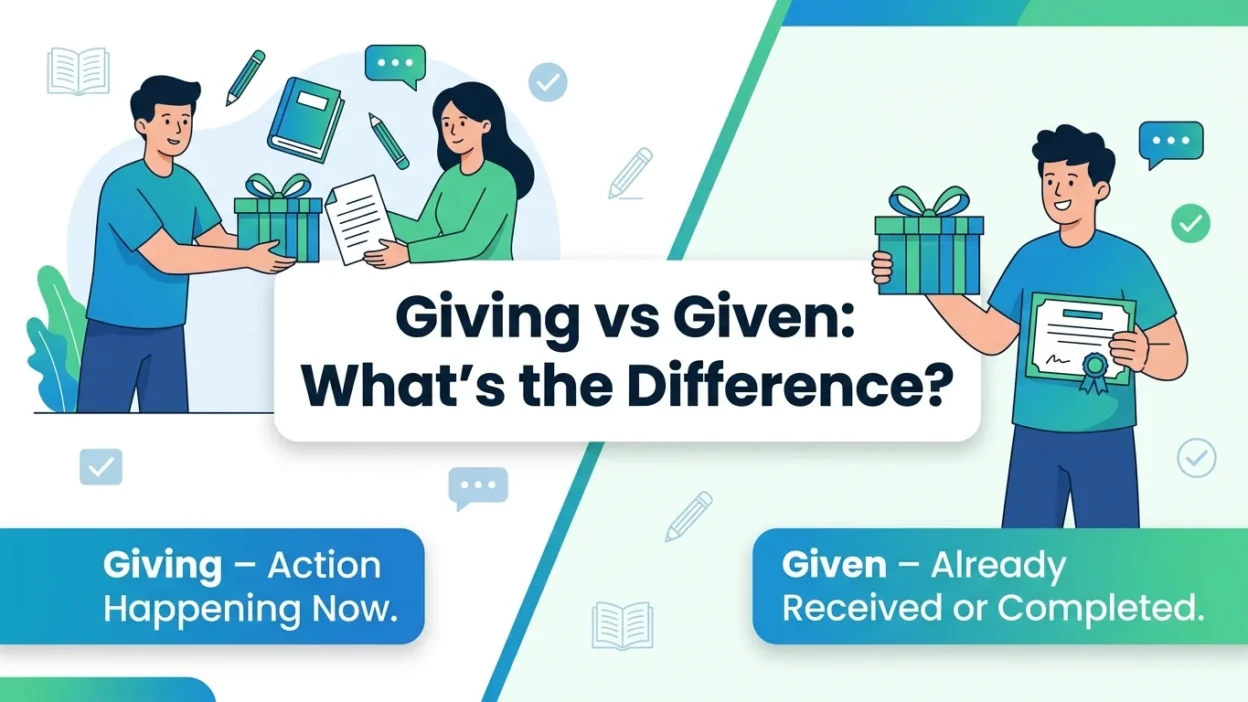
Giving is the present participle or gerund of give and refers to the action of providing something. Given is the past participle of give and is used with helping verbs or as an adjective. Simply put, giving describes an ongoing action, while given describes something already provided or considered.
Why People Confuse It
Many English learners mix up giving and given because both originate from the verb give. They often appear in similar contexts involving gifts, information, advice, or help.
The confusion usually happens because:
- Both come from the same base verb.
- Both can describe acts of providing.
- Both frequently appear in formal and informal writing.
- English verb forms can be difficult to memorize.
The easiest way to tell them apart is to identify whether you’re talking about an action happening now or something already completed.
Giving
Giving is the present participle and gerund form of give.
Meaning
It refers to the act of providing, offering, donating, or transferring something.
Grammar Role
Giving can function as:
- A verb in continuous tenses
- A noun (gerund)
- Part of a participle phrase
Examples
- She is giving a presentation today.
- They are giving free samples.
- Giving compliments makes people happy.
- We enjoy giving gifts during holidays.
- The teacher kept giving helpful feedback.
Given
Given is the past participle of give.
Meaning
It refers to something that has already been provided, offered, or assumed.
Grammar Role
Given is commonly used:
- With helping verbs (has, have, had, was, were)
- As an adjective
- In conditional or formal expressions
Examples
- She has given excellent advice.
- They were given another opportunity.
- The award was given yesterday.
- Given the weather, we’ll stay indoors.
- He had given his best effort.
Comparison Table
| Feature | Giving | Given |
| Verb Form | Present participle / Gerund | Past participle |
| Time | Ongoing action | Completed action |
| Used With | Continuous tenses | Perfect and passive tenses |
| Can Be a Noun? | Yes (gerund) | No |
| Can Be an Adjective? | Rarely | Yes |
| Example | She is giving a speech. | She has given a speech. |
When to Use Each
Use giving when:
- The action is happening now.
- Using continuous verb tenses.
- Referring to the act itself.
- Talking about habits or ongoing activities.
Use given when:
- The action is completed.
- Forming perfect tenses.
- Writing passive voice.
- Making assumptions (“Given the circumstances…”).
Examples
Here are practical examples to show the difference.
Giving
- She is giving her friend a ride.
- They enjoy giving to charity.
- I appreciate you giving me your time.
- We’re giving everyone another chance.
- He’s giving a speech this afternoon.
- Stop giving excuses.
Given
- She has given me the answer.
- The prize was given to the winner.
- I’ve given it a lot of thought.
- They were given clear instructions.
- Given the circumstances, we made the best decision.
- He had given up before the race ended.
Common Mistakes
Here are mistakes learners frequently make.
❌ She has giving me advice.
✅ She has given me advice.
❌ He is given a speech.
✅ He is giving a speech.
❌ They have giving us permission.
✅ They have given us permission.
❌ Giving the bad weather, we stayed home.
✅ Given the bad weather, we stayed home.
Memory Trick
Remember this simple rule:
- Giving = Going on (the action is still happening)
- Given = Gone (the action is already finished)
If you see is, am, are, was, were before the verb, giving is often correct.
If you see has, have, had, you almost always need given.
American vs British English
There is no significant difference between American and British English regarding giving and given.
Both varieties use these verb forms according to standard English grammar.
Examples:
- American English: She has given me the report.
- British English: She has given me the report.
Likewise:
- American English: He is giving a lecture.
- British English: He is giving a lecture.
The grammar remains identical.
Similar Words
If you’re learning giving vs given, you may also want to understand these related verb forms:
- Give
- Gives
- Gave
- Taken vs Taking
- Spoken vs Speaking
- Written vs Writing
- Done vs Doing
- Sent vs Sending
- Brought vs Bringing
Learning complete verb families makes English grammar much easier.
Final Verdict
The difference between giving and given is mainly grammatical.
Giving describes an ongoing action or functions as a noun, while given refers to a completed action and is used in perfect or passive constructions. Once you recognize whether the action is still happening or already finished, choosing the correct word becomes much easier.
Understanding these verb forms improves your grammar, strengthens your writing, and helps you communicate more accurately in both formal and everyday English.
Frequently Asked Questions
Is it “has giving” or “has given”?
The correct phrase is has given because given is the past participle used with has.
Can “giving” be used as a noun?
Yes. Giving is a gerund and can act as a noun.
Example: Giving is more rewarding than receiving.
Is “given” an adjective?
Yes. It can function as an adjective.
Example: Under the given conditions, success was unlikely.
Can “given” start a sentence?
Yes.
Example: Given the evidence, the decision was reasonable.
Is “giving” always a verb?
No. It can also function as a noun.
Example: Giving is an important value.
Why can’t I say “has giving”?
Because has must be followed by a past participle, which is given, not giving.
What’s the easiest way to remember the difference?
Think:
- Giving = happening now
- Given = already happened
Conclusion
Using giving and given correctly is easier once you understand their roles in English grammar. Giving focuses on an action in progress or the act itself, while given points to something already completed or provided. Recognizing this difference helps you build grammatically correct sentences with confidence.
As you practice reading, writing, and speaking English, pay attention to the helping verbs around these words. Over time, choosing between giving and given will become second nature, making your communication clearer and more natural.
Remember This
Giving = present participle (action in progress).
Given = past participle (action completed or already provided).
Whenever you’re unsure, check whether the action is still happening or already finished.

Quinn Mitchell is celebrated for historical fiction that combines authentic settings, unforgettable characters, and compelling narratives. His thoughtful writing brings history alive while inspiring curiosity and deeper understanding among readers.