English grammar often creates confusion, especially when it comes to choosing between who and whom. One of the most common questions people ask is whether they should write who to contact or whom to contact. You’ll see both expressions in emails, business documents, websites, and everyday conversations, making it difficult to know which one is actually correct.
The good news is that both phrases can be correct depending on the context and level of formality. However, modern English has shifted toward using who in many situations where whom was once expected. This guide explains the difference in plain English, provides practical examples, and helps you choose the right expression with confidence.
Quick Answer
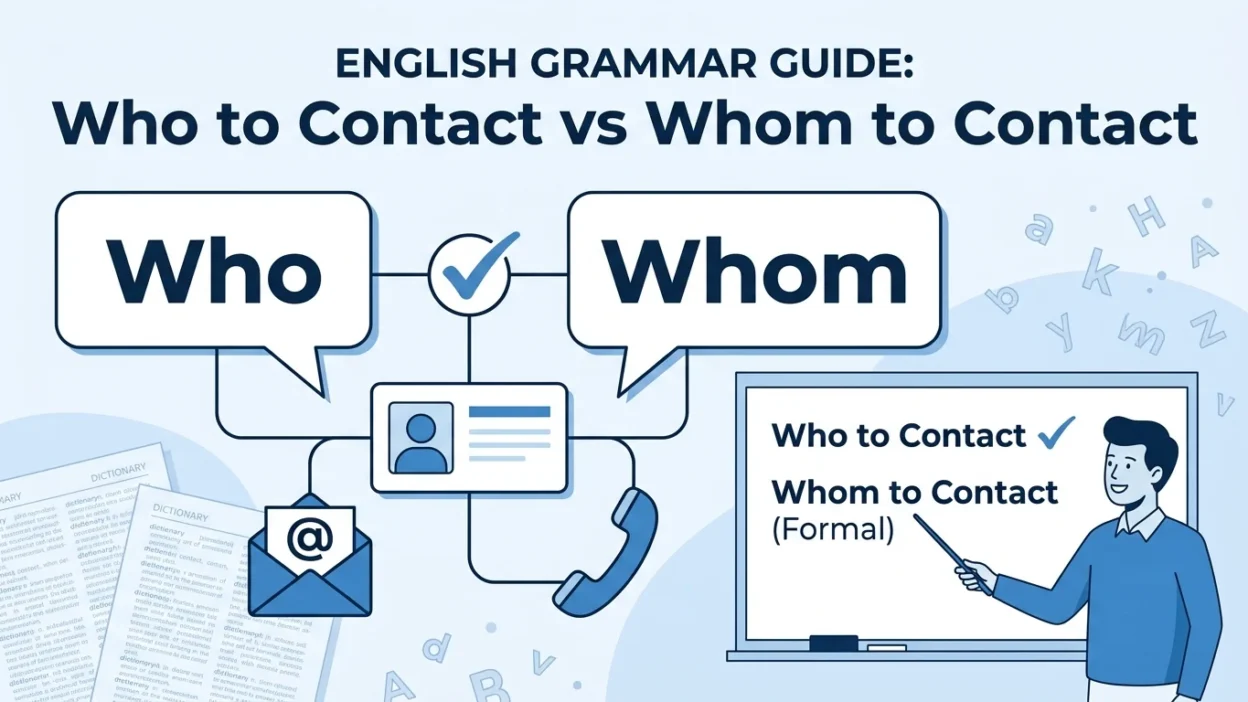
“Who to contact” is the preferred choice in modern English and sounds natural in both speech and writing. “Whom to contact” is grammatically formal because whom functions as an object. While both are correct, who to contact is far more common in everyday communication.
Why People Confuse It
Many English learners—and even native speakers—struggle with who and whom because modern English rarely uses whom in casual conversation.
Here are the main reasons:
- Both phrases appear in books and online.
- Schools often teach traditional grammar rules.
- Modern spoken English favors who.
- Formal writing sometimes still prefers whom.
- Many people aren’t sure when a pronoun is an object.
As a result, people often wonder whether grammar rules or natural usage should guide their writing.
First Word: Who to Contact
Who to contact is the expression you’ll hear most often today.
Although traditional grammar says whom should be used as an object, who has become widely accepted in everyday English—even when it’s technically an object.
Examples include:
- Please ask who to contact for technical support.
- I don’t know who to contact about the refund.
- The guide explains who to contact in an emergency.
- Tell me who to contact if I have questions.
This version is appropriate for:
- Emails
- Websites
- Customer service pages
- Business communication
- Everyday conversations
Second Word: Whom to Contact
Whom to contact follows traditional English grammar because whom is the object of the verb contact.
You’ll mostly find it in:
- Legal documents
- Academic writing
- Government publications
- Formal business correspondence
Examples:
- The handbook explains whom to contact for further information.
- Applicants should know whom to contact regarding visa questions.
- The policy outlines whom to contact during emergencies.
Although grammatically precise, it can sound overly formal in everyday conversation.
Comparison Table
| Feature | Who to Contact | Whom to Contact |
| Grammar | Common modern usage | Traditional grammar |
| Formality | Neutral to informal | Formal |
| Everyday English | Very common | Less common |
| Professional emails | Preferred | Acceptable but formal |
| Academic writing | Acceptable | Often preferred |
| Legal documents | Sometimes used | Frequently used |
| Sounds natural | Yes | Sometimes formal or old fashioned |
When to Use Each
Choose who to contact when:
- Writing emails
- Creating website content
- Speaking naturally
- Writing blog posts
- Communicating with customers
- Writing social media content
Choose whom to contact when:
- Writing legal documents
- Preparing academic papers
- Following strict grammar guidelines
- Writing highly formal correspondence
Simple Rule
If your goal is natural English, choose who to contact.
If your goal is maximum grammatical formality, whom to contact is perfectly acceptable.
Examples
Here are practical examples showing both expressions.
Using “Who to Contact”
- I don’t know who to contact about my application.
- The website explains who to contact for support.
- Ask reception who to contact after hours.
- Employees know who to contact during emergencies.
- Please tell me who to contact for billing questions.
- She wasn’t sure who to contact first.
Using “Whom to Contact”
- The manual specifies whom to contact in case of equipment failure.
- Applicants should understand whom to contact regarding admissions.
- The policy identifies whom to contact for complaints.
- The report explains whom to contact for additional information.
- Staff members were informed whom to contact during inspections.
- The contract states whom to contact if disputes arise.
Common Mistakes
Avoid these frequent errors:
Using “whom” just to sound smarter
Incorrect:
- Whom is coming today?
Correct:
- Who is coming today?
Thinking “whom” is always better
Modern English doesn’t require whom in most situations.
Avoiding “whom” completely
In formal writing, whom still has an important place.
Using the wrong level of formality
Match your grammar to your audience.
Memory Trick
Here’s an easy way to remember the difference.
- Who = he
- Whom = him
If him sounds correct, whom is traditionally correct.
Example:
You should contact him.
↓
You should know whom to contact.
However, remember that modern English often replaces whom with who, especially in conversation.
American vs British English
Both American and British English increasingly favor who over whom in everyday communication.
American English
- Strong preference for who to contact
- Whom mainly appears in formal writing
British English
- Similar trend toward who
- Whom survives slightly more often in official documents and formal publications
In both varieties, using who to contact is considered perfectly natural.
Similar Words
If you’re learning English grammar, you may also want to understand these commonly confused pronouns:
- Who vs Whom
- Whoever vs Whomever
- Who’s vs Whose
- Whoever vs Anyone
- Which vs That
- Whoever vs Whoever Is
- He vs Him
- They vs Them
Learning these related grammar pairs makes sentence construction much easier.
FAQs
Is “who to contact” grammatically correct?
Yes. It is widely accepted in modern English and is the preferred choice in most everyday situations.
Is “whom to contact” more correct?
According to traditional grammar rules, yes. Since whom functions as the object, it is technically more formal.
Which sounds more natural?
Who to contact sounds more natural in modern spoken and written English.
Should businesses use “who to contact”?
Yes. Most companies, websites, and customer service pages use who to contact because it’s clear and reader friendly.
Is “whom” disappearing?
Not completely. It’s becoming less common in everyday speech but remains useful in formal writing.
Do native English speakers still use “whom”?
Yes, but mostly in formal contexts such as legal, academic, or official documents.
Final Verdict
If you’re writing for a modern audience, who to contact is usually your best choice. It’s natural, easy to understand, and widely accepted in professional, educational, and everyday communication.
Choose whom to contact when writing formal documents or when following traditional grammar conventions. Both expressions are correct, but selecting the right one depends more on your audience and tone than on strict grammar alone.
Conclusion
Understanding the difference between who to contact and whom to contact doesn’t have to be difficult. Traditional grammar favors whom because it acts as the object of the verb, but modern English increasingly accepts who in the same position. As a result, who to contact has become the standard choice for everyday communication.
The best approach is to match your language to your audience. For emails, websites, and general business writing, who to contact sounds natural and approachable. For legal, academic, or highly formal documents, whom to contact remains an appropriate and grammatically precise option.
Remember This
Use “who to contact” for everyday English and professional communication. Use “whom to contact” when you want a more formal, traditional grammatical style.

Nova Turner specializes in imaginative science fiction blending futuristic technology, thrilling adventures, and powerful human emotions. Her innovative storytelling inspires curiosity, creativity, and exploration among readers of every age.