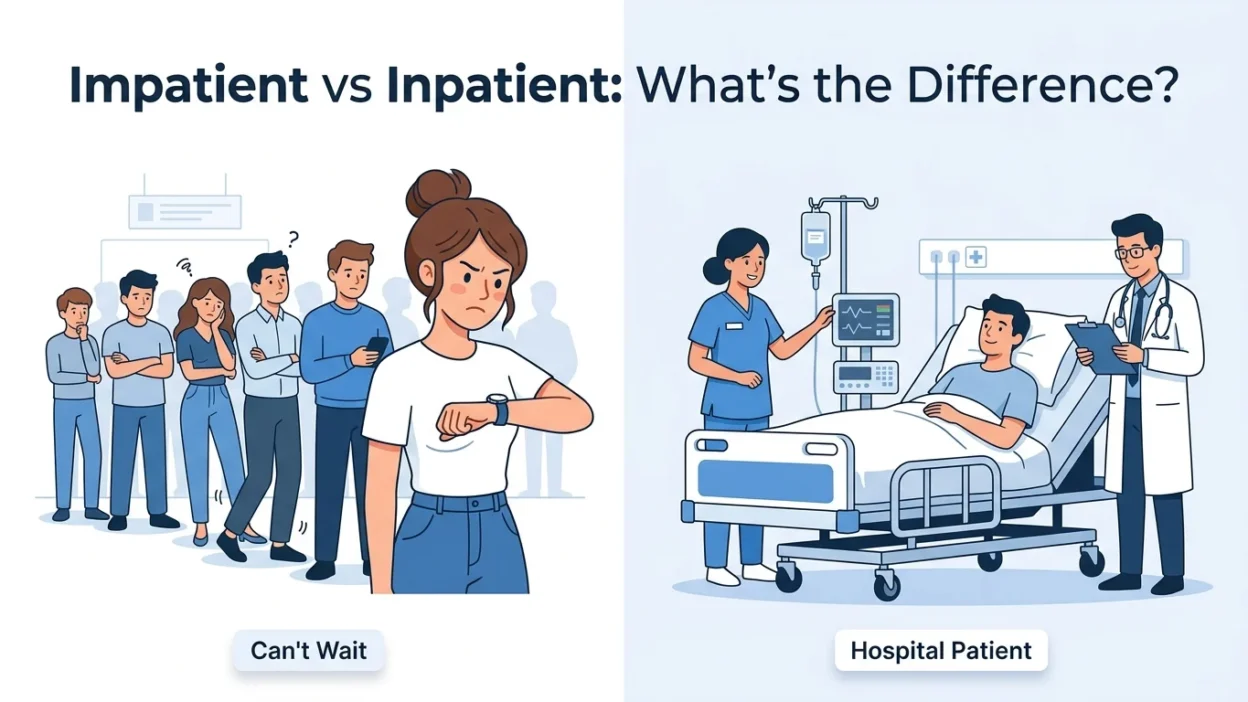
English has many words that look almost identical but carry completely different meanings. Impatient and inpatient are a perfect example. Changing just one letter can completely alter what you’re trying to say. One describes a person’s attitude, while the other refers to someone receiving medical care in a hospital.
If you’ve ever paused before writing these words, you’re not alone. Many English learners and native speakers occasionally confuse them because their spelling and pronunciation are similar. This guide explains the difference in simple language, provides practical examples, and helps you remember the correct word every time.
Quick Answer
Impatient means feeling annoyed because something is taking too long or because you don’t want to wait. Inpatient is a noun or adjective used in healthcare to describe a patient who stays in a hospital for treatment. Although they differ by only one letter, their meanings are completely unrelated.
Why People Confuse It
People often confuse impatient and inpatient because:
- They differ by only one letter.
- Their pronunciation is similar.
- Both are commonly used in everyday English.
- Spellcheck may not catch the mistake because both are real words.
- Fast typing often leads to accidental misspellings.
Understanding the context makes choosing the correct word much easier.
Impatient
Impatient is an adjective.
It describes someone who becomes irritated, restless, or frustrated while waiting for something.
Meaning
Someone who wants things to happen quickly and dislikes delays.
Examples
- She became impatient while waiting for the bus.
- The children were impatient to open their birthday presents.
- He grew impatient during the long meeting.
- Don’t be impatient—your order will arrive soon.
- I’m getting impatient with this slow internet connection.
Synonyms
- Restless
- Annoyed
- Eager
- Irritable
- Frustrated
Inpatient
Inpatient can be a noun or an adjective.
It refers to a person who stays in a hospital for medical treatment overnight or for several days.
Meaning
A patient admitted to a hospital who receives treatment while staying there.
Examples
- The doctor admitted her as an inpatient.
- The hospital has a new inpatient rehabilitation unit.
- He remained an inpatient for three days.
- Inpatient care is often required after major surgery.
- Nurses regularly check on every inpatient.
Related Terms
- Outpatient
- Hospital patient
- Medical care
- Hospital admission
- Healthcare services
Comparison Table
| Feature | Impatient | Inpatient |
| Part of Speech | Adjective | Noun or adjective |
| Meaning | Unable to wait calmly | A patient staying in a hospital |
| Used In | Everyday emotions | Healthcare and medicine |
| Example | She became impatient. | He is an inpatient. |
| Opposite | Patient | Outpatient (in medical context) |
When to Use Each
Use impatient when talking about:
- Waiting
- Delays
- Frustration
- Excitement
- Lack of patience
Use inpatient when discussing:
- Hospitals
- Medical treatment
- Healthcare
- Hospital admissions
- Patient care
A simple question can help:
- Talking about feelings? → Impatient
- Talking about hospitals? → Inpatient
Examples
Here are more examples to help you understand both words.
Using “Impatient”
- I became impatient after waiting for an hour.
- She looked impatient during the presentation.
- The customers were impatient because of the delay.
- He is too impatient to stand in long lines.
- We were impatient for the holidays to begin.
- Don’t sound impatient when speaking to customer support.
Using “Inpatient”
- She received inpatient treatment after surgery.
- The hospital expanded its inpatient services.
- Every inpatient receives daily medical evaluations.
- His insurance covered inpatient care.
- The nurse escorted the inpatient to the recovery room.
- They transferred the inpatient to another hospital.
Common Mistakes
Here are mistakes people frequently make.
❌ The doctor said I was becoming impatient after surgery.
✅ The doctor said I would remain an inpatient after surgery.
❌ She is an inpatient because she hates waiting.
✅ She is impatient because she hates waiting.
❌ Our hospital built a new impatient ward.
✅ Our hospital built a new inpatient ward.
Always ask yourself whether the sentence is about feelings or medical care.
Memory Trick
An easy way to remember the difference:
- Impatient contains “im”, reminding you of impatience, frustration, and waiting.
- Inpatient begins with “in”, reminding you that the patient stays in the hospital.
Think:
- In = In the hospital
- Impatient = Can’t wait
This simple association makes the difference easy to remember.
American vs British English
There is no significant difference between American and British English in the meaning or spelling of these words.
Both varieties use:
- Impatient for someone lacking patience.
- Inpatient for a hospital patient staying overnight.
Healthcare terminology may vary slightly between countries, but these two words remain the same.
Similar Words
If you’re learning English vocabulary, you may also confuse these word pairs:
- Patient vs Patience
- Inpatient vs Outpatient
- Accept vs Except
- Affect vs Effect
- Stationary vs Stationery
- Complement vs Compliment
- Principal vs Principle
- Advice vs Advise
Learning these commonly confused words improves both writing and speaking accuracy.
Final Verdict
Although impatient and inpatient differ by just one letter, they belong to completely different contexts.
Use impatient when describing someone who doesn’t like waiting or becomes frustrated by delays. Use inpatient when referring to a person admitted to a hospital for treatment. Paying attention to the context will help you choose the correct word every time.
Frequently Asked Questions (FAQs)
Is inpatient one word or two?
Inpatient is one word when referring to a hospital patient or hospital care.
Does impatient mean angry?
Not necessarily. It usually means feeling restless, frustrated, or unwilling to wait, though it can sometimes lead to anger.
Can inpatient be used as an adjective?
Yes. For example: inpatient care, inpatient treatment, and inpatient services.
What is the opposite of inpatient?
In healthcare, the opposite is outpatient, a patient who receives treatment without staying overnight.
Is impatient always negative?
Usually, yes. It suggests someone lacks patience or becomes frustrated easily.
How do I remember impatient vs inpatient?
Remember: Inpatient stays “in” the hospital, while impatient describes someone who can’t wait.
Can someone be both impatient and an inpatient?
Yes. A person staying in a hospital (an inpatient) can also become impatient while waiting for test results or treatment.
Conclusion
Confusing impatient and inpatient is understandable because they look and sound alike. However, their meanings are entirely different. One describes an emotional state, while the other belongs to medical vocabulary. Knowing the distinction improves your grammar, writing, and confidence in English.
Whenever you’re unsure, think about the situation. If it’s about waiting, frustration, or eagerness, choose impatient. If it’s about someone staying in a hospital for treatment, choose inpatient. With regular practice and the memory trick above, you’ll never mix them up again.
Remember This
Impatient = Can’t wait.
Inpatient = Stays in the hospital.

Willow Evans writes uplifting fantasy stories filled with magical worlds, courageous heroes, and meaningful life lessons. Her imaginative books encourage creativity, kindness, and hope in readers of all ages.