Many English learners get confused by itself and its self because both seem to contain the same words. At first glance, they look interchangeable, but they have very different meanings and uses. Choosing the wrong form can make your writing sound awkward or grammatically incorrect.
The good news is that the difference is simple once you understand how English pronouns work. In this guide, you’ll learn when to use itself, when its self is acceptable, and why one form is far more common than the other. You’ll also find practical examples, common mistakes, a comparison table, and an easy memory trick to help you remember the correct choice every time.
Quick Answer
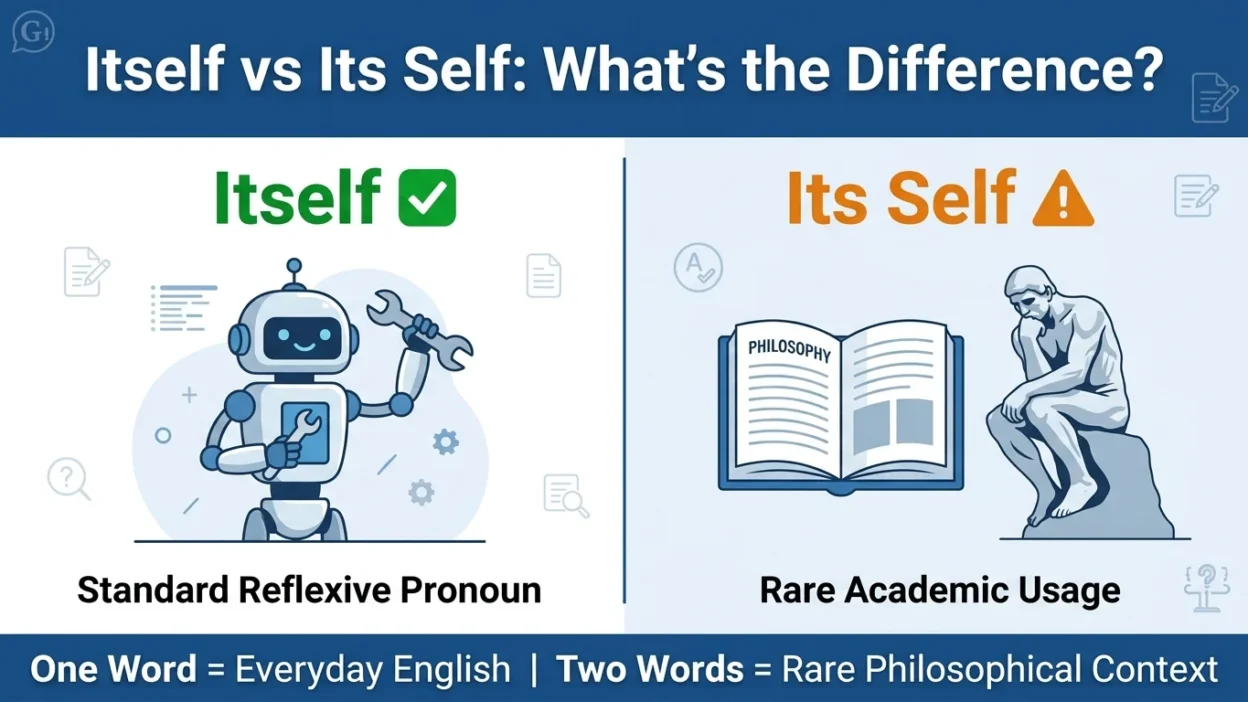
Itself is the standard reflexive pronoun used to refer back to a thing, animal, or idea. Its self is a rare two word phrase used only in specific linguistic or philosophical contexts where self functions as a separate noun. In everyday English, itself is almost always the correct choice.
Why People Confuse It
People often assume that itself should follow the same pattern as possessive phrases like its colour or its purpose, leading them to write its self. The confusion also comes from seeing words like myself, yourself, and himself, without realizing that itself is a single established reflexive pronoun.
Another reason is that its is already a possessive determiner, so writers mistakenly separate self into its own noun. While this is occasionally possible in specialized writing, it is not correct in normal grammar.
Itself
Itself is a reflexive pronoun. It refers back to a previously mentioned singular thing, object, animal, or concept.
Functions of itself
- Shows that the subject and object are the same.
- Adds emphasis to a noun.
- Refers to non human nouns or abstract ideas.
Examples
- The cat cleaned itself after dinner.
- The machine switched itself off.
- The company reinvented itself.
- The door opened by itself.
- The story explains itself clearly.
- The tree supports itself despite the wind.
Grammar Tip
If you can replace the word with himself, herself, or themselves, then itself is almost certainly the correct choice.
Its Self
Its self is a two word phrase in which its is a possessive determiner and self is a separate noun.
This construction is extremely uncommon in modern English. It mainly appears in:
- Philosophy
- Psychology
- Linguistics
- Literary analysis
- Discussions about identity or consciousness
Examples
- The philosopher discussed its self as an independent concept.
- The theory separates the object from its self.
These examples treat self as a noun rather than part of a reflexive pronoun.
Important Note
For everyday speaking and writing, its self is almost never appropriate.
Comparison Table
| Feature | Itself | Its Self |
| Part of speech | Reflexive pronoun | Possessive determiner + noun |
| Number of words | One | Two |
| Common in everyday English | Yes | No |
| Used for reflexive actions | Yes | No |
| Used in philosophy or identity discussions | Rarely | Yes |
| Recommended for general writing | Yes | Usually no |
When to Use Each
Use itself when:
- Referring back to a thing or animal.
- Expressing reflexive actions.
- Adding emphasis.
- Writing everyday English.
- Following standard grammar rules.
Use its self only when:
- Self is intentionally a separate noun.
- Writing about philosophy or psychology.
- Discussing identity as a concept.
- Quoting academic or historical texts.
Examples
Using itself
- The computer restarted itself.
- The puppy entertained itself with a toy.
- The issue resolved itself overnight.
- The robot repaired itself.
- The engine cooled itself naturally.
- The organisation transformed itself completely.
- The plant protected itself from insects.
- The app updated itself automatically.
- The story practically wrote itself.
- The building supports itself with steel beams.
Using its self
- The author distinguished the object from its self.
- The philosophical essay examined its self as an abstract idea.
Common Mistakes
Here are mistakes many learners make:
❌ The printer fixed its self.
✅ The printer fixed itself.
❌ The dog cleaned its self.
✅ The dog cleaned itself.
❌ The phone turned its self off.
✅ The phone turned itself off.
Tip: If you’re describing an ordinary action, choose itself.
Memory Trick
Think of this simple rule:
Reflexive pronouns are always one word.
Just like:
- myself
- yourself
- himself
- herself
- ourselves
- themselves
Itself belongs in the same family, so keep it as one word.
American vs British English
There is no difference between American and British English regarding itself and its self.
In both varieties:
- Itself is the standard reflexive pronoun.
- Its self is rare and mainly appears in academic, philosophical, or literary discussions.
Whether you’re writing in British or American English, everyday grammar follows the same rule.
Similar Words
These related word pairs often cause confusion:
- itself vs themselves
- its vs it’s
- yourself vs your self
- himself vs him self
- herself vs her self
- ourselves vs our self
- themselves vs their selves
- oneself vs one’s self
Learning reflexive pronouns together makes them much easier to remember.
Final Verdict
For nearly every situation, itself is the correct and natural choice. It is the standard reflexive pronoun used in everyday English and appears in books, newspapers, academic writing, and professional communication.
Although its self exists, it belongs to a small group of specialised expressions where self is treated as a separate noun. Unless you’re writing about philosophy, psychology, or identity theory, you should choose itself.
Frequently Asked Questions
Is itself one word or two?
Itself is one word and is the standard reflexive pronoun in English.
Is its self grammatically correct?
Yes, but only in rare contexts where self functions as a separate noun rather than part of a reflexive pronoun.
Which is more common: itself or its self?
Itself is overwhelmingly more common in modern English.
Can I write “The cat cleaned its self”?
No. The correct sentence is “The cat cleaned itself.”
Is its self old fashioned?
It can appear in older texts or specialised academic writing, but it is uncommon in modern everyday English.
Do American and British English use different forms?
No. Both use itself in standard writing.
How can I remember the correct form?
Remember that all standard reflexive pronouns are written as one word, including itself.
Conclusion
Understanding the difference between itself and its self is easier than it first appears. Itself is the standard reflexive pronoun used to describe actions that refer back to the subject or to add emphasis. It is the form you’ll use in almost every conversation, essay, email, and professional document.
Meanwhile, its self is a rare, specialised phrase found mainly in philosophical, psychological, or linguistic discussions where self acts as an independent noun. If you’re ever unsure, choose itself it’s the correct and natural option for nearly all everyday English.
Remember This
Use itself (one word) for almost every sentence. Reserve its self (two words) only for rare academic or philosophical contexts where self is a separate noun.

Hadley Price creates heartfelt contemporary fiction exploring relationships, hope, resilience, and personal growth. Her emotionally rich storytelling connects with readers through memorable characters and inspiring life experiences worldwide.