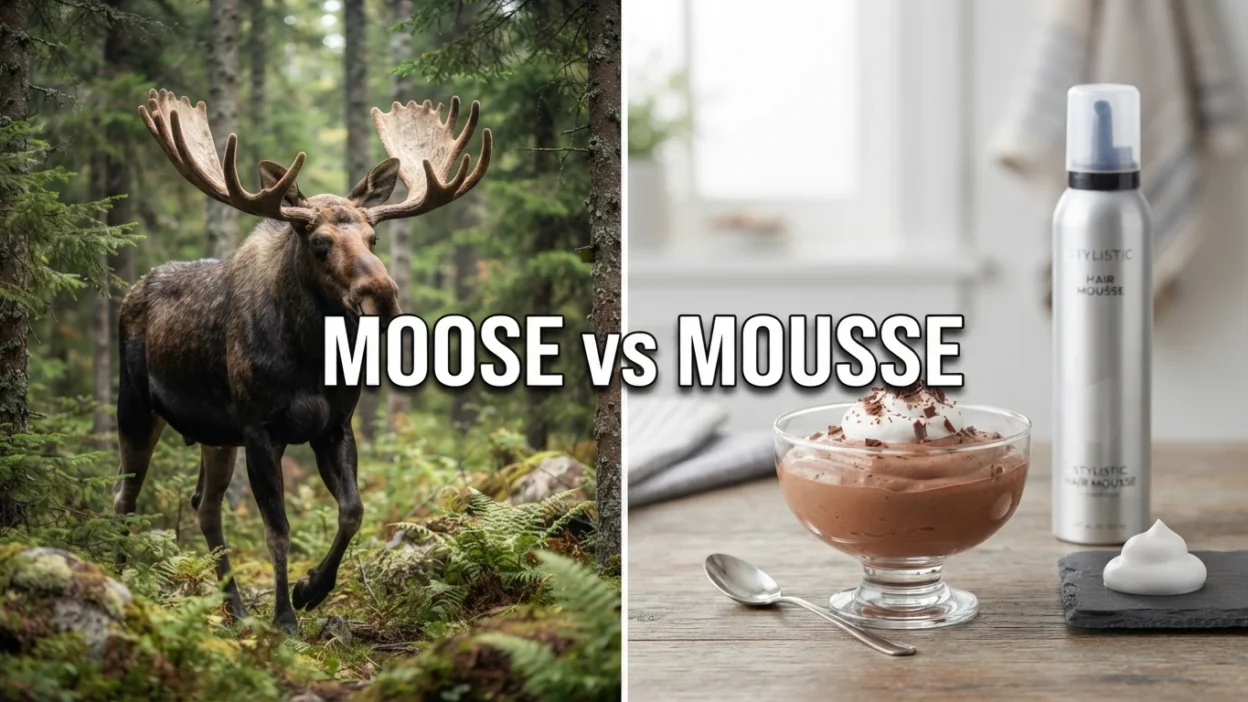
If you have ever seen the words moose and mousse and wondered whether they are related, you are not alone. They look surprisingly similar, but they have completely different meanings. One refers to a large wild animal, while the other can describe a light, fluffy food or a styling product for your hair. The difference becomes especially important in writing because using the wrong word can completely change the meaning of a sentence.
In this guide, we’ll explain moose vs mousse in simple, practical English. You’ll learn their definitions, pronunciation, grammatical uses, common mistakes, and plenty of real world examples. Whether you are improving your vocabulary, studying English, or simply trying to remember which spelling belongs to the animal and which belongs to the dessert, this comparison will make the distinction easy to remember.
Quick Answer
Moose is a large North American deer known for its antlers. Mousse is a light, airy food or a foamy hair styling product. They are pronounced differently: moose sounds like “moos,” while mousse usually sounds like “mooss.”
Why People Confuse It
The main reason people confuse moose vs mousse is their nearly identical spelling and similar pronunciation.
Both words begin with m and contain oo or a similar vowel sound. When heard in conversation, the distinction can also be easy to miss, particularly for English learners.
However, their meanings are completely unrelated:
- Moose = a large animal in the deer family.
- Mousse = a light, airy food or a hair styling product.
There is also an important spelling difference:
- moose → animal
- mousse → food or hair product
A simple context check usually tells you which word is correct.
First Word: Moose
Moose is a noun that refers to a very large deer found primarily in northern regions of North America, Europe, and Asia.
A moose is easily recognized by its enormous size, long legs, broad head, and, in males, large antlers.
Moose meaning
Moose means a large hoofed mammal belonging to the deer family.
For example:
We saw a moose near the lake.
Here, moose clearly refers to the animal.
Is “moose” singular or plural?
One unusual feature of moose is that the word stays the same in the plural.
- One moose
- Two moose
- Several moose
You generally do not say “mooses” in standard English when referring to multiple animals.
Examples:
- A moose crossed the road.
- We saw three moose in the forest.
- The park is home to many moose.
Pronunciation of moose
Moose is pronounced approximately:
/muːs/
It rhymes with:
- goose
- loose
- juice
- noose
Second Word: Mousse
Mousse is a noun borrowed from French. In English, it commonly refers to a light, airy preparation of food or a foamy product used to style hair.
Mousse meaning in food
In cooking, mousse is a soft, light, fluffy dish made by incorporating air into ingredients such as chocolate, cream, eggs, or fruit.
For example:
She ordered chocolate mousse for dessert.
Chocolate mousse is probably the most familiar culinary use of the word.
Mousse meaning in hair care
Mousse can also refer to a lightweight, foamy hair styling product.
It is often applied to the hair to add:
- Volume
- Texture
- Hold
- Definition
For example:
She applied mousse to her hair before blow drying it.
Pronunciation of mousse
In English, mousse is usually pronounced:
/muːs/
It therefore sounds essentially the same as moose in standard English pronunciation.
That makes context and spelling particularly important.
Moose vs Mousse: Comparison Table
| Feature | Moose | Mousse |
| Part of speech | Noun | Noun |
| Meaning | A large deer like animal | A light food or hair styling product |
| Main context | Wildlife, nature, geography | Food, cooking, beauty, hair care |
| Pronunciation | /muːs/ | /muːs/ |
| Plural | moose | mousses |
| Example | We saw a moose. | I ordered chocolate mousse. |
| Origin | English | French |
| Refers to an animal? | Yes | No |
The most important distinction is meaning and spelling, because the two words are generally pronounced the same.
When to Use Each
Choosing between moose and mousse is easy when you focus on the context.
Use “moose” when talking about an animal
Use moose when your sentence involves:
- Wildlife
- Forests
- National parks
- Antlers
- Deer
- Nature
- North American animals
Example:
The photographer waited quietly for the moose to emerge from the trees.
Use “mousse” when talking about food
Use mousse when discussing:
- Chocolate
- Desserts
- Cream
- Fruit
- Restaurants
- Recipes
- Cooking
Example:
The restaurant serves a delicious raspberry mousse.
Use “mousse” when talking about hair
Use mousse for a foamy hair product.
Example:
This mousse gives my hair more volume.
A useful question to ask yourself is: Am I talking about an animal, food, or hair product?
Animal = moose
Food or hair product = mousse
Moose vs Mousse Examples
Here are more than 10 examples showing the difference clearly.
Examples with “moose”
- We spotted a moose beside the river.
- The moose had enormous antlers.
- A moose wandered through the forest.
- The wildlife guide warned us not to approach the moose.
- Several moose live in this region.
- We were lucky enough to photograph two moose.
- The road sign warned drivers about moose crossing the highway.
- The young moose followed its mother through the woods.
- The national park is famous for its moose population.
- We watched a moose grazing near the lake.
Examples with “mousse”
- I ordered chocolate mousse after dinner.
- The chef prepared a delicate lemon mousse.
- She bought a new hair mousse.
- Apply a small amount of mousse to damp hair.
- The strawberry mousse was light and creamy.
- This styling mousse helps control frizz.
- The dessert menu includes chocolate mousse.
- He used mousse to add volume to his hair.
Notice how the surrounding words immediately reveal which spelling is appropriate.
Common Mistakes
1. Writing “mousse” for the animal
Incorrect:
We saw a large mousse in the forest.
Correct:
We saw a large moose in the forest.
If you are talking about wildlife, the correct spelling is moose.
2. Writing “moose” for a dessert
Incorrect:
I had chocolate moose for dessert.
Correct:
I had chocolate mousse for dessert.
The dessert is spelled mousse.
3. Assuming pronunciation will help
Because moose and mousse are normally pronounced alike in English, listening alone may not tell you which word is intended.
Instead, pay attention to context.
4. Using “mooses” as the plural
In standard English, the plural of moose is normally still moose.
Correct:
We saw five moose.
Not:
We saw five mooses.
By contrast, mousse can take the regular plural mousses when talking about different types or servings.
5. Confusing mousse with another hair product
Hair mousse is not the same thing as hair spray, gel, or wax. Mousse is typically a lightweight foamy styling product.
Memory Trick
Here is an easy way to remember moose vs mousse:
MOOS(E) = animal
Think of the E at the end of moose as standing for elk like animal.
For mousse, remember:
MOUSSE = food or foam
Chocolate mousse is fluffy, and hair mousse is foamy.
Another quick trick:
Moose has one “s” sound and one E at the end; mousse has a French looking spelling and usually relates to food or hair.
If you remember animal = moose, you will get the most important distinction right.
American vs British English
The meanings and spellings of moose and mousse are essentially the same in American and British English.
There is no major US versus UK spelling difference such as color/colour or favorite/favourite.
Both varieties use:
- moose for the animal
- mousse for the food
- mousse for the hair product
Pronunciation is also generally the same within each variety, with both words commonly pronounced /muːs/.
The biggest challenge is therefore not regional English but spelling and context.
Similar Words
Several words can cause confusion because they are connected to the same topics.
Moose vs elk
Both are members of the deer family, but they are different animals.
- Moose = very large deer with broad, distinctive antlers in males.
- Elk = another large deer species, generally smaller than a moose.
Mousse vs pudding
Both can be desserts, but they have different textures and preparation methods.
- Mousse = usually light and airy.
- Pudding = generally thicker and creamier.
Mousse vs foam
Foam is a broad term for bubbles or a bubbly substance, while mousse is a specific culinary or cosmetic term.
Mousse vs gel
In hair care:
- Mousse is typically lightweight and foamy.
- Gel is usually thicker and provides a different type of hold and texture.
FAQs
Is “moose” and “mousse” the same word?
No. Moose refers to a large animal in the deer family, while mousse usually refers to a light food or a foamy hair styling product.
Are moose and mousse pronounced the same?
Yes. In standard English, both are generally pronounced /muːs/, rhyming with “goose” and “juice.”
What is the plural of moose?
The plural of moose is normally moose.
- One moose
- Two moose
- Many moose
What is chocolate mousse?
Chocolate mousse is a light, airy chocolate dessert typically made with ingredients such as chocolate, cream, eggs, or other ingredients that create a fluffy texture.
What is hair mousse?
Hair mousse is a lightweight, foamy styling product used to add volume, texture, definition, or hold to hair.
Can I write “mooses” for more than one animal?
In standard English, moose is normally used for both singular and plural. “Mooses” is generally not the standard plural form.
Is mousse always a dessert?
No. Mousse can refer to a variety of light, airy foods, and the word is also commonly used for a foamy hair styling product.
Final Verdict
The difference between moose and mousse is simple once you connect each spelling with its meaning. Moose is the animal, while mousse is a light, airy food or a foamy hair product.
Because the two words are generally pronounced the same, spelling and context are your best clues. If you are writing about forests, wildlife, antlers, or deer, choose moose. If you are discussing chocolate, desserts, hair styling, or volume, choose mousse.
Remember This
Moose = the animal 🫎
Mousse = the food or hair product 🍫💇
If you are unsure, ask yourself: “Am I talking about an animal or something fluffy/foamy?” Animal → moose. Food or hair product → mousse.
Conclusion
Although moose and mousse look almost identical and are usually pronounced the same, they have completely different meanings. Moose is a large member of the deer family, whereas mousse describes a light, airy food or a foamy hair styling product. Their identical pronunciation makes spelling especially important.
Once you associate moose with wildlife and mousse with food or hair, the distinction becomes easy. Keep the context in mind, remember that the plural of moose is also moose, and you will be able to use both words confidently in everyday English.

Adam Aaron writes engaging mystery and adventure novels featuring intelligent characters, unexpected twists, and emotional storytelling. His creative imagination and compelling narratives have earned admiration from readers across generations.