If you have ever written an angry text, reacted to a mistake, or quoted someone’s frustrated remark, you may have wondered whether “dammit” or “damnit” is the correct spelling. Both forms appear online and in informal writing, and they sound virtually identical when spoken. That makes this pair especially easy to confuse.
The good news is that the difference is fairly simple. “Dammit” is the standard spelling and the safest choice when you want to write the exclamation in English. “Damnit” is also commonly seen, particularly in casual online communication, but it is generally treated as a nonstandard or variant spelling. Understanding this small distinction can help you choose the appropriate form in emails, dialogue, social media posts, and everyday writing.
Quick Answer
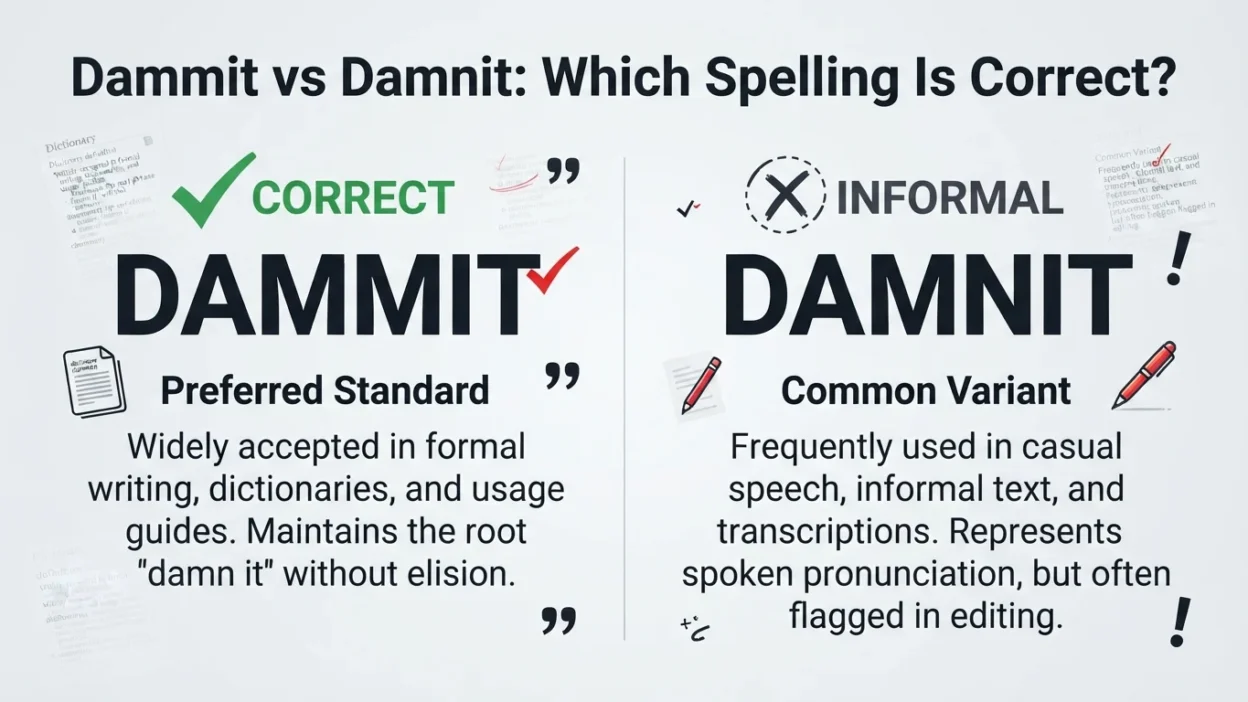
Dammit is the standard and most widely accepted spelling of the exclamation used to express anger, frustration, or annoyance. Damnit is a common informal variant, but “dammit” is the better choice in standard writing. Both are pronounced essentially the same way.
Why People Confuse It
The confusion between dammit and damnit comes mainly from pronunciation.
When people say the word quickly, the final sound can resemble either spelling. In informal speech, the word may also be pronounced with considerable emphasis, making it difficult to determine whether the speaker is saying “dammit” or “damnit.”
There is another reason for the confusion: damnit is widely used online. Social media posts, text messages, forums, subtitles, and informal dialogue often contain both spellings.
A few factors contribute to the confusion:
- Both words are pronounced almost identically.
- Both are used to express frustration or anger.
- “Damnit” looks like a plausible spelling based on pronunciation.
- Informal writing does not always follow dictionary standard spelling.
- People often encounter the variant repeatedly online and assume it is equally standard.
For everyday writing, however, dammit is the safer spelling.
First Word: Dammit
Dammit is the standard spelling of the informal interjection used to express anger, irritation, disappointment, or frustration.
It is essentially a written representation of the expression “damn it.” Over time, the two words became commonly written together as dammit.
Meaning of “dammit”
“Dammit” can communicate several related emotions:
- Anger
- Frustration
- Irritation
- Disappointment
- Exasperation
- Surprise at an unpleasant situation
For example:
“Dammit, I forgot my keys.”
Here, the speaker is frustrated with their mistake.
The word can also be used for emphasis:
“Dammit, we have to leave now.”
In this case, the speaker is showing strong frustration or urgency.
Is “dammit” a swear word?
Yes. Dammit is generally considered mild profanity or an offensive exclamation, although its strength depends on the context, audience, and culture.
It is much less severe than many stronger English swear words, but it may still be inappropriate in formal, professional, academic, or religious settings.
Second Word: Damnit
Damnit is a common informal spelling of the same exclamation.
It is frequently found in casual writing, especially online. However, it is generally regarded as a nonstandard spelling or variant form, whereas dammit is the preferred standard spelling.
For example:
“Damnit, I missed the train.”
Most readers will understand exactly what the writer means. Nevertheless, if you are writing carefully or want to use the conventional spelling, write:
“Dammit, I missed the train.”
Why does “damnit” exist?
The spelling “damnit” probably feels natural because writers often spell words according to how they sound. Since the final portion of dammit may sound similar to “nit” in rapid speech, “damnit” can seem logical.
However, familiar does not necessarily mean standard.
If you are unsure which form to use, choose dammit.
Comparison Table
| Feature | Dammit | Damnit |
| Standard spelling | Yes | Generally no |
| Common in informal writing | Yes | Yes |
| Meaning | Anger, frustration, annoyance | Anger, frustration, annoyance |
| Pronunciation | Essentially the same | Essentially the same |
| Appropriate for formal writing | Usually no because of profanity | No |
| Preferred spelling | Yes | No |
| Example | “Dammit, I forgot!” | “Damnit, I forgot!” |
The important point is that the difference is primarily spelling, not meaning. Both forms are intended to represent the same exclamation.
When to Use Each
Use “dammit” when:
Use dammit when you want the conventional spelling in informal dialogue or writing.
Examples include:
- Fictional dialogue
- Personal writing
- Text messages
- Informal conversations
- Social media posts
- Creative writing
- Quoted speech
Example:
“Dammit! I left my wallet at home.”
Use “damnit” when:
You may encounter or intentionally use damnit in very informal writing, particularly when reproducing someone else’s original spelling or deliberately adopting an internet style spelling.
However, it is not the best choice when you are trying to demonstrate standard English spelling.
Avoid both in formal situations
Even though dammit is the preferred spelling, the word itself is still informal and mildly profane.
In a professional email, academic essay, business report, or formal letter, alternatives such as these are usually better:
- “Unfortunately”
- “That’s frustrating.”
- “Oh no.”
- “This is disappointing.”
- “I’m extremely frustrated.”
Examples: Dammit vs Damnit in Sentences
Here are examples showing how the two forms work in context.
- Dammit, I forgot to charge my phone.
- Dammit! We’re already late.
- “Dammit,” he muttered after dropping the glass.
- Dammit, that was the last train.
- She shouted, “Dammit, stop doing that!”
- Damnit, I knew I had forgotten something.
Informal variant spelling. - “Damnit!” he said when the computer crashed.
Common online or informal spelling. - Dammit, I pressed the wrong button again.
- I thought, “Dammit, this cannot be happening.”
- Dammit, we were so close to winning.
- He whispered, “Dammit,” when he realized his mistake.
- Damnit, my alarm didn’t go off!
Understandable, but “dammit” is the standard spelling.
Notice that changing dammit to damnit does not normally change the meaning. The main distinction is that dammit is the conventional spelling, while “damnit” is generally treated as an informal variant or nonstandard form.
Common Mistakes
1. Assuming “damnit” is the standard spelling
Because “damnit” is common online, many people assume it is the dictionary preferred form.
Better: Use dammit when you want the standard spelling.
2. Treating “dammit” and “damnit” as different words
They do not normally represent different meanings.
Dammit and damnit are used as exclamations expressing similar emotions.
3. Using “dammit” in formal writing
Even though “dammit” is correctly spelled, it remains an informal expression and mild profanity.
Instead of:
“Dammit, the figures are wrong.”
A formal report could say:
“Unfortunately, the figures are incorrect.”
4. Thinking pronunciation determines spelling
English spelling is not always a direct representation of pronunciation. A word can sound one way while having a conventional spelling that differs from what you might expect.
5. Overusing the expression
“Dammit” can add emotion to dialogue, but repeated use can make writing sound unnatural or unnecessarily aggressive.
Memory Trick
Here is an easy way to remember the difference:
Dammit = damn + it
Think of the original expression:
Damn it!
When written as one word, the conventional form is:
Dammit!
So remember:
DAMN + IT → DAMMIT
The spelling damnit may look tempting because of pronunciation, but dammit is the form to choose when you want standard usage.
American vs British English
The spelling issue is not primarily a difference between American and British English.
Dammit is used and understood in both varieties of English. Damnit can also appear in informal writing in different English speaking communities.
The bigger distinction is between standard and informal/nonstandard spelling, rather than between American English and British English.
There can be differences in how strongly the expression is perceived depending on context and audience, but neither American nor British English requires “damnit” instead of “dammit.”
So if you are learning English and want one spelling to remember, choose:
Dammit.
Similar Words
Several English expressions can convey a similar sense of frustration or annoyance.
Damn
Damn can function as an exclamation or verb.
“Damn! I missed the bus.”
It is related directly to “dammit.”
Darn
Darn is a milder euphemism for “damn.”
“Darn, I forgot my umbrella.”
It is often more acceptable in family friendly situations.
Dang
Dang is another mild substitute for “damn.”
“Dang, that was close!”
Drat
Drat is a relatively old fashioned and mild expression of annoyance.
“Drat! I left my notebook at home.”
Shoot
Shoot can also be used as a mild expression of frustration.
“Shoot, I forgot the appointment.”
Oh no
For completely neutral language, “Oh no” is a useful alternative.
“Oh no, I deleted the file.”
These alternatives can be particularly useful when writing for children, communicating professionally, or avoiding profanity.
Final Verdict
Dammit is the preferred spelling. It is the conventional written form of the informal exclamation derived from “damn it,” and it is widely recognized in English.
Damnit is a common informal variant, but it is generally not the spelling to choose when you want standard English. If you are writing an article, school assignment, professional document, or polished piece of content, use dammit only when the informal expression itself is appropriate—and otherwise consider a milder alternative.
Remember This
Dammit = standard spelling
Damnit = common informal variant
If you only remember one form, remember dammit.
FAQs
Is “dammit” or “damnit” correct?
Dammit is the standard and preferred spelling. Damnit is a common informal variant, but it is generally considered nonstandard.
Is “damnit” a misspelling of “dammit”?
In standard usage, “damnit” is generally treated as a nonstandard or variant spelling of dammit. It is nevertheless widely understood.
Are “dammit” and “damnit” pronounced the same?
They are normally pronounced essentially the same way. This similarity in pronunciation is one reason people confuse the spellings.
Is “dammit” a swear word?
Yes. “Dammit” is generally considered mild profanity or an offensive exclamation. It expresses anger, frustration, annoyance, or disappointment.
Can I use “dammit” in formal writing?
It is usually best to avoid it in formal writing because it is an informal exclamation and mild profanity. Use a neutral expression such as “unfortunately” or “that’s frustrating” when appropriate.
Which spelling should I use in an essay?
If the word is necessary because you are quoting dialogue or discussing the expression, dammit is the preferred spelling. Otherwise, a formal alternative may be more appropriate.
Why do people spell it “damnit”?
“Damnit” likely feels natural because it reflects how the expression can sound in rapid speech. Its widespread use online has also helped establish it as a familiar informal variant.
Conclusion
When choosing between dammit and damnit, the answer is straightforward: dammit is the standard spelling. Both forms are used to express frustration, anger, irritation, or disappointment, and most readers will understand either one. However, “damnit” is generally considered a nonstandard or informal variant rather than the preferred spelling.
For polished English, remember the original expression “damn it” and the conventional combined form “dammit.” And because the expression is mildly profane, consider your audience before using it. In formal or professional communication, a neutral alternative such as “unfortunately,” “oh no,” or “that’s frustrating” will usually be a better choice.
Remember This:
Choose “dammit” for the standard spelling. “Damnit” is a common informal variant.

Nova Turner specializes in imaginative science fiction blending futuristic technology, thrilling adventures, and powerful human emotions. Her innovative storytelling inspires curiosity, creativity, and exploration among readers of every age.