
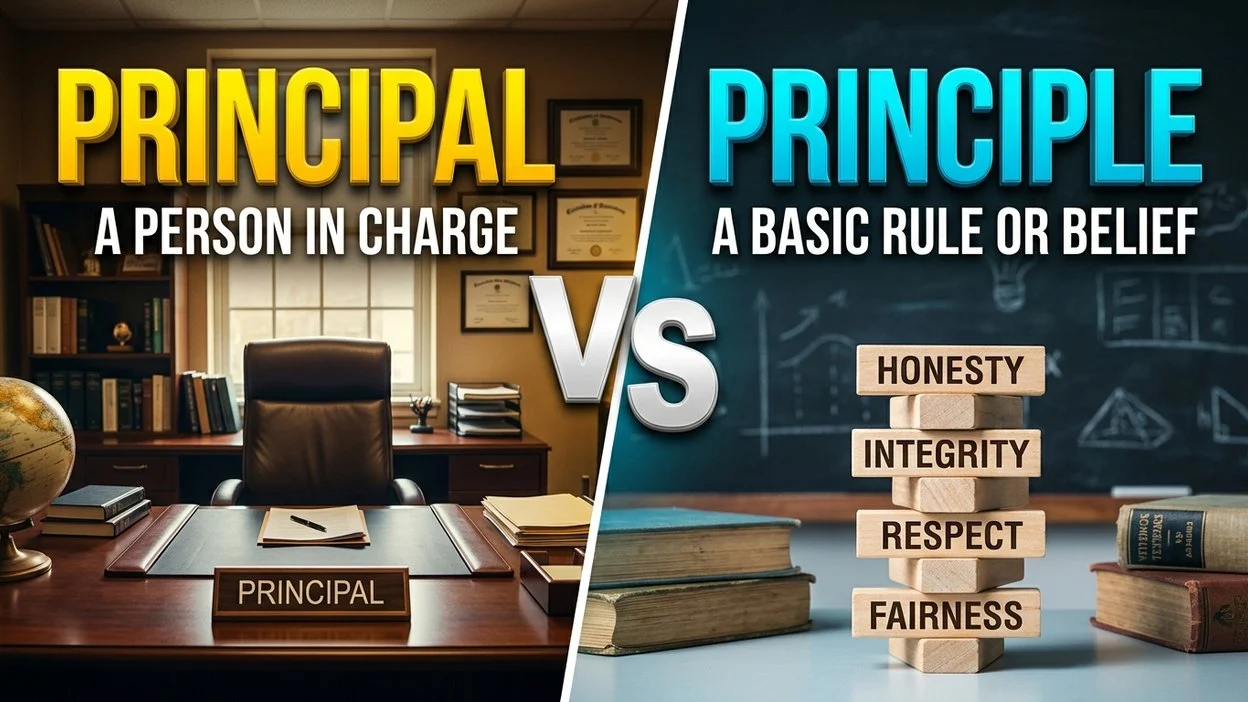
Have you ever wondered whether to write principal or principle? These two words sound exactly the same, but they have different meanings and uses. Choosing the correct word can be confusing for students, English learners, writers, and even people who use English every day. The good news is that understanding the difference is easier than you might think.
The main difference between principal and principle is their meaning. Principal usually refers to a person in charge, something most important, or the original amount of money in a loan or investment. Principle refers to a basic rule, belief, moral value, or general truth that guides decisions and behavior. Although both words are pronounced the same way, they cannot always replace each other in a sentence. Learning a few simple definitions, examples, and memory tricks will help you choose the right word confidently.
Quick Answer: Principal vs. Principle
Principal means the person in charge, the most important thing, or the original amount of money borrowed or invested. Principle means a basic rule, belief, moral value, or general truth. Both words sound the same, but their meanings and grammatical uses are different. Remember: the principal is a person or a primary thing; a principle is a rule or belief.
Why Do People Confuse Principal and Principle?
People confuse principal and principle because they are homophones. Homophones are words that have the same pronunciation but different meanings and spellings.
For example:
- The principal welcomed the new students.
- Honesty is an important principle of good leadership.
In the first sentence, principal refers to a school leader. In the second, principle refers to a moral belief.
Both words are pronounced approximately as PRIN-suh-puhl in common English pronunciation. Because you cannot hear the spelling difference, you must understand the meaning of the sentence to choose the correct word.
What Does Principal Mean?
Principal can be a noun or an adjective. It generally refers to a person in authority, something of primary importance, or the original amount of money involved in a financial agreement.
1. Principal as a Noun
As a noun, principal has several common meanings.
A person in charge of a school
A principal manages a school, supervises staff, supports students, and helps maintain educational standards.
Example: The principal announced the new school rules.
The most important person or participant
The word can refer to someone who has a leading role in an organization, business arrangement, or other activity.
Example: The principal of the organization approved the proposal.
The original amount of money
In finance, the principal is the original amount borrowed or invested, excluding interest.
Example: She paid back the principal on her loan over five years.
2. Principal as an Adjective
As an adjective, principal means main, primary, or most important.
Examples:
- Our principal concern is student safety.
- The principal reason for his absence was illness.
- Reading is a principal part of language learning.
In these sentences, principal describes something that has the greatest importance.
What Does Principle Mean?
Principle is a noun that refers to a fundamental rule, belief, moral value, or general truth. Principles help people decide what is right, understand how something works, or guide their actions.
1. Principle as a Moral Rule or Belief
A principle can be a personal value or ethical standard that guides behavior.
Examples:
- Honesty is an important principle of friendship.
- She refused to lie because it went against her principles.
- Fairness is a basic principle of good leadership.
These examples show how principles influence decisions and behavior.
2. Principle as a General Rule or Truth
A principle can also describe a basic idea or rule used in science, mathematics, education, business, and other fields.
Examples:
- The principle of gravity helps explain how objects fall.
- The teacher explained the basic principles of mathematics.
- The machine works according to a simple scientific principle.
In each sentence, principle refers to an idea or rule rather than a person or an amount of money.
Principal vs. Principle: What Is the Difference?
The following comparison makes the distinction easy to understand.
| Feature | Principal | Principle |
| Main meaning | Person in charge, main thing, or original amount of money | Basic rule, belief, or general truth |
| Part of speech | Noun or adjective | Noun |
| Common context | Schools, leadership, importance, finance | Ethics, science, education, beliefs |
| Example | The principal spoke to the class. | Honesty is a valuable principle. |
| Memory clue | Principal has an a like administrator | Principle has an e like ethics |
The simplest way to remember the difference is that principal refers to a person or something primary, while principle refers to a rule or belief.
When Should You Use Principal or Principle?
Choose the word that matches the meaning of your sentence.
Use Principal When Talking About a School Leader
Use principal when referring to the person who leads a school.
- The principal called a meeting with the teachers.
- Our school principal encouraged us to work hard.
- The principal congratulated the winning team.
Use Principal When Something Is Most Important
Use principal as an adjective when you mean main, leading, or primary.
- The principal objective is to improve reading skills.
- Her principal responsibility is managing the team.
- The principal cause of the delay was heavy traffic.
Use Principal in Financial Contexts
In banking and finance, principal means the original amount borrowed or invested, not the interest charged or earned.
- He borrowed $5,000 as the principal amount of his loan.
- The monthly payment covers both principal and interest.
- The investment earned interest on the principal.
Use Principle When Talking About Values
Use principle when discussing honesty, fairness, respect, responsibility, or other guiding beliefs.
- She believes in the principle of equal treatment.
- He stood by his principles despite the pressure.
- Respect is a fundamental principle of teamwork.
Use Principle When Describing Rules or Ideas
Use principle for a basic rule, scientific concept, or general truth.
- The principle of supply and demand affects prices.
- Students learned the principles of good writing.
- The design follows the principle of simplicity.
14 Examples of Principal vs. Principle in Sentences
These examples show how the two words work in everyday English.
- Principal: The principal greeted the students at the school entrance.
- Principle: Honesty is a principle I follow in my daily life.
- Principal: Safety is our principal concern during the trip.
- Principle: The principle of fairness applies to everyone.
- Principal: The principal organized a meeting for parents.
- Principle: She refused to accept a dishonest offer on principle.
- Principal: The principal amount of the loan was $10,000.
- Principle: The scientist explained the principle behind the experiment.
- Principal: His principal duty is to manage the department.
- Principle: Respect for others is an important social principle.
- Principal: The principal reason for the cancellation was bad weather.
- Principle: The principle of gravity explains why objects fall toward Earth.
- Principal: Most of the payment went toward reducing the loan principal.
- Principle: The company follows the principle that customers deserve fair treatment.
Notice that principal often refers to a person, a main responsibility, or money. Principle refers to a rule, belief, or idea.
Common Mistakes With Principal and Principle
Even though the difference is straightforward, several mistakes occur frequently.
Mistake 1: Using Principle for a School Leader
Incorrect: The principle welcomed the students.
Correct: The principal welcomed the students.
Why? A school leader is called a principal, not a principle.
Mistake 2: Using Principal for a Moral Belief
Incorrect: Honesty is an important principal.
Correct: Honesty is an important principle.
Why? A moral value or guiding belief is a principle.
Mistake 3: Confusing Principal and Interest
Incorrect: The interest is the original amount borrowed.
Correct: The principal is the original amount borrowed; interest is the additional amount charged for borrowing money or earned from lending or investing it.
Why? In finance, principal and interest are different components of a financial arrangement.
Mistake 4: Assuming Principal Always Refers to a Person
Incorrect assumption: Principal only means a school leader.
Correct understanding: Principal can also mean main or most important, and it can refer to the original amount of money borrowed or invested.
Example: The principal reason for the decision was cost.
Mistake 5: Using Principle as an Adjective
Incorrect: This is our principle objective.
Correct: This is our principal objective.
Why? Principal is the adjective meaning main or primary. Principle is a noun.
What Is an Easy Memory Trick for Principal vs. Principle?
Use these two simple memory tricks to remember the correct spelling.
1. Principal = Person or Primary
The word principal contains the letter a, which you can associate with administrator.
- The principal is the school administrator.
- The principal reason is the main reason.
- The principal amount is the original amount of money.
2. Principle = Ethics or Rule
The word principle contains the letter e, which you can associate with ethics.
- Honesty is a principle.
- Fairness is a principle.
- A scientific principle explains how something works.
Another useful reminder is:
The principal is your pal; a principle is a rule.
The phrase is a simple mnemonic, especially for students learning the difference between the two spellings.
Principal vs. Principle in American and British English
The meanings and spellings of principal and principle are the same in standard American and British English.
Both varieties use principal for a school leader, a main or primary thing, and the original amount of a loan. Both use principle for a moral belief, fundamental rule, or general truth.
The pronunciation is also essentially the same in both varieties, although individual accents may differ.
There is one related difference worth knowing: in some British English educational settings, the head of a school may be called a headteacher or headmaster rather than a principal. In American English, principal is the usual term for the leader of a school.
However, this regional difference does not change the spelling or meaning of principal and principle.
What Words Are Similar to Principal and Principle?
Several related words can help you understand the distinction more clearly.
Words Similar to Principal
- Main: The most important part of something.
- Primary: First in importance or order.
- Chief: The leading or most important.
- Administrator: A person who manages an organization or institution.
- Capital: Money or assets used for investment or business; in finance, this term is related to but not identical to principal.
Example: The principal reason, main reason, and primary reason all express a similar idea.
Words Similar to Principle
- Rule: An instruction or standard that guides behavior.
- Belief: Something a person accepts as true.
- Value: A quality or idea considered important.
- Ethic: A moral standard or guiding belief.
- Doctrine: A set of established beliefs or principles.
Example: Honesty can be described as a principle, a moral value, or an ethical belief, depending on the context.
These words are related in meaning, but they are not always interchangeable. Choose the word that best expresses your intended meaning.
Final Verdict: Principal or Principle?
The difference between principal and principle comes down to meaning.
Use principal when you mean a school leader, the main or most important thing, or the original amount of a loan or investment.
Use principle when you mean a fundamental rule, moral belief, ethical value, or general truth.
For example, write, “The principal explained the school’s principles.” The first word refers to the school leader, while the second refers to the school’s guiding rules or values.
FAQs:
1. What is the main difference between principal and principle?
Principal refers to a person in charge, something most important, or the original amount of money borrowed or invested. Principle refers to a basic rule, belief, moral value, or general truth. Their pronunciation is the same, but their meanings differ.
2. Is it school principal or school principle?
The correct term is school principal. A principal is the person who leads or manages a school. Principle means a rule or belief and does not refer to a school leader.
Example: The school principal welcomed the new students.
3. Is it principal or principle amount?
The correct phrase is principal amount. In finance, the principal is the original amount of money borrowed or invested, excluding interest.
Example: She paid off the principal amount of her loan.
4. Is honesty a principal or a principle?
Honesty is a principle because it is a moral value that guides a person’s actions and decisions.
Example: Honesty is an important principle in every healthy relationship.
5. Are principal and principle pronounced the same?
Yes. In standard English, principal and principle are homophones, meaning they have the same pronunciation but different meanings and spellings.
You usually need the context of the sentence to know which word is intended.
6. Can principal mean main or most important?
Yes. Principal can function as an adjective meaning main, primary, or most important.
Example: The principal objective of the lesson is to improve writing skills.
7. What is the difference between principal and interest?
The principal is the original amount borrowed or invested. Interest is the cost of borrowing that money or the return earned from lending or investing it.
For example, if someone borrows $1,000 and must repay $1,100 in total, the $1,000 is the principal and the additional $100 is the interest, assuming no other charges apply.
8. How can I remember principal vs. principle?
Remember principal = administrator or primary, and principle = ethics or rule.
You can also use the phrase “The principal is your pal” to remember that principal can refer to a person. Use principle for a belief, rule, or guiding value.
Remember This
- Principal: A school leader, a main thing, or the original amount of money.
- Principle: A rule, belief, moral value, or general truth.
- Principal example: The principal announced the new school policy.
- Principle example: Fairness is an important principle of good leadership.
When choosing between the two words, focus on what the sentence means rather than how the word sounds.
Conclusion:
Understanding the difference between principal and principle can make your English writing clearer and more accurate. Although the words sound alike, their meanings are different. Principal refers to a person in charge, something of primary importance, or the original amount of money in a financial arrangement. Principle refers to a fundamental rule, belief, moral value, or general truth.
The easiest way to remember the distinction is to connect principal with a person or something primary and principle with ethics or rules. Practice using both words in everyday sentences, pay attention to their context, and check their meanings whenever you are unsure. With a little practice, choosing the correct spelling will become much easier.

Willow Evans writes uplifting fantasy stories filled with magical worlds, courageous heroes, and meaningful life lessons. Her imaginative books encourage creativity, kindness, and hope in readers of all ages.