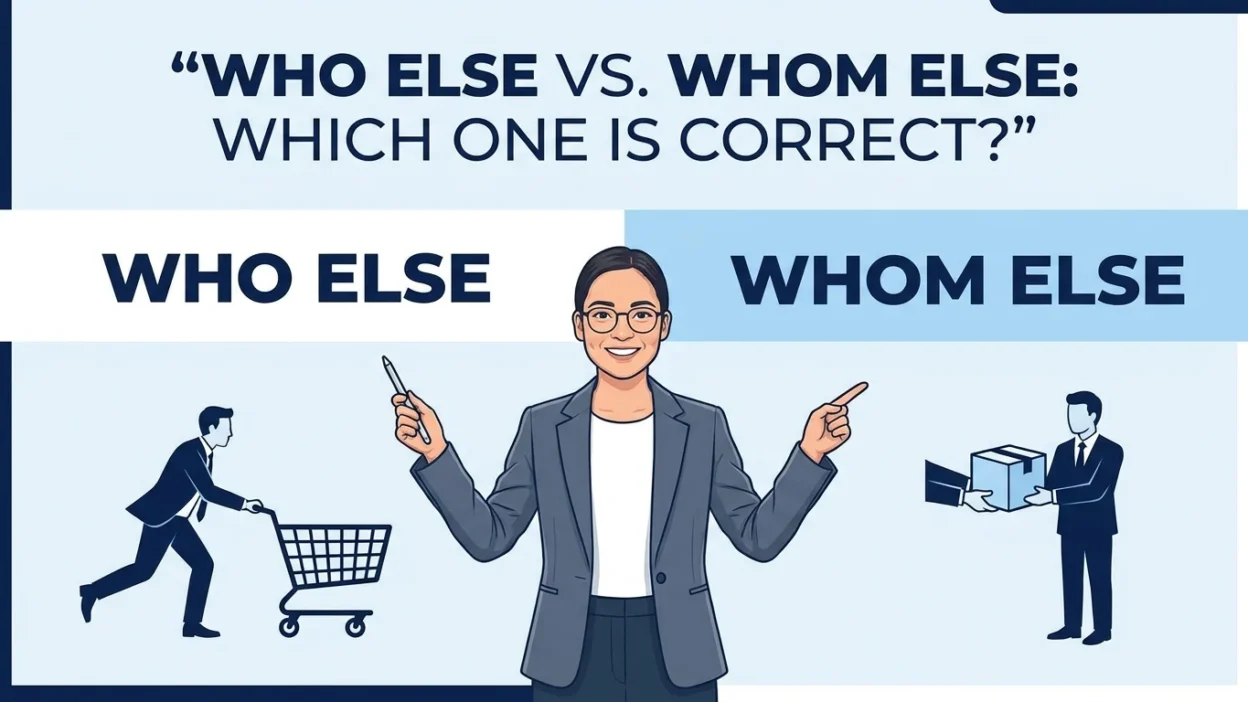
When you want to ask about another person, “who else” and “whom else” can both appear grammatically possible but they do not work in the same situations. The key difference is the grammatical role of the pronoun. Who is traditionally used for the subject of a clause, while whom is used for the object. This distinction can make phrases such as “Who else is coming?” and “Whom else did you invite?” easier to understand.
The good news is that you do not need to memorize complicated grammar rules. Once you know how to identify the subject and object, choosing between who else vs. whom else becomes much more straightforward. There is also an important point about modern English: who is increasingly used instead of whom, especially in everyday American and British speech. This guide explains the difference, gives you practical examples, and shows you when each form sounds natural.
Quick Answer
“Who else” is used when the person is the subject of a sentence, while “whom else” is traditionally used when the person is the object. For example, “Who else is coming?” but “Whom else did you invite?” In everyday English, “who else” is much more common.
Why People Confuse It
The confusion comes from the fact that who and whom refer to people, and else can follow either one.
The word else means “in addition to the person or people already mentioned or understood.”
For example:
- Who else is attending?
- Whom else did you call?
The tricky part is not actually else. The real issue is deciding whether the pronoun is functioning as a subject or an object.
There is also a difference between traditional grammar and modern usage. While whom remains grammatically correct in certain formal constructions, many native speakers naturally use who instead.
First Word: Who Else
“Who else” is used when the person being referred to is the subject of the verb.
In simple terms, ask:
Who is doing the action?
If the answer is the person represented by the pronoun, who else is generally appropriate.
Examples
- Who else wants some coffee?
- Who else is coming to the party?
- Who else knows about this?
- Who else can help us?
In each case, who else is connected to the person performing or experiencing the action.
“Who else” in questions
This expression is extremely common in everyday English:
Who else is going with you?
Here, “who else” is the subject of is going.
Another example:
Who else called you?
The person referred to by “who else” is doing the calling.
Second Word: Whom Else
“Whom else” is traditionally used when the person is the object of a verb or preposition.
In other words, ask:
Whom did someone do something to, for, with, or about?
For example:
Whom else did you invite?
The subject is you, and the person receiving the action of invite is the object.
Therefore, traditional grammar favors whom else.
Examples
- Whom else did you contact?
- Whom else should we ask?
- Whom else have they invited?
- Whom else are you talking about?
However, there is an important practical point: these sentences can sound formal or somewhat old fashioned in ordinary conversation.
Many speakers would simply say:
Who else did you invite?
That version is extremely common and natural in modern English.
Comparison Table
| Feature | Who else | Whom else |
| Grammatical role | Usually subject | Traditionally object |
| Typical question | Who else is coming? | Whom else did you invite? |
| Everyday usage | Very common | Less common |
| Formal grammar | Correct as subject | Correct as object |
| Modern conversation | Natural | Often sounds formal |
| After a preposition | Less traditional | Traditionally preferred |
| Example | Who else knows? | Whom else did you tell? |
When to Use Each
Use “who else” when:
- The pronoun is the subject.
- The person is performing the action.
- You are speaking casually.
- You want your sentence to sound natural and conversational.
Examples:
Who else wants pizza?
Who else knows the answer?
Who else is joining us?
Use “whom else” when:
- The pronoun is the object.
- The sentence is formal or carefully follows traditional grammar.
- The person is receiving the action.
Examples:
Whom else did you interview?
Whom else should I notify?
Whom else were they discussing?
A useful modern English tip
If you’re writing a formal document, whom can still be a good choice when it clearly functions as an object. But in ordinary conversation, who else is often the more natural choice even when traditional grammar would recommend whom else.
Examples
- Who else is coming to dinner?
“Who else” is the subject of “is coming.” - Who else wants to join us?
“Who else” performs the action of wanting. - Who else knows the truth?
“Who else” is the subject of “knows.” - Who else can solve this problem?
“Who else” is the subject of “can solve.” - Who else called this morning?
“Who else” performs the action of calling. - Whom else did you invite?
“Whom else” is the object of “invite.” - Whom else did she contact?
“Whom else” receives the action of “contact.” - Whom else should we inform?
“Whom else” is the object of “inform.” - Whom else did they interview?
“Whom else” receives the action of “interview.” - Whom else were you talking about?
“Whom else” is the object of the preposition “about.” - Who else could have done it?
“Who else” is the subject of “could have done.” - Who else did you see at the event?
Traditionally, “whom else” would be preferred because the pronoun is the object. However, who else is very common in modern English.
That last example demonstrates why grammar rules and real world usage do not always line up perfectly.
Common Mistakes
1. Assuming “who” is always correct
Some learners use who in every situation.
While modern English often accepts this in conversation, traditional grammar distinguishes between who and whom.
Compare:
- Who else is coming? ✓
- Whom else did you invite? ✓ traditionally
2. Assuming “whom” is always more correct
Using whom everywhere can make your English sound unnecessarily formal.
For example:
Whom else is coming to the party?
This is incorrect because “whom else” is the subject of “is coming.”
The correct form is:
Who else is coming to the party?
3. Forgetting the verb test
When you’re unsure, look at the verb.
Ask:
- Is the person doing the action? → who
- Is the person receiving the action? → traditionally whom
For example:
Who else called?
The person called someone else, so who is the subject.
But:
Whom else did you call?
“You” performed the action, while the other person received it.
4. Ignoring modern usage
Grammar books may teach a strict who/whom distinction, but actual English is more flexible.
In particular, who has become increasingly common in places where traditional grammar would use whom.
Memory Trick
Use this simple substitution trick:
Who = he/she
Whom = him/her
Try replacing the pronoun.
Example 1
Who else is coming?
Replace “who” with “she”:
She is coming.
That works, so who is correct.
Example 2
Whom else did you invite?
Replace “whom” with “her”:
You invited her.
That works, so traditional grammar calls for whom.
Easy shortcut
He/she → who
Him/her → whom
This is one of the easiest ways to remember the traditional distinction.
American vs British English
Both American and British English recognize the traditional distinction between who and whom.
However, everyday speech in both varieties commonly favors who, particularly when whom would sound stiff or overly formal.
For example, in ordinary conversation, you are very likely to hear:
Who else did you invite?
rather than:
Whom else did you invite?
In formal writing, legal language, academic prose, and other careful contexts, whom still appears more frequently when it functions as an object.
So the difference is not simply American = who and British = whom. Both varieties use both forms, but who is generally more dominant in informal modern English.
Similar Words
Several related expressions follow the same grammatical pattern.
Who
Used as a subject:
Who called you?
Whom
Traditionally used as an object:
Whom did you call?
Whoever
Usually used when referring to an unspecified person as a subject:
Whoever arrives first can choose a seat.
Whomever
The traditional object form:
Give the invitation to whomever you choose.
However, whomever is relatively formal and uncommon in everyday speech.
Which
“Which” can refer to things or, in some contexts, people:
Which one do you prefer?
The same subject object distinction can become relevant in more formal constructions.
FAQs
Is “who else” grammatically correct?
Yes. “Who else” is completely correct when the pronoun functions as the subject, as in “Who else is coming?” It is also very common in everyday English.
Is “whom else” correct?
Yes, when whom functions as an object under traditional grammar rules. For example, “Whom else did you invite?” is grammatically correct in formal usage.
Should I say “who else did you invite” or “whom else did you invite”?
Traditionally, “whom else did you invite?” is preferred because the pronoun is the object of “invite.” However, “who else did you invite?” is extremely common and natural in modern English.
Is “who else” more common than “whom else”?
Yes. “Who else” is much more common, particularly in everyday conversation and informal writing.
Can “who else” be used as an object?
Yes, especially in modern informal English. Although traditional grammar may prescribe whom, modern speakers frequently use who in object positions.
How can I quickly tell whether to use who or whom?
Use the he/she versus him/her test. If “he” or “she” fits, use who. If “him” or “her” fits, traditional grammar calls for whom.
Is “whom else” too formal?
Not necessarily, but it can sound formal in casual conversation. In many everyday situations, who else will sound more natural.
Final Verdict
The traditional rule is straightforward: use who else when the person is the subject and whom else when the person is the object.
For example:
- Who else is coming? ✓
- Whom else did you invite? ✓ traditionally
However, modern English is less strict about whom than older grammar rules were. In everyday speech, who else is often used even where traditional grammar would recommend whom else.
Remember This
Who else = who is doing the action.
Whom else = whom is receiving the action.
And if you’re speaking naturally in everyday English, “who else” will usually be the form you hear and use most often.
Conclusion
Understanding who else vs. whom else becomes much easier when you focus on grammatical function rather than trying to memorize isolated phrases. Who traditionally acts as the subject, while whom acts as the object. The simple he/she versus him/her test can help you make the distinction quickly.
At the same time, good English usage is about more than rigid rules. Modern speakers frequently use who instead of whom, especially in conversation. So learn the traditional distinction because it helps you write accurately and understand formal English, but don’t be surprised when you hear “Who else did you invite?” in perfectly natural everyday speech.

Quinn Mitchell is celebrated for historical fiction that combines authentic settings, unforgettable characters, and compelling narratives. His thoughtful writing brings history alive while inspiring curiosity and deeper understanding among readers.