
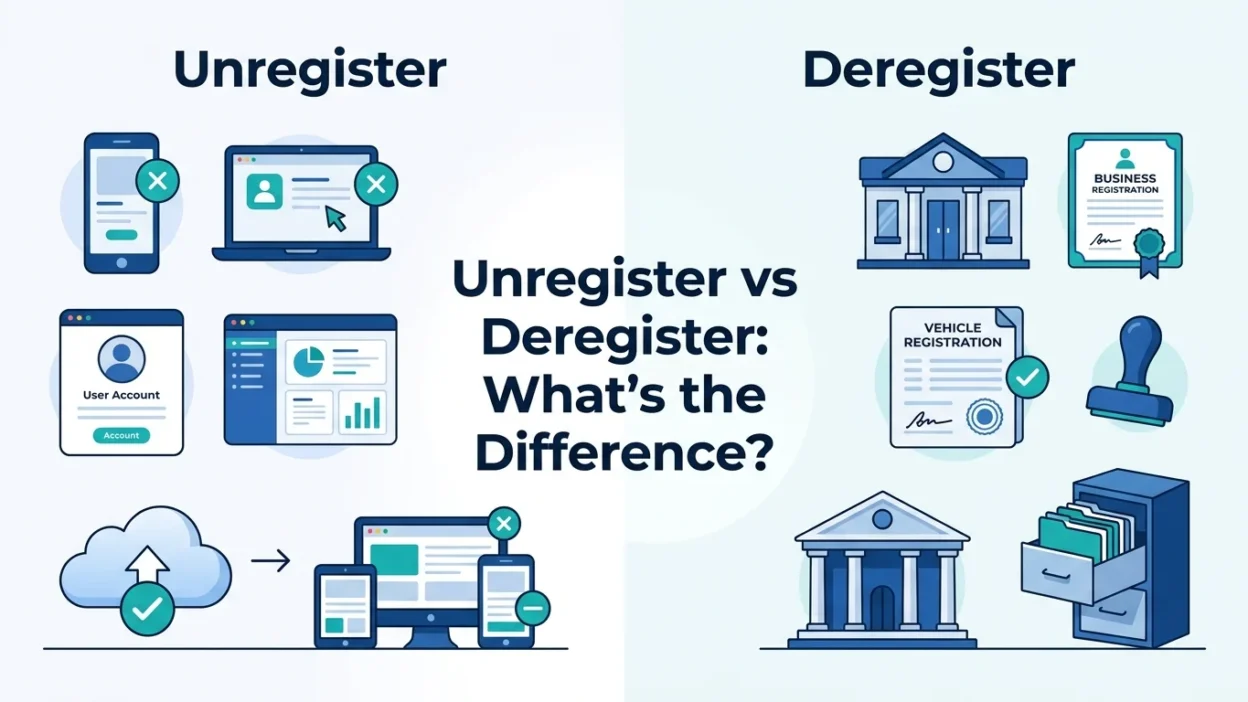
The words unregister and deregister often appear to mean exactly the same thing. Both describe removing something from an official register, system, database, or list. Because they share a similar purpose, many English learners and even native speakers use them interchangeably without considering the subtle differences in meaning and usage.
In reality, the choice between unregister and deregister depends on context, regional preferences, and the type of action being described. Whether you’re talking about software, vehicles, businesses, online accounts, or official records, understanding the distinction helps you write and speak with greater precision. This guide explains the differences with practical examples, common mistakes, and simple memory tips.
Quick Answer
Unregister usually means removing a device, account, or object from a system or service. Deregister commonly refers to officially removing something from a legal, governmental, or administrative register. While both can mean “remove from a register,” deregister sounds more formal and is more common in official contexts.
Why People Confuse It
It’s easy to mix up these two words because they share the same root word: register.
People confuse them because:
- Both involve removing something from a register or list.
- Many software companies use both terms differently.
- Dictionaries list similar definitions.
- Different English speaking countries prefer one over the other.
- The context not the dictionary definition often determines the best choice.
Although they overlap, choosing the right word makes your writing sound more natural.
Unregister
Unregister means to remove a person, device, account, or object from a system, service, or database.
It is especially common in:
- Technology
- Software licensing
- User accounts
- Mobile devices
- Digital services
Examples
- Please unregister your old phone before selling it.
- I forgot to unregister the application.
- The software lets users unregister unused devices.
- You should unregister from the mailing list.
- The account was automatically unregistered after inactivity.
Common contexts
- Unregister a device
- Unregister an account
- Unregister from a course
- Unregister an application
- Unregister a service
Deregister
Deregister means to officially remove something from an official register, database, or legal record.
It is commonly used in:
- Government documents
- Vehicle registration
- Business registration
- Tax authorities
- Healthcare systems
Examples
- You must deregister your vehicle before exporting it.
- The company chose to deregister from the stock exchange.
- Residents must deregister when moving abroad in some countries.
- The organization was officially deregistered.
- The tax office instructed him to deregister his business.
Common contexts
- Deregister a vehicle
- Deregister a company
- Deregister a business
- Deregister with authorities
- Deregister an organization
Unregister vs Deregister Comparison Table
| Feature | Unregister | Deregister |
| Meaning | Remove from a system or service | Remove from an official register |
| Formality | Less formal | More formal |
| Common use | Technology, software, online accounts | Government, legal, administrative records |
| Often used with | Devices, apps, subscriptions | Vehicles, businesses, organizations |
| British English | Common | Very common in official writing |
| American English | More common | Used mainly in legal contexts |
When to Use Each
Choose unregister when discussing:
- Apps
- Devices
- User accounts
- Online services
- Digital platforms
- Software systems
Choose deregister when discussing:
- Government records
- Business registration
- Vehicle registration
- Official databases
- Legal documentation
- Administrative procedures
Examples
Here are examples showing both words in context.
- Please unregister your old computer before installing the software elsewhere.
- I need to unregister from the online workshop.
- The administrator unregistered inactive users.
- You should unregister your smartwatch before resetting it.
- Remember to unregister the printer from the network.
- She had to deregister her company after closing the business.
- They deregistered the vehicle before shipping it overseas.
- Students moving abroad may need to deregister with local authorities.
- The charity was officially deregistered last year.
- He forgot to deregister his business license.
- The software automatically unregistered the inactive device.
- The government deregistered the organization for failing to meet legal requirements.
Common Mistakes
Here are mistakes many learners make.
Incorrect: I deregistered my Netflix account.
Better: I unregistered my Netflix account.
Incorrect: Please unregister your company from the government register.
Better: Please deregister your company.
Incorrect: I deregistered my Bluetooth headphones.
Better: I unregistered my Bluetooth headphones.
Incorrect: The business unregistered with the tax authority.
Better: The business deregistered with the tax authority.
Memory Trick
Think of it this way:
- Unregister = Undo a registration in a system.
- Deregister = Delete from an official register.
A simple reminder:
Digital things are often unregistered. Official things are often deregistered.
While there are exceptions, this rule works in most everyday situations.
American vs British English
Both American and British English recognize unregister and deregister, but usage differs slightly.
American English
American English generally prefers unregister for software, technology, and user accounts. Deregister appears mostly in legal, governmental, or financial contexts.
British English
British English uses both words, but deregister appears more frequently in official documents involving taxes, vehicles, healthcare, and business registration.
Similar Words
You may also encounter these related terms:
- Remove
- Delete
- Cancel registration
- Withdraw
- Deactivate
- Disable
- Unenroll
- Opt out
- Revoke
- Terminate registration
Each has a slightly different meaning depending on the context.
Final Verdict
Although unregister and deregister share similar meanings, they are not always interchangeable.
Use unregister when removing something from a digital platform, software, or online service. Use deregister when referring to official records, government systems, businesses, or legal registrations. Matching the word to the context makes your English more accurate and professional.
Frequently Asked Questions (FAQs)
Is unregister the same as deregister?
Not exactly. Both mean removing something from a register, but unregister is more common for digital systems, while deregister is preferred for official or legal records.
Which word is more formal?
Deregister is generally more formal because it is commonly used in legal and administrative contexts.
Can I use unregister for a vehicle?
It’s better to use deregister because vehicle registration is an official government process.
Which word is common in software?
Unregister is the preferred choice for software, applications, devices, and online accounts.
Is deregister used in American English?
Yes, but mainly in legal, business, taxation, and government related situations.
Is unregister a real English word?
Yes. It is widely recognized and commonly used in technology and computing.
Can both words appear in dictionaries?
Yes. Most major dictionaries include both words, although their examples often reflect different contexts.
Conclusion
Choosing between unregister and deregister becomes much easier once you understand the context. While both involve removing something from a register, unregister is typically associated with technology, software, and online services, whereas deregister is the preferred term for legal, governmental, and administrative actions.
The best approach is to consider what is being removed. If it’s a digital account or device, unregister usually fits naturally. If it’s an officially recorded business, vehicle, or organization, deregister is generally the correct choice. Using the appropriate term improves clarity and helps your writing sound more fluent and professional.
Remember This
Use “unregister” for digital systems and online services. Use “deregister” for official, legal, business, or government records. Context not just meaning determines the right choice.

Hadley Price creates heartfelt contemporary fiction exploring relationships, hope, resilience, and personal growth. Her emotionally rich storytelling connects with readers through memorable characters and inspiring life experiences worldwide.