Have you ever typed “invision” when you actually meant “envision”? You’re not alone. These two words are frequently confused because they sound nearly identical when spoken. However, only one is recognised as a standard English verb, while the other has a very different meaning in modern contexts.
Understanding the difference between envision vs invision can improve your writing, prevent embarrassing spelling mistakes, and help you communicate more clearly. Whether you’re writing a business proposal, academic paper, email, or creative story, choosing the correct word matters. In this guide, you’ll learn what each term means, why people confuse them, practical examples, common mistakes to avoid, and an easy memory trick that will help you remember the difference forever.
Quick Answer
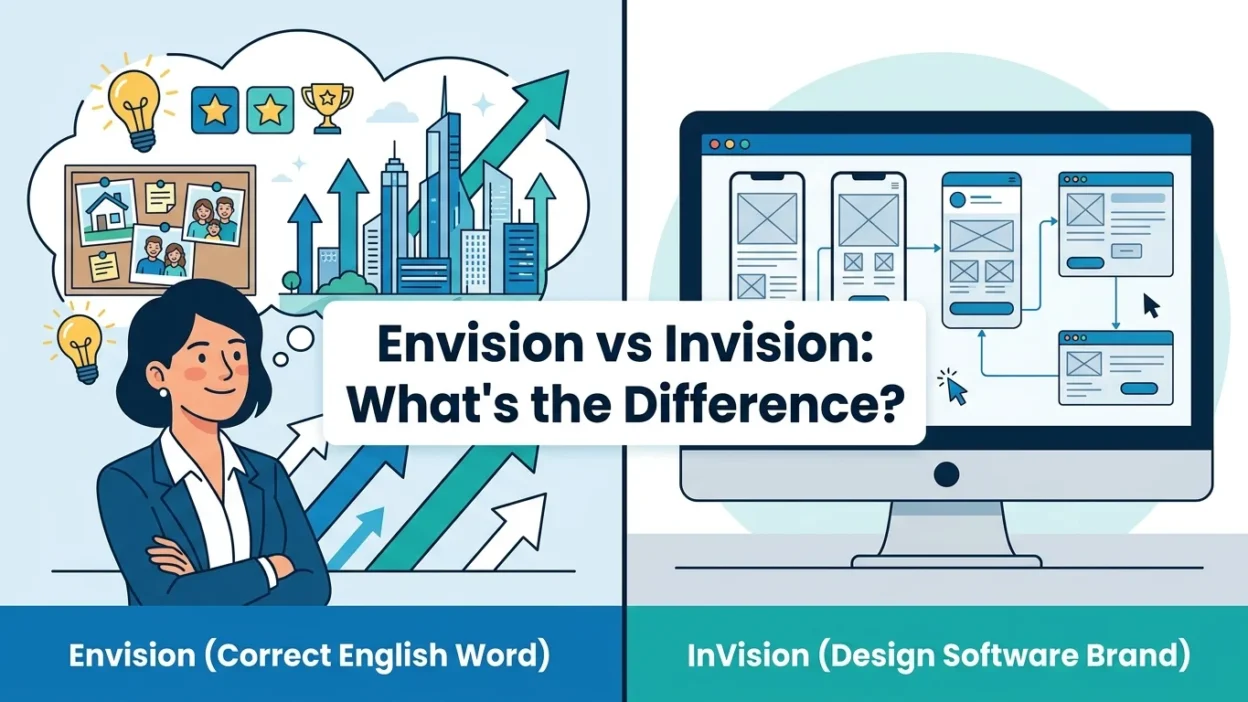
Envision is the correct English verb meaning to imagine or picture something in the future. Invision is not a standard English word. However, InVision (with a capital “V”) is the name of a popular digital product design and collaboration platform. In general writing, you almost always want envision.
Why People Confuse It
The confusion between envision and invision happens for several reasons:
- They sound almost identical.
- English prefixes en- and in- often appear in similar looking words.
- Spellcheck may not always catch InVision because it’s a recognised brand name.
- People assume “invision” is simply another spelling of “envision.”
- Fast typing often replaces en with in accidentally.
If you’re referring to imagining an idea or future event, envision is the correct choice.
Envision
Envision is a verb that means:
- To imagine vividly
- To picture mentally
- To think about a future possibility
- To form a clear vision of something
Examples
- I envision a brighter future for our company.
- She envisioned herself becoming a doctor.
- We can envision several possible outcomes.
- The architect envisioned a modern city skyline.
- Teachers encourage students to envision success.
Synonyms
- Imagine
- Picture
- Visualise
- Foresee
- Anticipate
- Dream of
- Conceive
Invision
Invision is not a recognised English dictionary word.
However, InVision (capitalised) is the name of a software company and design collaboration platform that allows teams to create prototypes, gather feedback, and collaborate on digital products.
Correct Example
- Our design team uses InVision to review app prototypes.
Incorrect Example
- ❌ I invision a better tomorrow.
- ✅ I envision a better tomorrow.
Unless you’re referring to the software brand, avoid using invision.
Comparison Table
| Feature | Envision | Invision |
| Part of speech | Verb | Not a standard English word |
| Meaning | To imagine or picture mentally | Incorrect spelling in general English |
| Dictionary recognised | Yes | No |
| Common usage | Everyday writing | Only as the brand InVision |
| Example | We envision growth. | Our team uses InVision software. |
When to Use Each
Use envision when you want to:
- Describe future goals
- Imagine possibilities
- Express long term plans
- Picture success
- Discuss creative ideas
Use InVision only when:
- Referring to the design software
- Mentioning the company by name
- Discussing UX/UI design tools
Examples
Here are practical examples showing correct usage.
- I envision opening my own business someday.
- The CEO envisioned global expansion.
- Can you envision life without smartphones?
- She envisioned a peaceful retirement.
- Scientists envision cleaner energy solutions.
- Parents often envision bright futures for their children.
- The author envisioned an entirely new world.
- We envision stronger customer relationships.
- The charity envisions a hunger free community.
- Designers collaborated using InVision.
- Our prototype was shared through InVision for feedback.
- The manager asked everyone to envision the project’s success.
Common Mistakes
Avoid these common errors:
- ❌ I invision myself graduating next year.
- ✅ I envision myself graduating next year.
- ❌ We invision many improvements.
- ✅ We envision many improvements.
- ❌ Invision is another spelling of envision.
- ✅ Invision is only correct when referring to the software brand.
Memory Trick
Remember this simple trick:
Envision begins with “en,” just like “enable.”
When you enable yourself to imagine the future, you envision it.
If you see InVision with a capital “V,” think of the software company rather than the English verb.
American vs British English
There is no difference between American and British English regarding this word.
| American English | British English |
| Envision | Envision |
Both varieties use envision with the same spelling and meaning.
The software brand InVision is also written the same way worldwide.
Similar Words
If you’re looking for alternatives, consider these words:
- Imagine
- Visualise (British English)
- Visualize (American English)
- Picture
- Foresee
- Anticipate
- Conceptualise
- Dream about
- Conceive
- Project
Each carries a slightly different nuance, but all relate to forming mental images or planning ahead.
Final Verdict
When comparing envision vs invision, the answer is straightforward.
Envision is the correct English verb used to describe imagining or picturing something mentally.
Invision is not a standard English word and should generally be avoided unless you’re specifically referring to InVision, the design software brand.
Choosing the right spelling helps your writing appear polished, professional, and grammatically accurate.
Frequently Asked Questions
Is “invision” a real English word?
No. It is not recognised as a standard English word. It is mainly seen as a misspelling of envision or as part of the InVision brand name.
Is envision grammatically correct?
Yes. Envision is a correct English verb meaning to imagine or picture something clearly.
Why do people write “invision”?
Most people spell it this way because it sounds similar to envision or because they’re familiar with the InVision software.
Can I use “InVision” in a sentence?
Yes, when referring to the software.
Example: Our UX designers presented the prototype using InVision.
Is envision formal or informal?
It works in both formal and informal writing, making it suitable for business, academic, and everyday communication.
What’s another word for envision?
Common alternatives include imagine, visualise, picture, foresee, and anticipate.
Conclusion
Although envision and invision may sound alike, they are not interchangeable. Envision is the proper English verb used when talking about imagining future possibilities, visualising goals, or forming mental pictures. It is widely accepted in both British and American English.
Meanwhile, InVision is simply the name of a well known design platform. Unless you’re discussing that software, always choose envision. Mastering this small spelling difference will make your writing more accurate, professional, and easier for readers to trust.
Remember This
Envision = imagine the future.
InVision = the software brand.
If you’re writing about ideas, dreams, goals, or possibilities, envision is almost always the correct choice.

Nova Turner specializes in imaginative science fiction blending futuristic technology, thrilling adventures, and powerful human emotions. Her innovative storytelling inspires curiosity, creativity, and exploration among readers of every age.