When you want to refer to your mother in everyday English, you may see two familiar spellings: mom and mum. Both words have the same basic meaning, but the spelling you choose often depends on the variety of English you are using. This is why learners sometimes wonder whether one is correct and the other is a mistake.
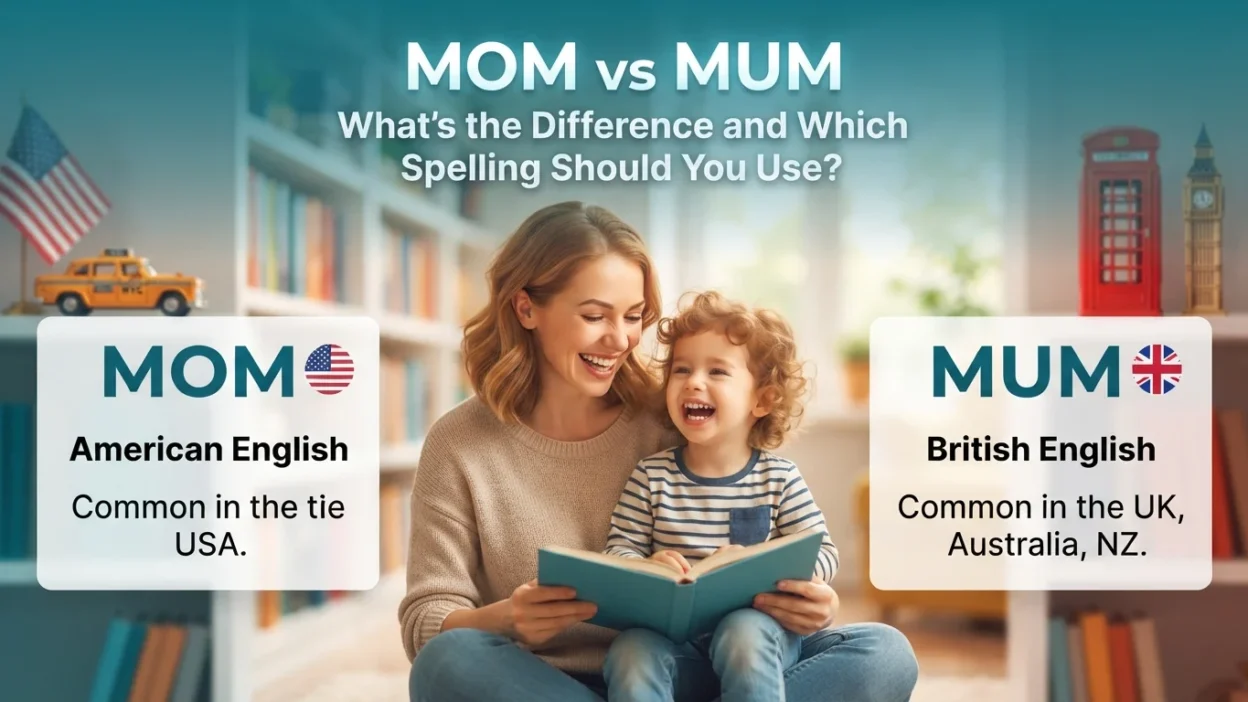
The good news is that both “mom” and “mum” are correct English words. “Mom” is strongly associated with American English, while “mum” is the usual form in British English and is also common in Australian and other varieties of English. The difference is mainly regional rather than grammatical. Understanding this distinction can help you choose the right spelling for your audience, writing style, or location. In this guide, we’ll compare mom vs mum, explain their pronunciation and usage, look at real examples, and show you an easy way to remember which form to use.
Quick Answer
Mom and mum both mean “mother.” Mom is most common in American English, while mum is preferred in British English and is widely used in Australia. Neither spelling is incorrect; choose the form that matches your variety of English and audience.
Why People Confuse It
People confuse mom vs mum because the two words have exactly the same basic meaning and are pronounced very similarly.
The difference is primarily regional spelling. English has many words that vary between American and British usage, and “mom” and “mum” are a good example.
For instance:
- American English: My mom is a doctor.
- British English: My mum is a doctor.
Both sentences are grammatically correct.
The confusion can become greater for English learners because “mum” has another meaning in British English: it can refer to being silent or saying nothing, as in “keep mum.”
Is “mom” or “mum” more correct?
Neither is universally more correct. The appropriate spelling depends on the variety of English you’re using.
If you’re writing for an American audience, mom is usually the natural choice. For a British audience, mum is generally preferred.
First Word: Mom
Mom is the common informal word for mother in American English.
It is a familiar, affectionate term and is widely used by children and adults when talking about their mothers.
Examples of “mom”
- My mom is making dinner tonight.
- I called my mom after work.
- My mom taught me how to swim.
- Her mom works at a local school.
- I bought a birthday gift for my mom.
Is “mom” informal?
Yes. Mom is generally an informal or familiar term for “mother.”
In formal writing, you would normally use mother instead.
Compare:
My mother attended the meeting.
with:
My mom attended the meeting.
The second sentence sounds more personal and conversational.
Capitalization of “Mom”
“Mom” is often capitalized when it is used like a name or direct form of address.
- I asked Mom if I could go.
- Thanks, Mom!
- Mom is coming home later.
But it is usually lowercase when preceded by a possessive or article:
- My mom is at home.
- Her mom called earlier.
- I spoke to his mom.
This same capitalization principle applies to mum.
Second Word: Mum
Mum is the standard informal word for mother in British English.
It is especially common in the United Kingdom and is also widely used in countries and regions influenced by British English.
Examples of “mum”
- My mum makes the best tea.
- I called my mum this morning.
- Her mum is a teacher.
- My mum gave me some great advice.
- I’m going to visit my mum this weekend.
Like “mom,” mum is informal and affectionate.
“Mum” has another meaning
There is an important additional use of mum.
In expressions such as “keep mum,” the word means silent or quiet.
For example:
- Please keep mum about the surprise.
- He kept mum about what had happened.
Here, “mum” does not mean mother.
This secondary meaning is one reason the word can sometimes seem confusing to English learners.
Comparison Table
| Feature | Mom | Mum |
| Meaning | Mother | Mother |
| Main variety | American English | British English |
| Common in | United States | United Kingdom |
| Also used in | Other American English contexts | Australia and other British English contexts |
| Formality | Informal | Informal |
| Pronunciation | Usually /mɑːm/ or similar | Usually /mʌm/ |
| Capitalized as a name/address | Yes | Yes |
| Formal equivalent | Mother | Mother |
| Other meaning | No common equivalent use | “Silent” in “keep mum” |
When to Use Each
The easiest rule is to match the spelling to your target audience.
Use “mom” when:
- You are writing in American English.
- Your audience is primarily American.
- You are writing dialogue for an American character.
- You are using an American style guide.
- The context is clearly American.
Example:
My mom is picking me up from school.
Use “mum” when:
- You are writing in British English.
- Your audience is primarily British.
- You are writing dialogue for a British character.
- You are following British spelling conventions.
- The context is British, Australian, or another variety where “mum” is customary.
Example:
My mum is picking me up from school.
What about international English?
If you’re writing for an international audience, either form can be understood easily. However, consistency matters.
If the rest of your article follows American spelling—such as color, favorite, and organize—then mom will generally fit better.
If you use British spellings such as colour, favourite, and organise, then mum is usually the better choice.
Mom vs Mum Examples
Here are more than ten examples showing how the two words work in everyday English.
- American: My mom is waiting outside.
British: My mum is waiting outside. - American: I need to call my mom.
British: I need to call my mum. - American: Her mom bought her a new laptop.
British: Her mum bought her a new laptop. - American: My mom loves gardening.
British: My mum loves gardening. - American: I learned this recipe from my mom.
British: I learned this recipe from my mum. - American: Mom, can you help me?
British: Mum, can you help me? - American: I’m going to visit my mom tomorrow.
British: I’m going to visit my mum tomorrow. - American: My friend’s mom is a nurse.
British: My friend’s mum is a nurse. - American: Mom made breakfast for everyone.
British: Mum made breakfast for everyone. - American: I bought flowers for my mom.
British: I bought flowers for my mum. - American: My mom always gives me good advice.
British: My mum always gives me good advice. - American: I thanked my mom for helping me.
British: I thanked my mum for helping me.
Notice that the grammar and meaning remain exactly the same. Only the regional word choice changes.
Common Mistakes
1. Thinking one spelling is wrong
A common mistake is assuming that “mom” is incorrect because you are more familiar with “mum,” or vice versa.
Both are correct.
2. Mixing regional styles unnecessarily
Using “mom” in otherwise strongly British writing can make the style feel inconsistent.
For example:
My mum loves her new favorite restaurant.
If you’re following British conventions, you would normally write:
My mum loves her new favourite restaurant.
Consistency is more important than choosing one spelling as universally “correct.”
3. Using “mum” as a replacement for “mother” in formal writing
Although “mum” is perfectly natural in conversation, it can sound too informal in formal contexts.
Instead of:
My mum attended the ceremony.
a formal document might use:
My mother attended the ceremony.
4. Confusing “mum” with its other meaning
In the expression “keep mum,” “mum” means silent, not mother.
They kept mum about the announcement.
Here, nobody is talking about someone’s mother.
5. Assuming pronunciation is identical everywhere
Although the words are closely related in pronunciation, the vowel sound can differ significantly between American and British English.
Memory Trick
Here’s an easy way to remember mom vs mum:
MOM = American English
MUM = British English
Think of the “O” in mom as connecting it with American English.
For British English, remember:
Mum sounds like the familiar British form you hear in phrases such as “my mum.”
If you’re unsure, ask yourself:
“Who is my audience?”
- American audience → mom
- British audience → mum
That’s usually all you need to know.
American vs British English
The difference between mom and mum is part of a larger pattern of vocabulary differences between American and British English.
For example:
| American English | British English |
| Mom | Mum |
| Apartment | Flat |
| Elevator | Lift |
| Vacation | Holiday |
| Cookie | Biscuit |
| Soccer | Football |
| Candy | Sweets |
| Truck | Lorry |
These differences don’t mean that one variety is more correct than the other. English has developed differently across regions, resulting in different vocabulary, spelling, pronunciation, and usage conventions.
Mom is strongly associated with the United States, while mum is strongly associated with Britain.
In Australia, mum is also the normal spelling. Other English speaking regions may show different preferences depending on local usage and cultural influence.
Similar Words
Several words can refer to a mother, but they differ in tone, region, or formality.
Mother
Mother is the standard and most formal/general term.
My mother is a university professor.
It works naturally in formal and informal contexts.
Mom
Mom is an informal American English term.
I called my mom last night.
Mum
Mum is an informal British English term.
I called my mum last night.
Mama
Mama is an affectionate or childlike term used in many varieties of English.
Mama, can you read me a story?
Its use varies by family, culture, and region.
Mommy
Mommy is a particularly affectionate or child oriented American form.
Mommy, look at this!
Mummy
Mummy is commonly associated with British English as an affectionate or child oriented form.
Mummy, can you help me?
Be careful with context, though: mummy can also refer to an ancient preserved body.
FAQs
Is “mom” or “mum” correct?
Both are correct. Mom is the usual American English spelling, while mum is the usual British English spelling. Choose according to your audience and the variety of English you’re using.
Is “mum” British or American?
Mum is primarily associated with British English. It is also widely used in Australian English and some other varieties influenced by British English.
Do Americans say “mum”?
Generally, Americans say “mom” rather than “mum” when referring to their mother. “Mum” may appear in American writing when someone is deliberately using British English or in specific expressions such as “keep mum.”
Do British people say “mom”?
Some British speakers may use or encounter “mom,” especially because of American media and regional variation. However, mum is the standard and most widespread British form.
Is “mom” informal?
Yes. “Mom” is an informal, familiar term for “mother.” In formal writing, mother is usually more appropriate.
Is “mum” informal?
Yes. “Mum” is an informal and affectionate term for “mother” in British English.
Why do Americans spell it “mom” instead of “mum”?
The two forms developed as regional variants of the same family term. American English settled on mom as its dominant spelling, while British English generally uses mum.
Which should I use in an essay?
If the essay is formal, mother may be the safest choice. If you are quoting dialogue or discussing everyday language, use mom for American English and mum for British English.
Final Verdict
The difference between mom vs mum is simple: mom is primarily American English, while mum is primarily British English. Both words mean “mother,” and neither spelling is inherently wrong.
The best choice depends on your audience and the variety of English you are following. When writing for Americans, choose mom. When writing for British readers, choose mum. If you need a formal or universally appropriate term, mother works in virtually every variety of standard English.
Remember This
Mom = American English 🇺🇸
Mum = British English 🇬🇧
Mother = formal/standard term
The key isn’t deciding which word is “correct.” It’s choosing the spelling that fits your English variety, audience, and context.
Conclusion
Mom and mum are both correct ways to refer to your mother, but they belong to different regional varieties of English. “Mom” is most strongly associated with American English, whereas “mum” is the usual choice in British English and is also common in Australian English. Neither one is grammatically superior.
When in doubt, look at the rest of your writing. If you’re using American spelling and vocabulary, go with mom. If you’re following British conventions, choose mum. For formal writing, mother is generally the best option. Once you connect mom with American English and mum with British English, the distinction becomes easy to remember.

Hadley Price creates heartfelt contemporary fiction exploring relationships, hope, resilience, and personal growth. Her emotionally rich storytelling connects with readers through memorable characters and inspiring life experiences worldwide.