English has many word pairs that look and sound similar but have completely different meanings. Prescribe and proscribe are a classic example. Both words come from Latin roots and are commonly used in formal writing, medicine, law, government, and academic contexts. However, confusing them can change the meaning of a sentence dramatically. One generally means to recommend or officially order something, while the other means to forbid or officially prohibit it.
The confusion often happens because prescribe and proscribe differ by only one vowel sound, and both can describe an authority giving instructions. If a doctor prescribes medication, the doctor is recommending or ordering treatment. If an organization proscribes an activity, it is banning or forbidding it. Understanding this simple contrast will help you choose the right word confidently and avoid one of the more subtle vocabulary mistakes in English.
Quick Answer
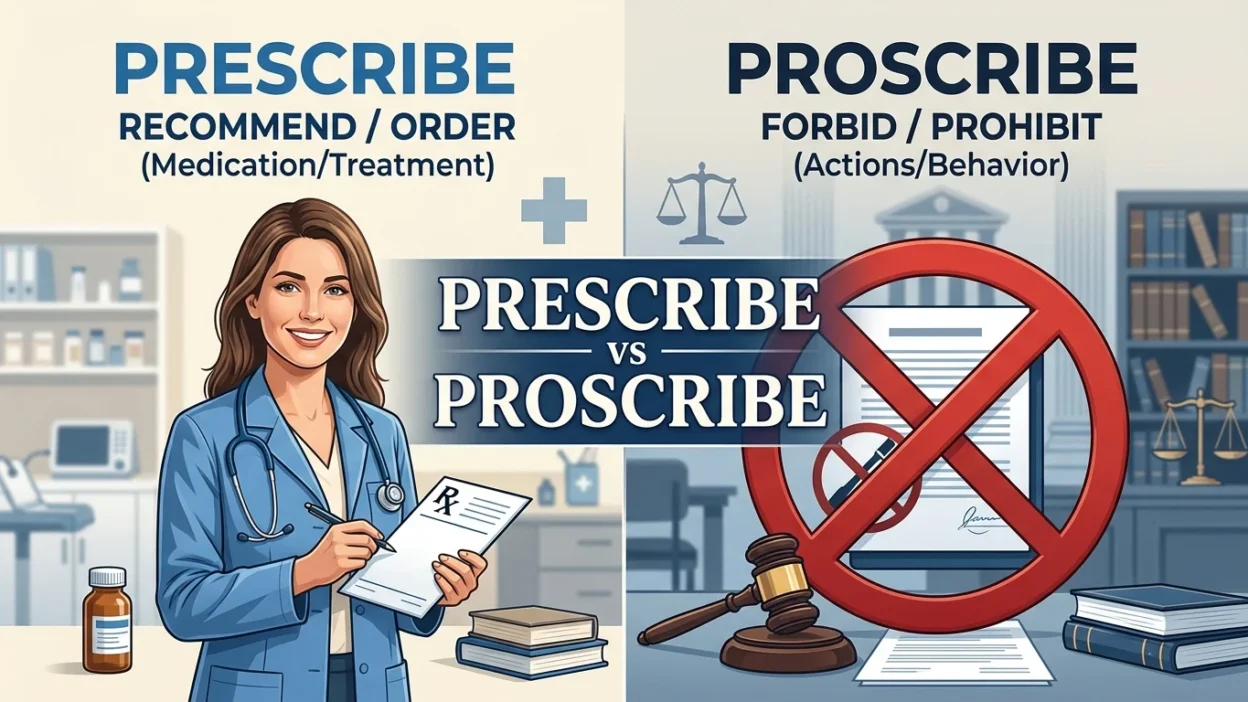
Prescribe means to recommend, authorize, or officially order something, especially medicine or a course of action. Proscribe means to officially forbid or prohibit something. Think of it this way: a doctor prescribes treatment, while a law may proscribe certain behavior.
Why People Confuse It
The words prescribe and proscribe are easy to mix up for several reasons:
- They are spelled almost identically.
- Both can be used when an authority gives an official instruction.
- They share the Latin root scribere, meaning “to write.”
- Both frequently appear in formal or professional English.
- Their meanings are almost opposites in certain contexts.
The prefixes provide the biggest clue.
Pre- often means “before” or indicates something being laid out in advance. Thus, to prescribe something is to set out what should be done.
Pro- in proscribe comes from a Latin root associated with publicly announcing something as forbidden. Therefore, to proscribe something is to prohibit it.
A useful shortcut is:
Prescribe = say what should be done.
Proscribe = say what must not be done.
First Word: Prescribe
Meaning of Prescribe
Prescribe is a verb meaning to recommend, order, or officially establish something as a rule or course of action.
It is especially common in medical English.
For example:
- The doctor prescribed antibiotics for the infection.
- The physician prescribed a lower dose.
- The therapist prescribed daily exercises.
In these examples, prescribe means that a medical professional officially recommends or orders a particular treatment.
However, the word is not limited to medicine. It can also mean to establish something as a rule or requirement.
For example:
The regulations prescribe strict safety procedures.
Here, prescribe means that the regulations specify what people are required or expected to do.
Common Uses of Prescribe
Prescribe can refer to:
- Medication
- Medical treatment
- Therapy
- Exercise
- A course of action
- Rules or procedures
- Official requirements
- Standards of behavior
Prescribe in a Sentence
The doctor prescribed a new medication for her condition.
The company handbook prescribes the procedures employees must follow.
The central idea is setting out what should be done.
Second Word: Proscribe
Meaning of Proscribe
Proscribe is a verb meaning to officially forbid, ban, or prohibit something.
It is much less common in everyday conversation than prescribe, but it appears frequently in formal, legal, political, and academic writing.
For example:
The law proscribes discrimination in the workplace.
This means the law prohibits discrimination.
Another example:
The organization proscribed the use of offensive language.
Here, the organization officially banned that behavior.
Common Uses of Proscribe
Proscribe is often used with:
- Activities
- Behaviors
- Practices
- Substances
- Organizations
- Methods
- Actions
- Forms of conduct
The core meaning is officially saying that something must not be done.
Proscribe in a Sentence
The new regulations proscribe the disposal of chemicals in public waterways.
In simple English, this means:
The new regulations forbid people from disposing of chemicals in public waterways.
Comparison Table
| Word | Meaning | Typical Context | Example |
| Prescribe | Recommend, order, or specify | Medicine, rules, procedures | The doctor prescribed medication. |
| Proscribe | Forbid or prohibit | Law, regulations, formal rules | The law proscribes discrimination. |
| Prescribed | Recommended or officially specified | Treatment or requirements | She followed the prescribed treatment. |
| Proscribed | Officially forbidden | Laws or policies | The activity is proscribed by law. |
| Prescription | An instruction or medical order | Healthcare | The pharmacist filled the prescription. |
| Proscription | An official prohibition | Formal/legal contexts | The policy includes the proscription of certain practices. |
The easiest distinction is:
Prescribe = recommend or require.
Proscribe = prohibit.
When to Use Each
Choosing between these words becomes much easier when you identify whether the sentence is about requiring something or forbidding something.
Use “Prescribe” When Something Is Recommended or Required
Use prescribe when a doctor recommends treatment:
The doctor prescribed pain medication.
Use it when a rule specifies what people should do:
The policy prescribes regular safety inspections.
Use it when an authority establishes a particular procedure:
The regulations prescribe how applications must be submitted.
Use “Proscribe” When Something Is Forbidden
Use proscribe when a law bans an activity:
The law proscribes the use of certain materials.
Use it when an organization officially forbids behavior:
The school proscribes bullying and harassment.
A Simple Test
Ask yourself:
Does the sentence mean “tell someone what to do”?
Use prescribe.
Does it mean “tell someone what not to do”?
Use proscribe.
Examples
Here are several examples showing the difference in context.
- The doctor prescribed antibiotics for the patient.
- The hospital prescribes strict hygiene procedures for all staff.
- The law proscribes discrimination based on protected characteristics.
- The organization proscribed the use of unauthorized equipment.
- The physician prescribed a daily exercise routine.
- The regulations prescribe specific safety standards.
- The government proscribed the illegal practice.
- The doctor prescribed a higher dosage after reviewing the test results.
- The company policy proscribes employees from sharing confidential information.
- The treatment plan prescribes several weeks of physical therapy.
- The rules proscribe behavior that could endanger other participants.
- The medication was prescribed by a qualified physician.
- The constitution may proscribe certain forms of government action.
- The guidelines prescribe a standard method for handling complaints.
- The new policy proscribes unauthorized access to the system.
Notice the pattern: prescribe focuses on what is recommended, ordered, or specified, whereas proscribe focuses on what is prohibited.
Common Mistakes
Mistake 1: Using “Proscribe” When You Mean “Prescribe”
Incorrect:
The doctor proscribed antibiotics.
Correct:
The doctor prescribed antibiotics.
A doctor normally prescribes medicine because the doctor recommends or orders it.
Mistake 2: Using “Prescribe” for a Ban
Incorrect:
The law prescribes smoking in the building.
This sentence suggests that the law requires smoking, which is probably the opposite of the intended meaning.
Correct:
The law proscribes smoking in the building.
Mistake 3: Assuming “Proscribe” Means Recommend
Because proscribe resembles prescribe, learners sometimes assume the words have related meanings. They do not.
Proscribe = prohibit.
Mistake 4: Confusing “Prescribed” With “Proscribed”
Compare:
The doctor gave me the prescribed medication.
This means the medication was ordered or recommended.
The activity is proscribed by law.
This means the activity is forbidden by law.
One letter can completely reverse the meaning.
Memory Trick
Try this simple memory trick:
PREscribe = PREpare a plan
A doctor prescribes a treatment plan.
Think:
PREscribe → Plan what should happen.
PROscribe = PROhibit
Both proscribe and prohibit begin with PRO.
Think:
PROscribe → PROhibit something.
So remember:
Prescribe = provide a plan.
Proscribe = prohibit.
This association is especially useful when you’re writing quickly and need to choose the correct word.
American vs British English
There is essentially no major difference in meaning between American and British English for prescribe and proscribe.
In both varieties of English:
- Prescribe means to recommend, order, or specify.
- Proscribe means to prohibit or forbid.
The main difference is frequency and context rather than meaning.
Prescribe is extremely common in both American and British English because of its frequent use in healthcare:
The doctor prescribed medication.
Proscribe is considerably more formal and less common in everyday speech in both varieties. It tends to appear in legal, governmental, academic, and formal contexts.
For everyday communication, speakers will often choose simpler alternatives such as ban, forbid, recommend, or order.
Similar Words
Several words are closely related to prescribe and proscribe.
Words Similar to Prescribe
- Recommend — suggest something as a good choice
- Advise — give guidance
- Order — officially require something
- Specify — state something precisely
- Recommend — suggest a particular course of action
Example:
The doctor recommended more exercise.
This is similar to saying the doctor prescribed exercise, although prescribe can sound more official or authoritative.
Words Similar to Proscribe
- Prohibit — officially prevent something
- Ban — officially stop something from being allowed
- Forbid — tell someone that something is not allowed
- Outlaw — make something illegal
- Disallow — refuse to permit something
For example:
The rules prohibit outside food.
This has essentially the same core meaning as:
The rules proscribe outside food.
However, proscribe generally sounds more formal.
FAQs
1. What is the difference between prescribe and proscribe?
Prescribe means to recommend, order, or specify something. Proscribe means to officially forbid or prohibit something.
2. Does a doctor prescribe or proscribe medicine?
A doctor prescribes medicine. The doctor recommends or orders the medication as part of a patient’s treatment.
3. Does proscribe mean prohibit?
Yes. Proscribe means to officially forbid, ban, or prohibit something.
4. Is prescribe the opposite of proscribe?
In many contexts, they can function as opposites. Prescribe establishes what should be done, while proscribe establishes what must not be done.
5. Is “proscribe” a common English word?
It is a legitimate English word, but it is much less common in everyday conversation than prescribe. It is especially useful in formal, legal, academic, and governmental writing.
6. What is an easy way to remember prescribe vs proscribe?
Remember prescribe = plan or recommend and proscribe = prohibit. The “PRO” in proscribe can remind you of prohibit.
7. Can rules prescribe something?
Yes. Rules, laws, policies, and regulations can prescribe procedures, requirements, or standards. For example, “The regulations prescribe regular inspections.”
Final Verdict
The difference between prescribe and proscribe is simple once you focus on their direction. Prescribe tells someone what should be done, recommended, or officially specified. Proscribe tells someone what must not be done because it is forbidden or prohibited.
If you’re talking about a doctor giving medication, treatment, or medical advice, prescribe is almost certainly the word you need. If you’re talking about a law, policy, or authority banning an action, proscribe is the appropriate choice. When in doubt, replace the word mentally with recommend/order or prohibit and see which meaning fits.
Remember This
Prescribe = recommend, order, or specify.
Proscribe = forbid or prohibit.
Doctor → prescribes treatment.
Law → proscribes prohibited behavior.
That one distinction will prevent most prescribe vs proscribe mistakes.
Conclusion
Although prescribe and proscribe look remarkably similar, their meanings are very different. Prescribe is about recommending, ordering, or laying down what should happen, while proscribe is about officially preventing something from happening. This distinction matters particularly in medical, legal, professional, and academic writing, where choosing the wrong word can significantly alter the intended message.
The next time you encounter these two easily confused words, remember the simple contrast: prescribe tells you what to do; proscribe tells you what not to do. With that memory trick, you can use both words accurately and confidently in formal English.

Adam Aaron writes engaging mystery and adventure novels featuring intelligent characters, unexpected twists, and emotional storytelling. His creative imagination and compelling narratives have earned admiration from readers across generations.