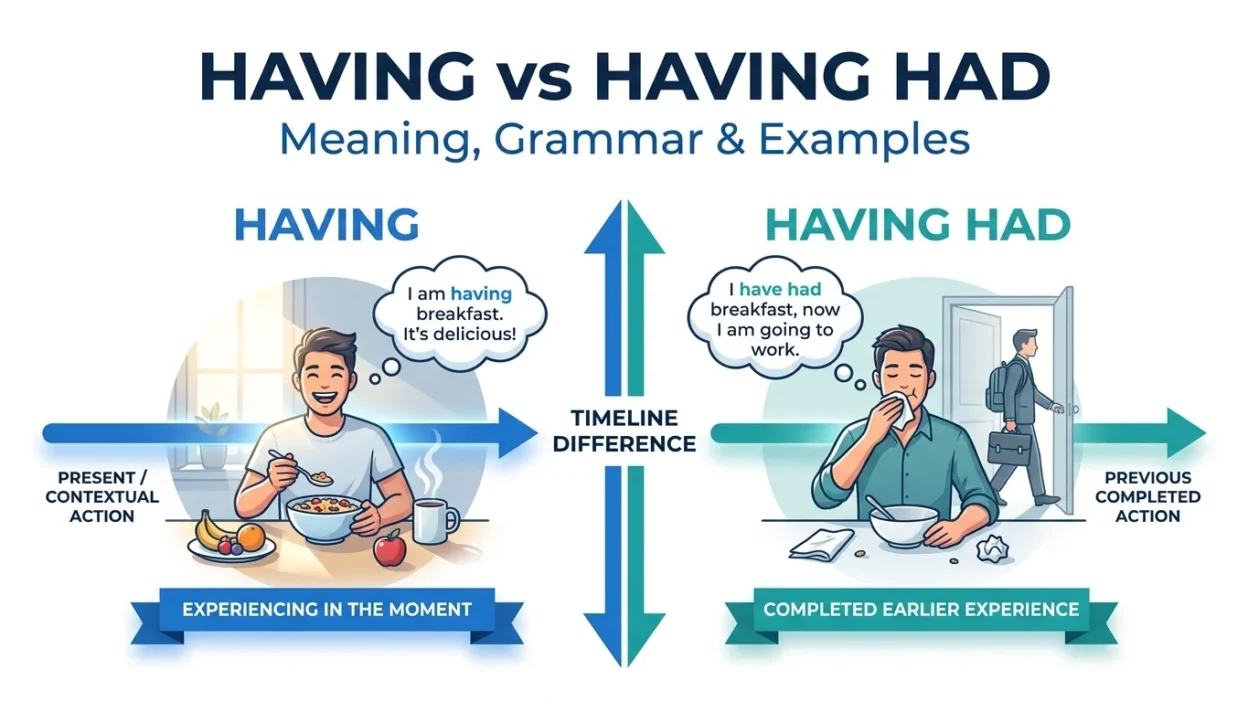
“Having” and “having had” can look almost identical, but they express different relationships between actions, experiences, and time. The confusion usually appears when English learners try to describe something that is happening now versus something that happened earlier. For example, “Having a good time” describes a current experience, while “Having had a good time” refers to an experience that was already completed before another event.
Understanding the difference between having vs having had becomes much easier when you focus on the verb that follows them and the timing of the action. “Having” can describe possession, experience, or an activity in progress, while “having had” combines having with the past participle had to show that an earlier experience or situation was completed before another point in time. This guide explains the grammar, meaning, usage, common mistakes, and practical examples so you can confidently choose the correct form.
Quick Answer
Having usually refers to an experience, activity, or situation occurring at the relevant time. Having had refers to something experienced, possessed, or completed earlier, usually before another action. Compare: “Having lunch, I called him” and “Having had lunch, I left the restaurant.”
Why People Confuse It
The main reason people confuse having and having had is that both begin with having. However, the words serve different grammatical purposes when combined with had.
- Having = present participle or gerund form of have.
- Having had = perfect participle construction.
- Having can describe something happening or existing at a particular time.
- Having had emphasizes that something happened or was completed before another event.
Consider these two sentences:
- Having breakfast, she read the newspaper.
- Having had breakfast, she left for work.
In the first sentence, the emphasis is on the activity of eating breakfast. In the second, breakfast was already finished before she left.
This difference is especially important when writing formal English, academic English, professional communication, and grammatically precise sentences.
First Word: Having
Having is the present participle or gerund form of the verb have. Its exact meaning depends on the context.
It can refer to:
- Possessing something: “Having enough money makes travel easier.”
- Experiencing something: “Having fun is important.”
- Eating or drinking: “We are having dinner.”
- Participating in an activity: “They are having a meeting.”
- Causing or experiencing a situation: “She is having difficulty understanding the instructions.”
When having appears at the beginning of a sentence as a participial phrase, it generally connects an action or situation with the main clause.
Examples:
- Having enough time, we decided to walk.
- Having lunch, they discussed the project.
- Having a car, he can travel more easily.
The important point is that having does not automatically mean that something happened earlier. Its timing must be understood from the context.
Second Word: Having Had
Having had is a perfect participle construction.
It consists of:
having + past participle
Since the past participle of have is had, the result is:
having had
This construction indicates that the experience, possession, or action involving have occurred before another action or point in time.
For example:
Having had enough time to prepare, she felt confident before the exam.
First, she had enough time to prepare. Later, she felt confident.
Another example:
Having had dinner, they went for a walk.
First, they finished dinner. Then, they went for a walk.
Therefore, having had is particularly useful when you want to make the sequence of events clear.
Comparison Table
| Feature | Having | Having Had |
| Basic form | Having | Having had |
| Grammar | Present participle / gerund | Perfect participle |
| Main idea | An experience, activity, or situation | An earlier completed experience or situation |
| Time relationship | Current or context dependent | Earlier than another event |
| Example | Having dinner, we talked. | Having had dinner, we went home. |
| Focus | The activity or situation | Completion before another action |
| Common use | Activities, possession, experiences | Previous experiences or completed actions |
| Typical meaning | “Experiencing/possessing/doing” | “After having experienced/possessed/done” |
When to Use Each
Use “Having” When the Action Is Current or Contextually Relevant
Use having when you are talking about an activity, experience, possession, or situation without specifically emphasizing that it was completed before another action.
Examples:
- Having a good job gives him financial security.
- She is having trouble with her computer.
- Having dinner with friends is always enjoyable.
- Having enough information helps us make better decisions.
Use “Having Had” When Something Happened Earlier
Choose having had when you want to show that one experience or situation came before another.
Examples:
- Having had breakfast, I felt ready for work.
- Having had several years of experience, she applied for the senior position.
- Having had enough of the argument, he walked away.
- Having had the opportunity to study abroad, she understood the culture better.
A useful test is to ask:
“Did this happen before the main action?”
If the answer is yes, having had may be the better choice.
A Simple Comparison
- Having lunch, John answered his emails.
John was eating lunch while answering his emails. - Having had lunch, John answered his emails.
John finished lunch before answering his emails.
The difference can be subtle, but the second sentence makes the sequence much clearer.
Examples: Having vs Having Had
Here are practical examples showing how the two forms differ.
1. Breakfast
Having breakfast, Maria checked her phone.
Maria was eating breakfast while checking her phone.
Having had breakfast, Maria went to work.
Maria finished breakfast before going to work.
2. Experience
Having experience in marketing, he understood the strategy.
His marketing experience is presented as a relevant qualification.
Having had experience in marketing, he knew what challenges to expect.
His previous experience happened before the situation being discussed.
3. Dinner
Having dinner with my family is important to me.
This describes the activity generally.
Having had dinner, we decided to watch a movie.
Dinner was completed before the decision.
4. Enough Time
Having enough time, she completed the project carefully.
She had sufficient time in the situation.
Having had enough time to prepare, she was ready for the presentation.
The preparation period had already occurred.
5. A Difficult Day
Having a difficult day, he decided to take a break.
He was experiencing a difficult day.
Having had a difficult day, he went straight home.
The difficult day had already occurred before he went home.
6. Enough Money
Having enough money makes traveling easier.
This is a general statement about possessing sufficient money.
Having had enough money saved, they finally bought a house.
They had accumulated the money before buying the house.
7. Fun
Having fun with friends is good for your mental well being.
This describes the activity generally.
Having had fun at the party, they thanked the host and left.
The enjoyable experience was completed before they left.
8. Trouble
Having trouble with the software, she contacted technical support.
She was experiencing a problem at that time.
Having had trouble with the software before, she knew how to fix it.
She had experienced the problem previously.
9. Enough
Having enough food, we didn’t need to visit the store.
The situation involved having sufficient food.
Having had enough food, we skipped dessert.
We had already eaten enough.
10. A Chance
Having a chance to speak with the manager was helpful.
This focuses on the opportunity or experience.
Having had a chance to speak with the manager, I understood the situation better.
The conversation happened before the later understanding.
11. A Conversation
Having a conversation with her can be very helpful.
This describes the activity.
Having had a conversation with her, I knew what she wanted.
The conversation happened first, followed by the understanding.
12. Enough Practice
Having enough practice improves your confidence.
This is a general observation.
Having had enough practice, the students performed confidently.
The practice occurred before the performance.
Common Mistakes
Mistake 1: Treating “Having Had” as a Tense
Having had is not a standalone verb tense. It is a perfect participle construction.
It is used as part of a larger sentence:
Having had enough rest, she returned to work.
Mistake 2: Using “Having” When You Mean “After Having”
Sometimes writers use having when they need to make a previous action clear.
Less precise:
Having dinner, we went home.
Clearer when dinner was completed first:
Having had dinner, we went home.
The first sentence can suggest that the two actions happened around the same time. The second clearly establishes the sequence.
Mistake 3: Confusing “Had” and “Having Had”
These structures are different:
- I had dinner before I left.
- Having had dinner, I left.
The first uses the simple past had. The second uses a perfect participial phrase.
Mistake 4: Adding an Unnecessary “Had”
Avoid incorrect constructions such as:
Having had had breakfast, she left.
Unless a very unusual grammatical context specifically requires another verb form, this is normally incorrect.
The natural form is:
Having had breakfast, she left.
Mistake 5: Creating a Dangling Modifier
The subject of the introductory phrase should normally match the subject of the main clause.
Incorrect:
Having had breakfast, the office seemed unusually quiet.
The office did not have breakfast.
Better:
Having had breakfast, I found the office unusually quiet.
Memory Trick
Use this simple rule:
Having = experiencing or doing.
Having had = already experienced or completed.
Think of had as a signal that you are looking backward.
For example:
Having lunch → the lunch activity is happening or being considered.
Having had lunch → lunch happened already.
Another quick trick:
Having = now/ongoing/contextual
Having had = before/earlier
This is not an absolute rule for every sentence, but it is an excellent starting point for understanding the difference.
American vs British English
There is no major difference between American and British English in the basic grammar of having and having had.
Both varieties use these forms to express similar meanings.
For example, both American and British speakers can say:
Having had breakfast, she left for work.
The main differences between American and British English tend to involve vocabulary, pronunciation, spelling, and certain usage preferences rather than the fundamental grammar of these constructions.
In everyday conversation, speakers in both varieties may also choose simpler wording:
After breakfast, she left for work.
This version is often more natural in casual communication because it avoids a more formal participial construction.
Similar Words and Structures
Several related structures can help you understand having vs having had.
Have
Have is the base form.
I have enough time.
Has
Has is the third person singular present form.
She has enough time.
Had
Had is the past tense and past participle of have.
She had enough time.
Having
Having is the present participle or gerund.
Having enough time is useful.
Having Had
Having had is the perfect participle.
Having had enough time, she completed the task.
After Having
After having is another way to emphasize that an action happened before another.
After having dinner, we went home.
This can often be easier to understand than a participial phrase, especially for English learners.
After
In many situations, simple after is the most natural option:
After dinner, we went home.
This sentence is shorter and clearer than:
Having had dinner, we went home.
The longer form is useful when you specifically want a participial construction or a more formal style.
Final Verdict
The difference between having and having had is mainly about timing and completion. Having can describe an activity, experience, possession, or situation, while having had usually shows that the experience or situation occurred before another action.
When deciding which form to use, ask yourself whether the “having” experience is already completed. If it is, and you want to connect it to a later event, having had is often the right choice. If you are simply describing the activity or situation itself, having is usually enough.
FAQs
1. What is the difference between “having” and “having had”?
Having describes an activity, experience, possession, or situation, while having had generally shows that something happened before another event.
2. Is “having had” grammatically correct?
Yes. Having had is a grammatically correct perfect participle construction formed from having + had.
3. Does “having had” mean “after having”?
Often, yes. Having had dinner, we left has essentially the same sequence as After having dinner, we left. Both indicate that dinner came before leaving.
4. Which is correct: “having lunch” or “having had lunch”?
Both can be correct, but they can express different timing.
- Having lunch focuses on the lunch activity.
- Having had lunch indicates that lunch was already completed.
5. Can “having” refer to the past?
Yes. The meaning of having depends on context. However, when you specifically need to emphasize that an action was completed before another action, having had often provides clearer sequencing.
6. Is “having had” formal English?
It can sound more formal or literary than simpler alternatives such as after or because. However, it is standard English and is common in formal writing.
7. What is an easy way to remember “having vs having had”?
Remember: having focuses on the experience or activity, while having had looks backward to an experience or situation that occurred earlier.
Remember This
Having = an activity, experience, possession, or situation.
Having had = an earlier or completed experience, possession, or situation before another event.
Compare:
Having dinner, we talked.
We talked while eating dinner.
Having had dinner, we went home.
We finished dinner before going home.
When in doubt, look for the time relationship between the two actions. If one clearly happened first, having had can make that sequence clear.
Conclusion
Understanding having vs having had does not require memorizing complicated grammar rules. The key is to recognize what having is doing in the sentence and whether the experience or action was completed before another event. Having can describe an activity, possession, or experience, while having had normally looks back at something that happened earlier.
For everyday English, you can often use simpler expressions such as after, after having, or a separate clause. However, learning how to use having had correctly will help you understand more advanced English grammar and write more precise sentences. Once you connect having had with the idea of a previous experience, the distinction becomes much easier to remember.

Quinn Mitchell is celebrated for historical fiction that combines authentic settings, unforgettable characters, and compelling narratives. His thoughtful writing brings history alive while inspiring curiosity and deeper understanding among readers.