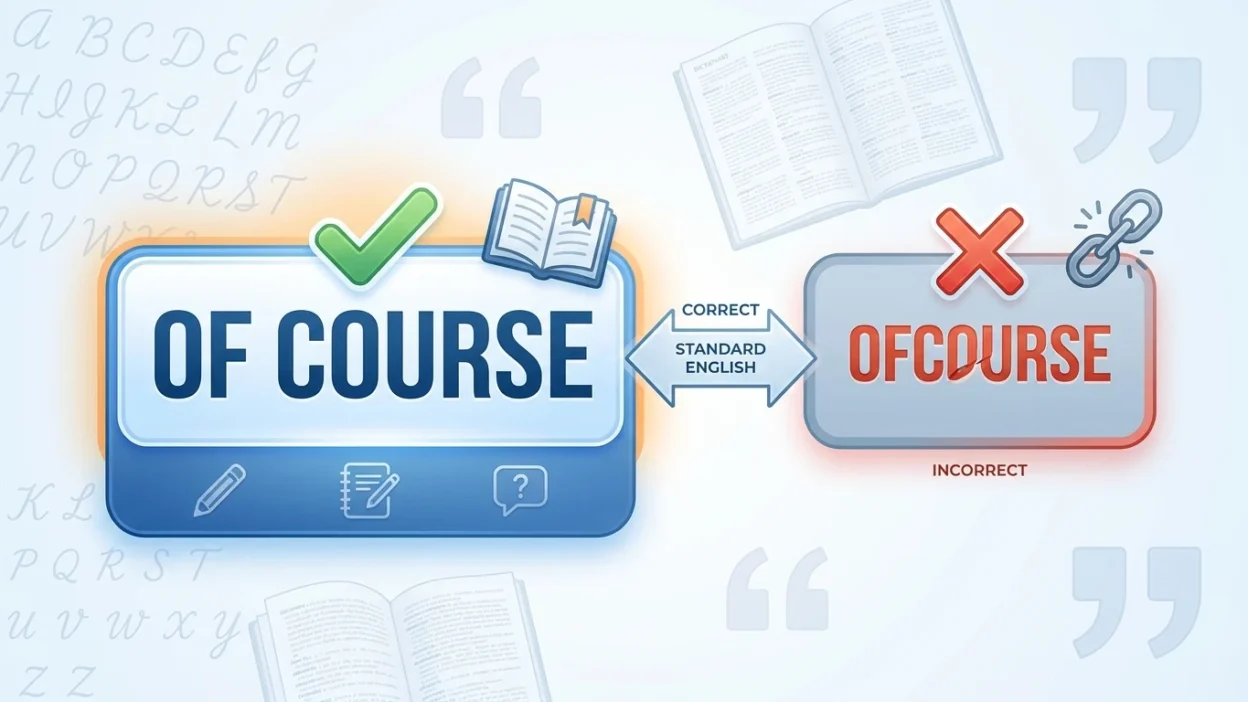
If you have ever wondered whether to write “of course” or “ofcourse,” you are not alone. These two forms look almost identical, and because English contains many words that have been joined together over time, it is easy to assume that “ofcourse” might also be an accepted spelling. However, there is a clear difference between the correct standard form and the common misspelling.
The correct spelling is “of course” two separate words. It is a very common English expression used to show agreement, certainty, or that something is obvious or expected. “Ofcourse” is not considered a standard English spelling and should generally be avoided in formal and informal writing. Whether you are writing an email, school assignment, article, text message, or professional document, “of course” is the form you should use.
Quick Answer
“Of course” is correct, while “ofcourse” is incorrect in standard English. The expression is always normally written as two words. Use “of course” to mean certainly, naturally, or in an expected way. Avoid “ofcourse” in essays, emails, professional writing, and other standard English contexts.
Why People Confuse It
The confusion mainly comes from the way “of course” sounds when spoken.
In fast speech, the two words can sound almost like one unit. This may lead writers, especially English learners, to assume that they should be joined together.
English also has many compound words, such as:
- sometimes
- already
- altogether
- however
- maybe
Because some commonly used expressions have developed into single words, it is understandable that people may wonder whether “of course” has done the same.
It has not.
The standard spelling remains two separate words: “of course.”
Another reason for the mistake is informal digital communication. People sometimes type quickly in text messages, comments, or social media posts and write “ofcourse.” Seeing the incorrect version repeatedly can make it look familiar, even though familiarity does not make it grammatically correct.
First Word: “Of”
“Of” is a preposition that has many functions in English. It can express relationships involving possession, connection, quantity, origin, or association.
For example:
- a cup of tea
- the color of the car
- the end of the road
- a friend of mine
In the expression “of course,” however, “of” works together with “course” to form a fixed expression.
You should not remove the space between the two words.
Correct:
Of course, I will help you.
Incorrect:
Ofcourse, I will help you.
Second Word: “Course”
The word “course” has several meanings by itself.
It can refer to:
- a series of lessons or classes
- a direction or route
- one part of a meal
- the movement of something
For example:
She enrolled in an English course.
The ship changed its course.
The main course was delicious.
In “of course,” however, the phrase has a different function. It is an idiomatic expression meaning certainly, naturally, or obviously.
For example:
“Can you help me?”
“Of course!”
Here, “of course” does not refer to a class, route, or meal. It expresses willingness or certainty.
Comparison Table
| Expression | Correct? | Meaning | Example |
| of course | Yes | Certainly; naturally; obviously | Of course, you can come with us. |
| ofcourse | No | Nonstandard/misspelled form | Avoid “ofcourse” in standard writing. |
| of course! | Yes | Certainly! | “Will you join us?” “Of course!” |
| of course not | Yes | Certainly not | Of course not. I wasn’t angry. |
The key point is simple: “of course” is written as two words.
When to Use Each
When to Use “Of Course”
Use “of course” when you want to express certainty, agreement, willingness, or something that seems natural or obvious.
For example:
Of course, I’ll call you tomorrow.
It can also be used to politely respond to a request:
“May I borrow your pen?”
“Of course.”
You can use it in both casual and formal communication, although its tone can change depending on the context.
When to Use “Ofcourse”
In standard English, there is no normal situation in which “ofcourse” should be used as a single word.
If you see “ofcourse” online, it is generally a spelling error rather than an alternative spelling.
For reliable English writing, always choose:
of course ✅
not:
ofcourse ❌
Examples of “Of Course”
Here are several natural examples showing how to use the expression correctly:
- Of course, I can help you with your homework.
- “Are you coming to the party?” “Of course!”
- Of course, she knew the answer.
- You can stay here, of course.
- Of course not! I would never do that.
- He will agree to the plan, of course.
- Of course, we should consider all the options first.
- “Can I ask you a question?” “Of course.”
- Of course, everyone makes mistakes sometimes.
- She was tired, of course, but she continued working.
- Of course you can bring a friend.
- I understand why you’re worried, of course.
- Of course, the final decision is yours.
- “Would you like some coffee?” “Of course, thank you.”
- Of course not; there is no reason to worry.
Notice that “of course” remains two words in every example.
Common Mistakes
1. Writing “ofcourse”
This is the most common mistake.
❌ Ofcourse, I understand.
✅ Of course, I understand.
2. Assuming pronunciation determines spelling
English pronunciation does not always reveal where word boundaries occur.
Even if “of course” sounds connected in rapid speech, it is still written as two words.
3. Using “ofcourse” in formal writing
A spelling checker may catch this error, but not every writing environment will.
Always check the spelling before submitting:
- essays
- applications
- business emails
- reports
- academic papers
- professional documents
4. Confusing familiarity with correctness
Because “ofcourse” appears frequently online, some people assume it is an accepted variant.
It isn’t standard English.
Memory Trick
Use this simple trick:
Of + course = two words.
Think of the phrase as a small combination rather than a single word.
You can remember:
“Of course” has a space, of course!
The slightly playful reminder makes the correct spelling easier to remember.
Another useful technique is to replace the expression with “certainly.”
For example:
Of course, I will help.
becomes:
Certainly, I will help.
If “certainly” makes sense, you are probably using the expression “of course” in its usual sense.
American vs British English
There is no meaningful spelling difference between American and British English when it comes to this expression.
Both varieties use:
of course ✅
The incorrect form:
ofcourse ❌
is not a standard American or British spelling.
You may encounter “ofcourse” in informal online communication in either variety, but that reflects a spelling mistake, typing habit, or nonstandard usage not a regional spelling rule.
So whether you are writing for an American audience, a British audience, or an international English speaking audience, use “of course.”
Similar Words
Several expressions can have a meaning similar to “of course,” depending on the context.
Certainly
Means definitely or without doubt.
Certainly, I can help you.
Naturally
Suggests that something is expected or logical.
Naturally, she was disappointed.
Obviously
Indicates that something is clear or easy to understand.
Obviously, we need more time.
Sure
Common in informal English, especially as a response.
“Can you help?” “Sure!”
Indeed
A more formal expression used to emphasize agreement or truth.
Indeed, that was an important decision.
These alternatives are not always interchangeable. “Of course” is particularly useful when expressing confident agreement, willingness, or something that is considered natural or expected.
Final Verdict
The correct form is “of course.”
It should normally be written as two separate words. “Ofcourse” is a common spelling mistake, but it is not accepted as the standard spelling in modern English.
So if you are wondering which version to use in an email, essay, article, text, or professional document, the answer is straightforward:
Of course ✅
Ofcourse ❌
When in doubt, remember that the expression contains “of” + “course,” with a space between them.
Frequently Asked Questions
Is “ofcourse” one word?
No. “Ofcourse” is not the standard spelling. The correct form is “of course,” written as two separate words.
Is “of course” grammatically correct?
Yes. “Of course” is a standard English expression used to indicate certainty, agreement, willingness, or something considered natural or obvious.
Why do people write “ofcourse”?
People often write “ofcourse” because the expression can sound like a single unit in fast speech. Frequent informal online usage can also make the misspelling look familiar.
Should I write “of course” in formal English?
Yes. “Of course” is perfectly acceptable in formal English. However, the exact tone may depend on the context, and sometimes alternatives such as “certainly” may sound more formal.
Is “ofcourse” accepted in British English?
No. British English uses “of course” as the standard form. “Ofcourse” is not a recognized British spelling variant.
Is “of course” one word or two words?
“Of course” is two words. Always include a space between “of” and “course.”
Can “of course” mean “certainly”?
Yes. In many contexts, “of course” means “certainly,” “naturally,” or “without doubt.”
For example:
Of course, I’ll be there.
This means:
Certainly, I’ll be there.
Remember This
OF COURSE = TWO WORDS
Think:
of + course = of course ✅
Never write “ofcourse” when you mean the common English expression.
Conclusion
The difference between “of course” and “ofcourse” is simple once you know the standard spelling. “Of course” is the correct form, and it should always be written as two words. It is a versatile expression that can communicate certainty, agreement, willingness, or that something is natural or expected.
Although “ofcourse” may appear frequently in online messages and informal writing, it is still considered a spelling mistake in standard English. For clear, professional, and grammatically correct writing, choose “of course” every time. If you can remember “of + course,” you will never need to second guess the spelling again.

Hadley Price creates heartfelt contemporary fiction exploring relationships, hope, resilience, and personal growth. Her emotionally rich storytelling connects with readers through memorable characters and inspiring life experiences worldwide.