
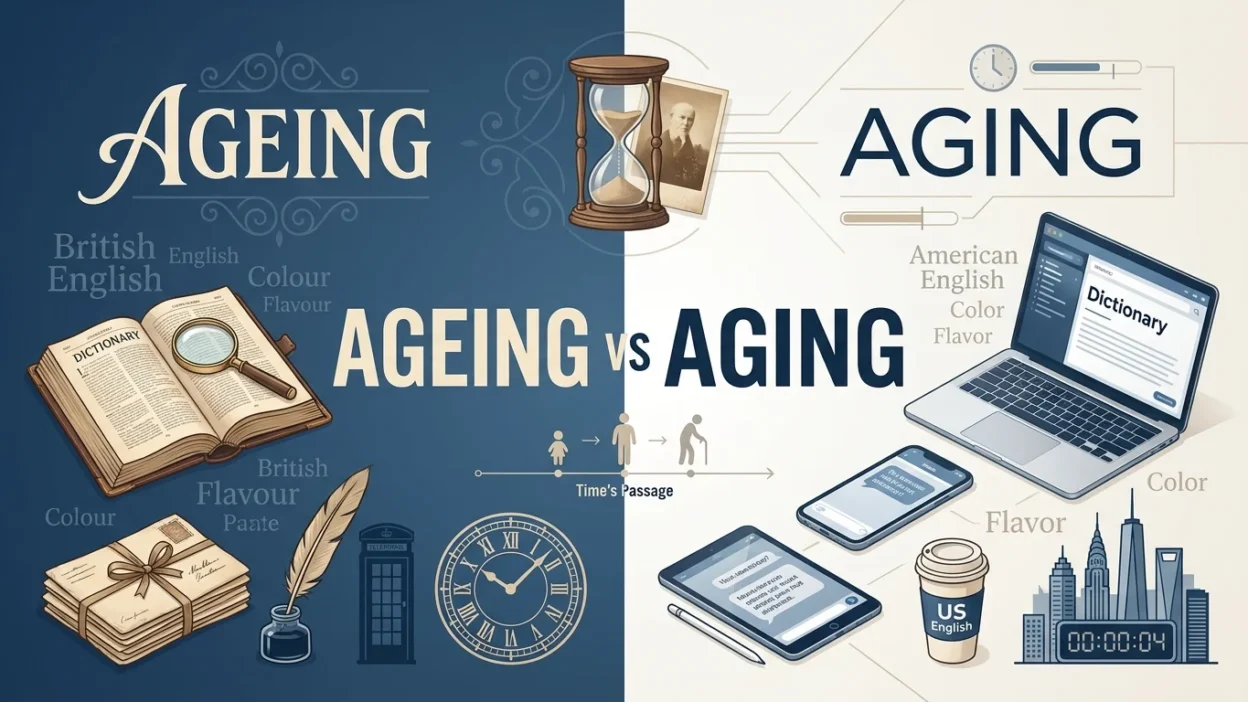
If you have ever wondered whether ageing or aging is the correct spelling, you are not alone. Both forms are standard English words, and the main difference is where they are used. “Ageing” is generally preferred in British English, while “aging” is the standard spelling in American English. Both words refer to the process of getting older or becoming older over time.
The confusion usually comes from differences in English spelling conventions. Many verbs ending in -e change differently when they take certain suffixes, and “age” is one of those words where British and American usage developed slightly different preferences. Whether you are writing an email, academic paper, website content, or social media post, knowing which spelling fits your audience can help your writing look polished and natural.
Quick Answer
Ageing and aging are both correct. Ageing is more common in British English, while aging is preferred in American English. They have the same meaning and function as the present participle or gerund of age, meaning to grow or become older.
Why People Confuse It
People confuse ageing vs aging because the two words have exactly the same meaning and pronunciation in most varieties of English.
The only significant difference is spelling preference by region.
In British English, writers commonly retain the e before adding -ing:
- age → ageing
- dye → dyeing
- singe → singeing
American English often drops the final e before -ing in words such as “age”:
- age → aging
This can make learners wonder whether one spelling is a mistake. It is not.
The important point is that both “ageing” and “aging” are legitimate spellings. Your choice should usually depend on the variety of English you are using.
Ageing
Ageing is the spelling traditionally associated with British English and other varieties influenced by British spelling conventions.
It is the present participle or gerund of the verb age.
Meaning of ageing
Ageing can mean:
- Growing older
- Becoming older over time
- Showing the effects of increasing age
- Developing or maturing with time
- Allowing something to mature over a period of time
For example:
The ageing population is creating new challenges for healthcare systems.
Here, “ageing” describes a population that is becoming older.
The word can also describe products or materials that are deliberately allowed to mature:
The cheese improves through a careful ageing process.
Is “ageing” correct?
Yes. Ageing is completely correct, especially when writing in British English.
You will commonly see it in British publications, educational materials, government documents, and formal writing.
Examples include:
- ageing population
- ageing process
- ageing infrastructure
- healthy ageing
- ageing workforce
- signs of ageing
Aging
Aging is the standard spelling in American English.
It has exactly the same meaning as ageing.
For example:
The aging population is putting additional pressure on healthcare services.
American writers generally use “aging” without the e.
You may also see it in expressions such as:
- aging population
- aging process
- healthy aging
- aging infrastructure
- aging workforce
- signs of aging
Is “aging” correct?
Yes. Aging is the standard American spelling.
It is not an incorrect or informal version of “ageing.” If you are writing for an American audience, aging is normally the better choice.
Comparison Table
| Feature | Ageing | Aging |
| Meaning | Growing or becoming older | Growing or becoming older |
| Spelling | Retains the “e” | Drops the “e” |
| British English | Common/preferred | Less common |
| American English | Less common | Common/preferred |
| Pronunciation | Essentially the same | Essentially the same |
| Part of speech | Gerund/present participle | Gerund/present participle |
| Example | The ageing population needs support. | The aging population needs support. |
| Correct? | Yes | Yes |
When to Use Each
The easiest way to decide between ageing and aging is to consider your target audience.
Use “ageing” when writing British English
Choose ageing if your writing follows British spelling conventions.
For example:
The government is concerned about the ageing population.
You may prefer this spelling when writing for readers in:
- The United Kingdom
- Ireland
- Australia
- New Zealand
- Other contexts that generally follow British English conventions
However, spelling preferences can vary somewhat between countries and individual style guides.
Use “aging” when writing American English
Choose aging when following American English.
For example:
The government is concerned about the aging population.
It is especially appropriate for:
- American websites
- U.S. newspapers
- American academic writing
- U.S. business communication
- Content targeting American readers
The most important rule: be consistent
If you choose British English, use ageing consistently.
If you choose American English, use aging consistently.
Mixing British and American spellings in the same piece of writing can make your work appear inconsistent.
Examples of Ageing and Aging
Here are more than 10 examples showing how the words are used naturally.
- British: The country has an ageing population.
- American: The country has an aging population.
- British: Regular exercise can support healthy ageing.
- American: Regular exercise can support healthy aging.
- British: The building is showing signs of ageing.
- American: The building is showing signs of aging.
- British: Scientists are researching the causes of ageing.
- American: Scientists are researching the causes of aging.
- British: The company must replace its ageing infrastructure.
- American: The company must replace its aging infrastructure.
- British: The ageing workforce presents both opportunities and challenges.
- American: The aging workforce presents both opportunities and challenges.
- British: Wine can improve through careful ageing.
- American: Wine can improve through careful aging.
- British: The effects of ageing become more noticeable over time.
- American: The effects of aging become more noticeable over time.
Notice that the meaning does not change. Only the preferred spelling changes.
Common Mistakes
Mistake 1: Thinking one spelling is always wrong
A common misconception is that aging is a misspelling of “ageing,” or that “ageing” is an outdated version of “aging.”
Neither assumption is correct.
Both spellings are accepted in English.
Mistake 2: Using “aging” in British writing without considering consistency
“aging” is understandable to British readers, but ageing is generally the more conventional British spelling.
If your article otherwise uses British spellings such as “colour,” “organise,” and “centre,” using “aging” may look inconsistent.
Mistake 3: Assuming “ageing” is only formal
“Ageing” is not restricted to formal English.
You can use it in everyday writing:
My dog is ageing gracefully.
Mistake 4: Mixing regional spellings
Suppose an article is written for an American audience but uses a mixture of American and British spellings. That can create an inconsistent editorial style.
Choose one spelling system and follow it throughout your content.
Mistake 5: Confusing “ageing” with “ag(e)ing” rules in general
English spelling does not follow one perfectly predictable rule for every word ending in -e.
That is why it is better to learn common forms individually rather than assume every verb will behave exactly like “age.”
Memory Trick
Here is a simple way to remember ageing vs aging:
Britain keeps the E: ageing.
America drops the E: aging.
Think:
British = E stays
American = E goes
So if your article follows British English, write ageing.
If it follows American English, write aging.
The meaning remains the same either way.
American vs British English
The difference between ageing and aging is a good example of how English spelling varies between major English speaking regions.
British English
British English generally prefers:
ageing
For example:
The government is preparing for an ageing population.
American English
American English generally prefers:
aging
For example:
The government is preparing for an aging population.
This regional distinction is similar to many other spelling differences between British and American English, although each word has its own history and usage patterns.
For SEO writers, the best choice depends on search intent and audience. If your website primarily targets readers in the United States, “aging” is usually the natural choice. If you are targeting British readers, “ageing” is generally more appropriate.
Similar Words
Several words and phrases are closely related to ageing/aging.
Age
Age can be a noun or a verb.
Age can affect the body’s ability to recover quickly.
As a verb:
People age at different rates.
Aged
Aged is the past participle or adjective form of “age.”
The building is more than 100 years old and visibly aged.
It can also describe something that has been matured intentionally:
The restaurant serves aged cheese.
Elderly
Elderly is an adjective traditionally used to describe older people.
The organization provides services for elderly residents.
In modern writing, however, context and audience matter because terms such as older adults may be preferred in many settings.
Growing older
“Growing older” is a natural phrase that expresses the same general idea as ageing or aging.
Everyone experiences the process of growing older.
Maturing
Maturing means developing or becoming fully developed. Depending on context, it can overlap with ageing but does not always mean becoming older.
The wine is maturing in oak barrels.
Senescence
Senescence is a more technical term referring to the biological process associated with deterioration or aging.
It is commonly found in scientific and medical contexts.
Final Verdict
So, ageing vs aging is not a question of right versus wrong. Both spellings are correct. The main distinction is regional spelling preference.
Use ageing when following British English conventions, and use aging when following American English conventions. Both words mean the process of becoming older, and they function in the same grammatical way.
For professional writing, the key is consistency. Decide which variety of English your audience expects, then use that spelling throughout your article, website, report, or other content.
FAQs
Is “ageing” or “aging” correct?
Both are correct. Ageing is generally preferred in British English, while aging is the standard American English spelling.
Is “aging” American or British?
Aging is primarily the standard American English spelling. British English generally prefers ageing.
Is “ageing” British English?
Yes. Ageing is the commonly preferred British English spelling of the present participle and gerund of “age.”
Do “ageing” and “aging” mean the same thing?
Yes. They have the same meaning: the process of growing or becoming older. The difference is primarily a matter of regional spelling.
Which spelling should I use for an American audience?
Use aging when writing for an American audience. It is the standard U.S. spelling.
Which spelling should I use in British English?
Use ageing in British English. It is the conventional spelling in British usage.
Can I use both “ageing” and “aging” in the same article?
You can, but it is generally better to choose one spelling based on your target variety of English and use it consistently throughout the article.
Remember This
Ageing = British English
Aging = American English
Both are correct, both have the same meaning, and both are pronounced essentially the same. The best spelling depends on your audience and your chosen style of English.
Conclusion
The difference between ageing and aging is simple once you know the regional spelling rule. British English generally uses ageing, while American English generally uses aging. Neither spelling is inherently more correct than the other, and both describe the process of becoming older.
If you are writing for a specific audience, let that audience determine your spelling. Choose ageing for British style writing and aging for American style writing, and most importantly, remain consistent. When in doubt, remember: Britain keeps the E; America lets it go.

Willow Evans writes uplifting fantasy stories filled with magical worlds, courageous heroes, and meaningful life lessons. Her imaginative books encourage creativity, kindness, and hope in readers of all ages.