
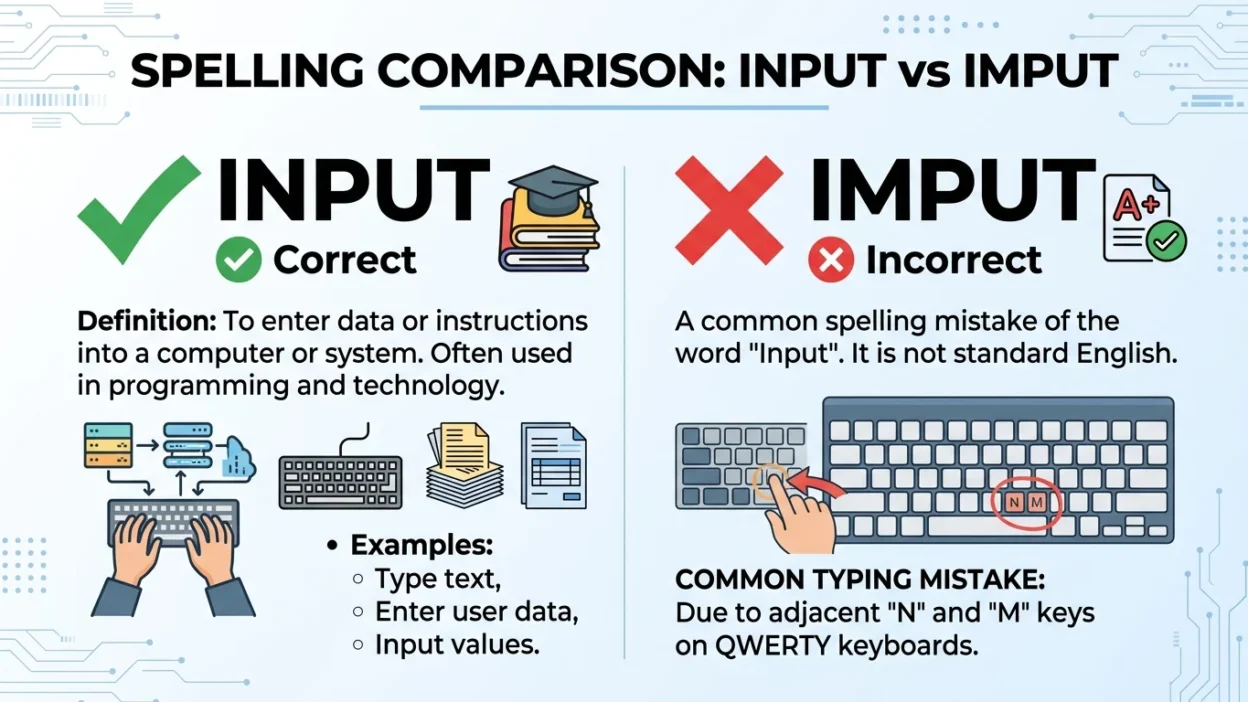
If you’ve ever typed “imput” instead of “input,” you’re not alone. It’s one of the most common spelling mistakes, especially when typing quickly or working with computers, forms, or technical documents. Because the letters “n” and “m” sit next to each other on a keyboard, it’s easy to hit the wrong key. However, only one of these words is accepted in standard English.
Understanding the difference between input and imput is important for students, professionals, writers, programmers, and anyone who wants to communicate clearly. In this guide, you’ll learn which spelling is correct, why the mistake happens, when to use the correct word, and simple tricks to remember it forever. You’ll also find practical examples, common mistakes to avoid, and answers to frequently asked questions.
Quick Answer
Input is the correct English word. It means information, data, advice, or something that is put into a system, process, or discussion. Imput is a misspelling and is not recognized as a standard English word. Always use input in writing.
Why People Confuse It
Many people accidentally write imput because:
- The M and N keys are next to each other on a keyboard.
- Fast typing increases the chance of keyboard errors.
- The pronunciation of input can sound similar during rapid speech.
- Spell check doesn’t always catch mistakes in every application.
- Beginners in English may assume both spellings are acceptable.
Fortunately, this confusion is easy to fix once you know the correct spelling.
Input
Input is the correct spelling.
It can be used as both a noun and a verb.
As a noun
It refers to:
- Information
- Advice
- Data
- Resources contributed to a project or process
Examples:
- Thank you for your valuable input.
- The manager requested everyone’s input before making a decision.
- User input helps improve software.
As a verb
It means to enter data or information into a computer or system.
Examples:
- Please input your password.
- The receptionist will input your details into the database.
Imput
Imput is not a correct English word.
It is simply a spelling mistake of input. Although you may see it in emails, social media posts, or online comments, dictionaries do not recognize it as a standard word.
Incorrect examples:
- Please imput your name.
- Thank you for your imput.
Both sentences should use input instead.
Input vs Imput Comparison Table
| Feature | Input | Imput |
| Correct spelling | ✅ Yes | ❌ No |
| Found in dictionaries | Yes | No |
| Part of speech | Noun and verb | None |
| Used in formal writing | Yes | No |
| Used in computing | Yes | No |
| Recommended for academic writing | Yes | Never |
When to Use Each
Use Input when:
- Referring to information or feedback.
- Talking about data entered into a computer.
- Writing academic papers.
- Creating technical documents.
- Writing emails or business reports.
Never use Imput because:
- It is a typo.
- It is not accepted in English dictionaries.
- It appears unprofessional in formal writing.
Examples
Here are examples showing the correct use of input:
- Your input helped us finish the project.
- Please input your email address.
- Customer input is valuable for improving products.
- The software accepts keyboard input.
- Teachers appreciate student input during discussions.
- I forgot to input today’s sales figures.
- The team welcomed everyone’s input.
- Accurate input leads to accurate results.
- The technician asked me to input the code again.
- We need more community input before making a decision.
- The survey collected valuable input from participants.
- Good planning starts with reliable input.
Common Mistakes
Avoid these errors:
❌ Please imput your password.
✅ Please input your password.
❌ Thank you for your imput.
✅ Thank you for your input.
❌ The program needs user imput.
✅ The program needs user input.
Memory Trick
Remember this simple phrase:
IN = Information Needed
Since input begins with IN, think of information going IN to a system.
If you see imput, remember it’s usually just your finger slipping onto the M key instead of N.
American vs British English
There is no difference between American and British English.
Both varieties use:
- ✅ Input
- ❌ Imput
Whether you’re writing in the UK, the US, Canada, Australia, or elsewhere, input is always the correct spelling.
Similar Words
Here are some related words often used with input:
- Output
- Data
- Feedback
- Information
- Entry
- Response
- Contribution
- Command
- Upload
- Processing
These terms frequently appear in computing, education, engineering, and business writing.
Final Verdict
The answer is simple:
- Input ✅ Correct
- Imput ❌ Incorrect
If you’re writing an essay, email, report, software documentation, or social media post, always choose input. Using the correct spelling improves clarity, professionalism, and credibility.
Frequently Asked Questions
1. Is “imput” a real English word?
No. Imput is a misspelling of input and is not accepted in standard English.
2. What does “input” mean?
It means information, advice, data, or something entered into a system or process.
3. Can “input” be a verb?
Yes. As a verb, it means to enter information into a computer or system.
4. Why do people type “imput”?
Usually because the M and N keys are next to each other on a keyboard, making it a common typing error.
5. Is “input” used in computer science?
Yes. It is one of the most common computing terms and refers to data entered into a computer or device.
6. Is “input” correct in academic writing?
Absolutely. It is widely accepted in academic, professional, and technical writing.
7. Do British and American English spell it differently?
No. Both use input with the same spelling and meaning.
Conclusion
Although input and imput may look similar, only input is correct. The confusion usually comes from typing errors rather than grammar rules. Once you remember that information goes in to a system, choosing the correct spelling becomes much easier.
Whether you’re writing a school assignment, business email, software documentation, or everyday message, always use input. Consistent spelling strengthens your writing, improves readability, and leaves a more professional impression.
Remember This
Input = Correct English spelling
Imput = Typing mistake
Whenever you write about information, feedback, or data entered into a system, choose input every time.

Quinn Mitchell is celebrated for historical fiction that combines authentic settings, unforgettable characters, and compelling narratives. His thoughtful writing brings history alive while inspiring curiosity and deeper understanding among readers.