
If you’ve ever paused while writing companywide or company wide, you’re not alone. Many English speakers, including professionals, writers, and students, wonder whether these forms are interchangeable or if one is grammatically correct. Since both versions appear online, it’s easy to become confused.
The good news is that the difference is straightforward once you understand how English compound words work. In this guide, you’ll learn the meaning of companywide and company wide, when to use each, common mistakes to avoid, and simple memory tricks that make choosing the correct form effortless. Whether you’re writing business emails, company policies, reports, or website content, this article will help you use the right term with confidence.
Quick Answer
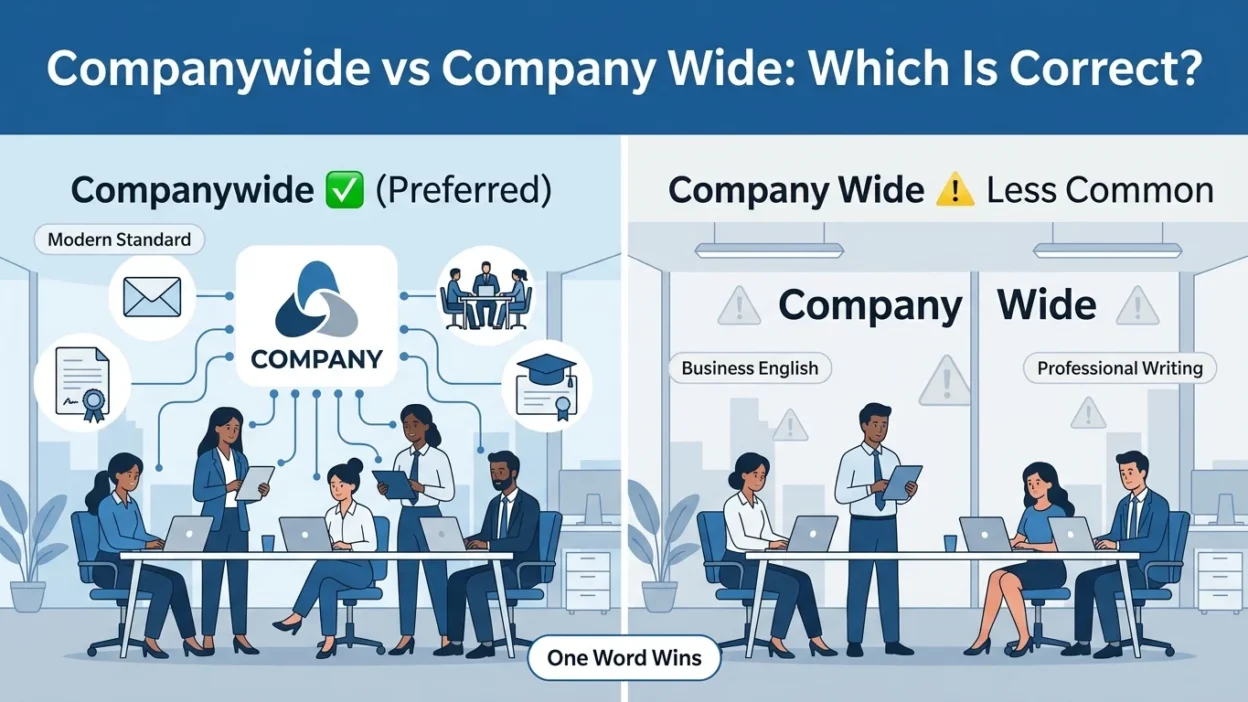
Companywide (one word) is the standard and preferred spelling in modern English when describing something that applies to an entire company. Company wide (two words) is an older or less common variation that still appears occasionally, but companywide is generally recommended in professional and formal writing.
Why People Confuse It
The confusion comes from the way English forms compound adjectives and compound adverbs.
Many expressions start as two separate words before gradually becoming one word over time. Similar examples include:
- Workplace
- Nationwide
- Worldwide
- Companywide
Because company wide still appears in some older documents and informal writing, people often assume both forms are equally preferred. However, major dictionaries and modern style guides generally favour companywide.
Companywide
Companywide is a compound adjective and sometimes an adverb.
It describes something that affects, includes, or applies to the entire company.
Meaning
Across the whole organisation.
Examples
- The companywide meeting starts at 10 a.m.
- We introduced a companywide safety policy.
- Employees completed the companywide survey.
- The CEO announced a companywide hiring freeze.
- Companywide training begins next month.
Why It Is Preferred
Modern business English increasingly joins common compounds into one word. Using companywide makes your writing cleaner, more professional, and more consistent with current usage.
Company Wide
Company wide uses two separate words.
Although it carries the same meaning, it is much less common in contemporary writing.
Meaning
Across the entire company.
Examples
- The policy applies company wide.
- We held a company wide event.
While readers will understand these examples, many editors would revise them to companywide for consistency and style.
Companywide vs Company Wide: Comparison Table
| Feature | Companywide | Company Wide |
| Spelling | One word | Two words |
| Modern usage | Preferred | Less common |
| Formal business writing | Recommended | Usually edited |
| Meaning | Across the whole company | Across the whole company |
| Professional documents | Excellent choice | Acceptable but less preferred |
| web writing | Preferred | Rarely used |
When to Use Each
Use companywide when:
- Writing business reports
- Creating HR documents
- Publishing blog posts
- Writing employee handbooks
- Preparing company announcements
- Sending professional emails
- Writing marketing materials
Use company wide when:
- Following an older style guide
- Quoting historical documents
- Keeping consistency with existing company documentation
In most modern situations, companywide is the better choice.
Examples
Here are practical examples showing the preferred usage.
- The companywide celebration was a success.
- We launched a companywide wellness programme.
- Employees received companywide updates yesterday.
- A companywide survey improved communication.
- The CEO sent a companywide email.
- Companywide standards ensure consistency.
- Our companywide meeting lasted two hours.
- We introduced companywide cybersecurity training.
- Companywide policies protect employees.
- The companywide bonus was announced today.
- Managers supported the companywide initiative.
- The software rollout became companywide within three months.
Common Mistakes
Avoid these frequent errors:
Using inconsistent spelling
❌ The companywide policy applies company wide.
✅ The companywide policy applies across the company.
Assuming both are equally preferred
Although both are understandable, companywide is generally considered the standard spelling.
Splitting modern compounds unnecessarily
Many compound words eventually become one word.
Examples include:
- Worldwide
- Nationwide
- Companywide
- Systemwide
Memory Trick
Think about these familiar words:
- Worldwide
- Nationwide
- Statewide
Since they are all written as one word, companywide follows the same pattern.
Easy reminder:
If it covers the whole company, write it as companywide.
American vs British English
The spelling preference is virtually the same in both American and British English.
| American English | British English |
| Companywide | Companywide |
Neither variety strongly prefers company wide in modern professional writing.
Similar Words
These related compound words follow the same pattern:
- Nationwide
- Worldwide
- Organisation wide (often hyphenated in British English)
- Enterprise wide
- Systemwide
- Campuswide
- Schoolwide
- Department wide
Notice that some compounds remain hyphenated while others have evolved into single words depending on style guides and usage.
Final Verdict
If you’re choosing between companywide and company wide, the safest and most professional option is companywide.
Although both forms communicate the same meaning, companywide has become the preferred spelling in modern business English. It looks cleaner, aligns with current writing conventions, and is widely accepted in corporate communication.
Whenever you’re writing reports, emails, policies, website content, or internal announcements, choose companywide unless you’re required to follow a style guide that specifically prefers the two word version.
Frequently Asked Questions
Is companywide one word?
Yes. Companywide is the preferred modern spelling in business and professional English.
Is company wide incorrect?
No. It isn’t incorrect, but it is less common and generally not the preferred style today.
Which spelling should I use in business writing?
Use companywide for reports, policies, presentations, websites, and professional emails.
Does Microsoft Word accept companywide?
Yes. Most modern spell checkers recognise companywide as a standard compound word.
Is companywide a compound adjective?
Yes. It commonly functions as a compound adjective describing something that applies across an entire company.
Does British English use companywide?
Yes. British and American English both commonly use companywide in modern writing.
Can I use company wide in formal documents?
You can, but many editors will recommend changing it to companywide for consistency with current usage.
Conclusion
Choosing between companywide and company wide is much easier once you know current English conventions. While both forms express the same idea, modern business communication overwhelmingly favours companywide because it reflects the natural evolution of English compound words.
Using the preferred spelling not only improves clarity but also gives your writing a more polished and professional appearance. Whether you’re drafting company policies, preparing presentations, or writing website content, sticking with companywide will help you communicate more confidently and consistently.
Remember This
Use companywide (one word) for almost all modern business writing. While company wide is understandable, companywide is the standard, cleaner, and more widely accepted choice.

Nova Turner specializes in imaginative science fiction blending futuristic technology, thrilling adventures, and powerful human emotions. Her innovative storytelling inspires curiosity, creativity, and exploration among readers of every age.