The difference between PRK and LASI depends on what these terms mean in context. PRK is commonly used as an abbreviation for photorefractive keratectomy, a type of laser eye surgery. LASI, however, is not a standard alternative name for LASIK and may be a misspelling, an acronym, or a specialized term. Understanding the context is important before comparing them.
For students, beginners, and general readers, the key lesson is to identify the exact meaning of each term before deciding how they differ. Similar-looking abbreviations can refer to different procedures, organizations, or concepts. In medical discussions, even a small spelling difference can change the intended meaning. This guide explains PRK, clarifies the likely meaning of LASI, and provides practical examples to help readers understand the terms accurately. If you encountered these abbreviations in an eye-care article, medical report, or online discussion, checking the original spelling will help you find the right information.
Quick Answer: PRK vs LASI
PRK stands for photorefractive keratectomy, a laser eye surgery that reshapes the cornea after its outer cell layer is removed. LASI is not a commonly recognized standard name for a competing laser eye procedure. If you mean LASIK, both PRK and LASIK correct certain vision problems, but they differ in how the cornea is accessed and how recovery usually progresses.
Why Do People Confuse PRK and LASI?
People may confuse these terms because medical abbreviations often contain similar letters and appear in discussions about the same subject.
Three common reasons explain the confusion:
- Similar spelling: PRK, LASIK, and LASI may appear together in searches about laser vision correction.
- Related meanings: PRK and LASIK are both procedures used to correct refractive errors, including nearsightedness.
- Typing errors: Someone may type “LASI” when they intend to write “LASIK.”
The important distinction is that PRK is an established medical abbreviation, while LASI is not the standard name for LASIK. The comparison below therefore explains PRK versus LASIK, the likely intended comparison.
First Word: What Does PRK Mean?
PRK stands for photorefractive keratectomy. It is a type of refractive surgery that uses a laser to reshape the cornea, the clear front surface of the eye, so light can focus more accurately on the retina.
How Does PRK Work?
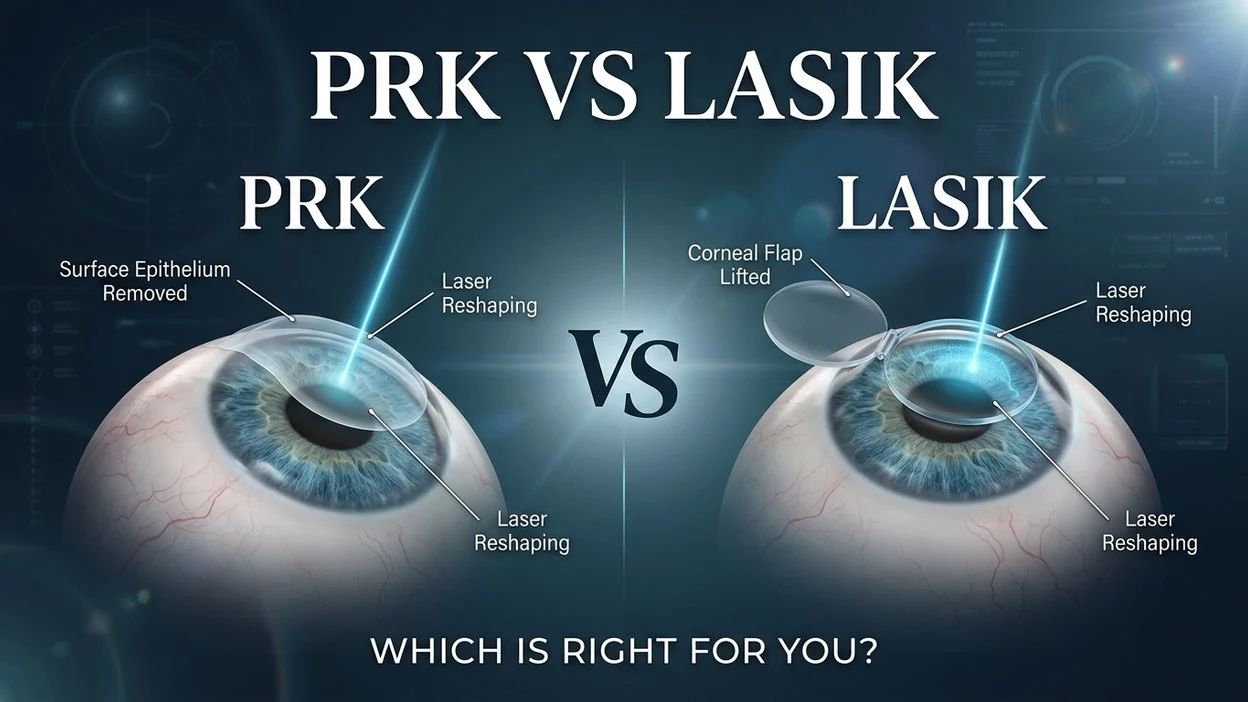
During PRK, an eye surgeon removes the thin outer layer of corneal cells, called the epithelium. An excimer laser then reshapes the underlying corneal tissue.
The epithelial layer grows back naturally during healing. Because the surface must heal after surgery, patients often experience discomfort and blurred vision during the early recovery period.
What Is PRK Used For?
PRK can correct certain refractive errors, including:
- Myopia, also called nearsightedness.
- Hyperopia, also called farsightedness, in selected cases.
- Astigmatism, a condition involving irregular focusing caused by the shape of the cornea or lens.
Not everyone is a suitable candidate for PRK. An eye specialist must assess corneal health, prescription stability, and other factors before recommending surgery.
Second Word: What Does LASI Mean?
LASI does not have one widely accepted meaning in the context of laser eye surgery. It is not the standard abbreviation for the procedure commonly compared with PRK.
The likely intended term is LASIK, which stands for laser-assisted in situ keratomileusis.
What Is LASIK?
LASIK is a refractive surgery that reshapes the cornea using a laser. The surgeon creates a thin flap in the cornea, lifts it, reshapes the underlying tissue, and repositions the flap.
Unlike PRK, LASIK does not require the entire central epithelial surface to be removed for treatment. This difference generally allows faster early visual recovery.
Is LASI the Same as LASIK?
Not necessarily. If you see “LASI” in a document, check whether it is a typing error or a specialized abbreviation used in that particular field. Do not assume it means LASIK without confirming the context.
PRK vs LASIK: Comparison Table
The following table compares PRK with LASIK, assuming LASI was intended to mean LASIK.
| Feature | PRK | LASIK |
| Full form | Photorefractive keratectomy | Laser-assisted in situ keratomileusis |
| Main purpose | Corrects refractive errors | Corrects refractive errors |
| Corneal approach | Removes the surface epithelial layer | Creates a corneal flap |
| Laser treatment | Reshapes exposed corneal tissue | Reshapes tissue beneath the flap |
| Early recovery | Usually slower | Usually faster |
| Initial discomfort | Often greater during early healing | Usually milder |
| Return of useful vision | Generally takes longer | Often occurs within a day or a few days |
| Corneal flap | No | Yes |
| Suitability | May be preferred for some people with thinner corneas or certain activity-related concerns | Requires sufficient corneal thickness and appropriate anatomy |
| Final decision | Requires a specialist assessment | Requires a specialist assessment |
Both procedures have potential risks, including dry eyes, glare, halos, undercorrection, overcorrection, and other complications. Neither procedure is suitable for everyone.
When Should You Use Each Term?
The correct term depends on the situation and the meaning you want to communicate.
When to Use PRK
Use PRK when referring to photorefractive keratectomy.
Examples:
- “My eye surgeon recommended PRK.”
- “PRK requires healing of the corneal surface.”
- “The patient is researching PRK recovery time.”
When to Use LASIK
Use LASIK when referring to laser-assisted in situ keratomileusis.
Examples:
- “LASIK is commonly associated with rapid early visual recovery.”
- “The surgeon explained the benefits and risks of LASIK.”
- “I want to compare LASIK with PRK.”
When to Use LASI
Use LASI only when the source clearly defines it as an acronym or specialized term. If the discussion concerns laser vision correction, verify whether the intended word is LASIK.
12 Examples of PRK vs LASIK in Sentences
These examples show how to use the terms correctly in everyday English.
- PRK: My doctor explained how PRK reshapes the cornea.
- LASIK: My sister chose LASIK after a detailed eye examination.
- PRK vs LASIK: The patient compared PRK vs LASIK before making a decision.
- PRK recovery: PRK recovery usually takes longer than early recovery after LASIK.
- LASIK recovery: Many patients notice useful vision relatively quickly after LASIK.
- PRK procedure: The PRK procedure involves removing the corneal epithelium.
- LASIK procedure: The LASIK procedure involves creating a thin corneal flap.
- Medical terminology: PRK is a recognized abbreviation in ophthalmology.
- Incorrect spelling: The article used “LASI,” but the intended term may have been LASIK.
- Patient education: The surgeon discussed the risks of both PRK and LASIK.
- Treatment choice: A person’s corneal thickness can influence the choice between PRK and LASIK.
- Clarification: Before comparing PRK and LASI, confirm what LASI means in the original source.
Common Mistakes When Comparing PRK and LASI
1. Treating LASI as the Standard Name for LASIK
LASI is not the standard abbreviation for laser-assisted in situ keratomileusis. Use LASIK when that is the intended procedure.
2. Assuming PRK and LASIK Are Identical
Both procedures reshape the cornea, but their surgical approaches and recovery patterns differ.
3. Believing Faster Recovery Means Better Results
LASIK generally provides faster early visual recovery, but recovery speed alone does not determine which procedure is best for an individual.
4. Assuming PRK Is Always Safer
PRK avoids creating a corneal flap, but it has its own risks and healing requirements. The most appropriate procedure depends on the patient’s eyes and circumstances.
5. Choosing Surgery Without a Professional Assessment
Online comparisons cannot replace an examination by a qualified ophthalmologist. Corneal measurements, prescription stability, and overall eye health matter.
Memory Trick: How to Remember PRK vs LASIK
Use this simple memory aid:
- PRK = Surface first. The epithelial surface is removed before laser treatment.
- LASIK = Flap first. A corneal flap is created before the underlying tissue is reshaped.
Remember that both procedures use laser treatment to change the cornea’s shape. The main difference is how the surgeon reaches the tissue being treated.
American vs British English
PRK and LASIK are medical abbreviations, so their spelling does not change between American and British English.
| Term | American English | British English |
| PRK | PRK | PRK |
| LASIK | LASIK | LASIK |
| Cornea | Cornea | Cornea |
| Ophthalmologist | Ophthalmologist | Ophthalmologist |
| Visual recovery | Visual recovery | Visual recovery |
Some surrounding vocabulary may differ. For example, “eye doctor” is common in everyday American English, while “eye specialist” is also widely understood in British English. The medical terms PRK and LASIK remain the same.
Similar Words and Related Terms
Understanding related medical terms makes it easier to follow discussions about laser eye surgery.
- PRK: Photorefractive keratectomy, a surface-based laser vision correction procedure.
- LASIK: Laser-assisted in situ keratomileusis, a procedure involving a corneal flap.
- LASEK: Laser-assisted subepithelial keratectomy, a surface-based procedure related to PRK.
- SMILE: Small-incision lenticule extraction, a refractive procedure that removes a small piece of corneal tissue through a small incision.
- Refractive surgery: A category of procedures designed to correct focusing problems in the eye.
- Myopia: Nearsightedness; distant objects appear blurry.
- Hyperopia: Farsightedness; near vision may be difficult, depending on its severity.
- Astigmatism: A refractive error caused by irregular focusing, often associated with the shape of the cornea.
These terms are related, but they are not interchangeable. Each procedure has distinct techniques, eligibility requirements, benefits, and risks.
Final Verdict: PRK vs LASI
PRK is a recognized laser eye surgery abbreviation meaning photorefractive keratectomy. LASI is not the standard name of the commonly compared procedure and may be a misspelling of LASIK.
If you intended to compare PRK and LASIK, the key difference is the surgical approach: PRK treats the cornea after removing its outer epithelial layer, while LASIK reshapes the cornea beneath a flap. PRK generally requires a longer initial recovery, whereas LASIK often offers faster early visual recovery.
The right procedure depends on a person’s eye health, corneal characteristics, prescription, lifestyle, and professional medical assessment.
FAQs:
1. What is the main difference between PRK and LASI?
LASI is not a standard term for a laser eye surgery procedure. If you mean LASIK, the main difference is that PRK removes the corneal epithelial layer, while LASIK creates a corneal flap before reshaping the underlying tissue.
2. Is PRK better than LASIK?
Neither procedure is universally better. PRK may be appropriate for some people who are not ideal LASIK candidates, while LASIK generally offers faster early visual recovery. An ophthalmologist can determine which option is suitable.
3. Is PRK more painful than LASIK?
PRK usually causes more discomfort during the first few days because the surface epithelial layer must heal. LASIK often causes less initial discomfort, although individual experiences vary.
4. Which procedure has a faster recovery time?
LASIK generally provides faster early visual recovery, often within a day or a few days. PRK typically takes longer because the corneal surface needs time to heal, and vision may fluctuate during recovery.
5. Can PRK and LASIK correct astigmatism?
Yes. Both procedures can correct certain cases of astigmatism when the patient’s eyes meet the relevant eligibility criteria.
6. Why might a doctor recommend PRK instead of LASIK?
A doctor may recommend PRK when a patient has certain corneal characteristics, including some cases of thinner corneas, or when avoiding a corneal flap is desirable. Suitability must be confirmed through a complete eye examination.
7. Does LASI mean LASIK?
Not necessarily. LASI is not the standard abbreviation for LASIK. If you see it in a medical document or article, check the surrounding text or ask the author or healthcare professional to clarify the intended meaning.
Remember This
- PRK means photorefractive keratectomy.
- LASIK means laser-assisted in situ keratomileusis.
- LASI is not the standard abbreviation for LASIK.
- PRK treats the cornea after removing its surface epithelial layer.
- LASIK reshapes the cornea beneath a flap.
- LASIK usually offers faster early visual recovery, but the best procedure depends on individual suitability.
Conclusion:
PRK and LASIK are established laser vision correction procedures that help eligible people reduce their dependence on glasses or contact lenses. Although both reshape the cornea, they use different surgical approaches and have different recovery patterns. Understanding these differences helps readers make sense of medical information and ask better questions during an eye-care consultation.
If your original question specifically refers to “PRK vs LASI,” confirm the meaning of LASI before making a direct comparison. If you meant LASIK, the key distinction is simple: PRK treats the cornea’s surface after removing the epithelium, while LASIK uses a corneal flap. A qualified ophthalmologist can explain which procedure, if either, is appropriate for your eyes.

Hadley Price creates heartfelt contemporary fiction exploring relationships, hope, resilience, and personal growth. Her emotionally rich storytelling connects with readers through memorable characters and inspiring life experiences worldwide.