
Many English learners get confused by homophone, homograph, and homonym because these words look very similar and are often explained in different ways. Some books even use the terms differently, which makes the topic even more confusing. If you have ever wondered which word is correct in a certain situation, you are not alone.
The good news is that the differences are much easier than they first appear. Once you understand what each word means and see a few everyday examples, you will be able to tell them apart with confidence. This guide explains everything in simple English, with clear definitions, comparison tables, memory tricks, and real life examples that are easy to remember.
Quick Answer
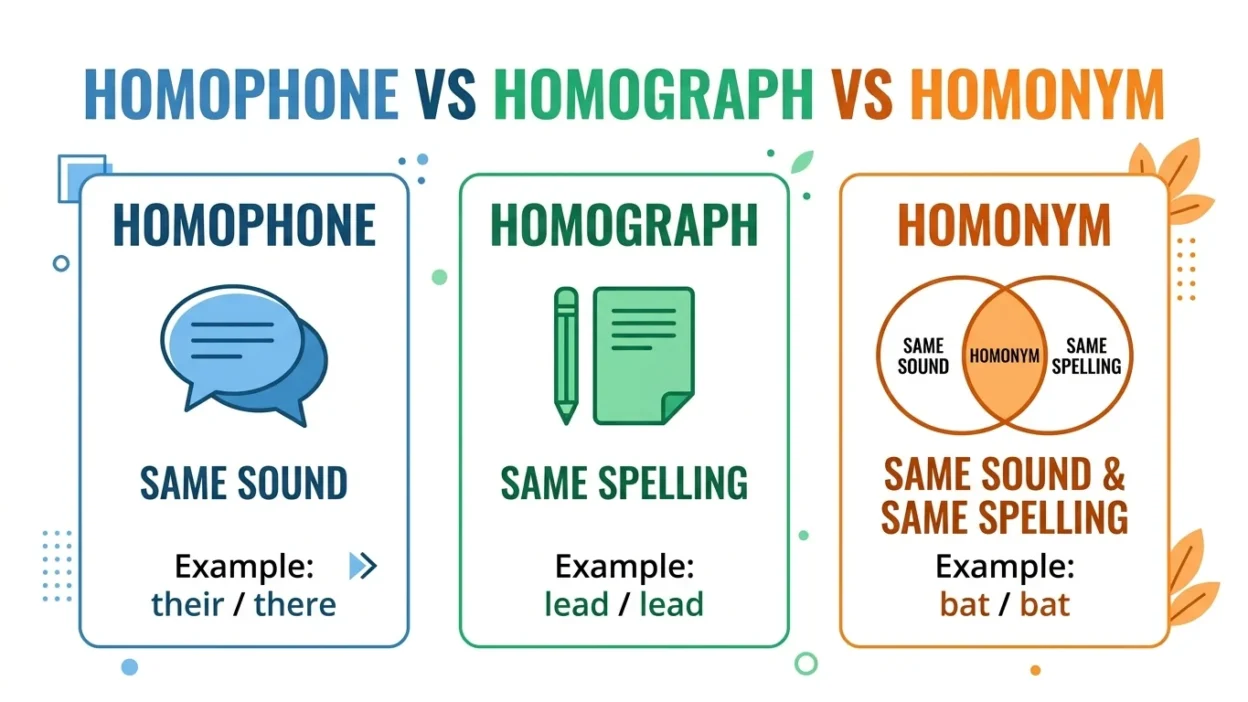
A homophone sounds the same but has a different meaning. A homograph is spelled the same but has a different meaning and may have a different pronunciation. A homonym is a general term for words that share the same spelling, pronunciation, or both, while having different meanings.
Why People Confuse It
These three language terms all describe words that are connected in some way. They often appear together in grammar books and English lessons, so learners naturally mix them up.
The confusion grows because some dictionaries define homonym differently. In many cases, it is used as a broad term that includes both homophones and homographs. Because of this, you may find slightly different explanations depending on the source. However, the basic ideas remain the same.
What Is a Homophone?
A homophone is a word that sounds the same as another word but has a different meaning and often a different spelling.
The pronunciation is the same, but the words are not.
Common homophone examples
- two and too
- their and there
- flower and flour
- right and write
- sea and see
- peace and piece
Example sentences
- I have two dogs.
- I want to come too.
- The baker used flour.
- The flower smells wonderful.
What Is a Homograph?
A homograph is a word that has the same spelling as another word but a different meaning. Sometimes the pronunciation changes, and sometimes it stays the same.
Common homograph examples
- lead (to guide) / lead (a metal)
- tear (to rip) / tear (a drop from the eye)
- wind (moving air) / wind (to turn something)
Example sentences
- Please lead the group.
- The pipe is made of lead.
- She began to tear the paper.
- A tear rolled down his face.
What Is a Homonym?
A homonym is a word that shares the same spelling, the same pronunciation, or both, but has a different meaning.
Many teachers use homonym as a general category that includes homophones and homographs.
Common homonym examples
- bat (an animal) / bat (sports equipment)
- bank (financial institution) / bank (side of a river)
- fair (just) / fair (public event)
Example sentences
- We saw a bat flying at night.
- He picked up his baseball bat.
- She went to the bank to save money.
- They sat beside the river bank.
Comparison Table
| Feature | Homophone | Homograph | Homonym |
| Same pronunciation | Yes | Sometimes | Sometimes |
| Same spelling | Usually no | Yes | Sometimes or yes |
| Different meanings | Yes | Yes | Yes |
| Example | right / write | lead / lead | bat / bat |
| Main focus | Sound | Spelling | General relationship |
When to Use Each
Choose homophone when you are talking about words that sound alike.
Choose homograph when you are talking about words that are spelled the same.
Choose homonym when referring to words with shared spelling, pronunciation, or both, depending on the definition being used.
A simple way to remember it is:
- Sound the same → Homophone
- Spelled the same → Homograph
- General category → Homonym
Examples
Here are more examples to make the differences clear.
Homophones
- sun / son
- knight / night
- mail / male
- buy / by
- hear / here
Homographs
- row (argument) / row (line)
- object (thing) / object (to disagree)
- minute (60 seconds) / minute (very small)
Homonyms
- bark (dog sound) / bark (tree covering)
- ring (jewelry) / ring (telephone sound)
- match (game) / match (used to start a fire)
- spring (season) / spring (coil)
Common Mistakes
Many learners make these mistakes:
- Thinking all words that sound alike are homographs.
- Believing every homograph has a different pronunciation.
- Assuming every dictionary defines homonym exactly the same way.
- Mixing up spelling and pronunciation.
- Forgetting that context tells you which meaning is correct.
Memory Trick
Try this easy trick:
- Phone reminds you of sound, so homophone means same sound.
- Graph reminds you of writing, so homograph means same spelling.
- Homonym is the bigger group that can include both.
This simple connection helps many students remember the differences.
American vs British English
The meanings of homophone, homograph, and homonym are generally the same in both American and British English.
The only small difference is that some dictionaries and language guides classify homonym more broadly than others. This is a difference in terminology rather than everyday English usage.
Similar Words
You may also hear these related language terms:
- Synonym
- Antonym
- Heteronym
- Polysemy
- Idiom
- Phrase
- Collocation
- Prefix
- Suffix
- Root word
Learning these terms can improve your vocabulary and grammar skills.
Final Verdict
The easiest way to understand these three terms is to focus on what they compare.
- Homophones share pronunciation.
- Homographs share spelling.
- Homonyms describe words with the same spelling, pronunciation, or both, but different meanings.
Remember that dictionaries may explain homonym in slightly different ways, but the practical idea stays the same. Once you know whether you are comparing sound or spelling, choosing the correct term becomes much easier.
Frequently Asked Questions
Is every homophone a homonym?
In many grammar guides, yes. Since homonyms are often treated as a broad category, homophones usually fit within it.
Can a homograph have the same pronunciation?
Yes. Some homographs are pronounced the same, while others are pronounced differently.
Which is easier to recognize?
Homophones are often easier because you notice the identical sound when speaking.
Why do dictionaries define homonym differently?
Language experts use different classification systems. The differences are about terminology, not the meanings of the words themselves.
Is “lead” a homograph?
Yes. It has the same spelling but different meanings and different pronunciations.
Is “their” and “there” a homograph?
No. They are homophones because they sound alike but are spelled differently.
What is the easiest way to remember the three terms?
Think phone = sound, graph = writing, and homonym = the general group.
Conclusion
Understanding the difference between homophone, homograph, and homonym makes reading, writing, and speaking English much easier. Although the names sound similar, each one focuses on a different relationship between words. Paying attention to spelling and pronunciation is the key to choosing the right term.
The next time you come across words that look alike or sound alike, ask yourself one simple question: Are they connected by pronunciation, spelling, or both? That answer will quickly tell you whether you are dealing with a homophone, a homograph, or a homonym.
Remember This
- Homophone = Same sound
- Homograph = Same spelling
- Homonym = Same spelling, pronunciation, or both, with different meanings
- Context always helps you understand the correct meaning.
- Practice with real examples to remember the differences for life.

Nova Turner specializes in imaginative science fiction blending futuristic technology, thrilling adventures, and powerful human emotions. Her innovative storytelling inspires curiosity, creativity, and exploration among readers of every age.