Many English learners and even native speakers sometimes get confused between too bad and to bad. The two phrases look very similar because they differ by only one letter. However, their meanings and grammar are completely different.
This confusion usually happens when people write quickly, send text messages, post on social media, or type emails without checking their spelling. Since to and too sound exactly the same, it is easy to mix them up. Understanding the difference is important because one phrase is commonly used in English, while the other is usually considered incorrect in most situations.
If you have ever wondered whether you should write too bad or to bad, this guide will explain everything in simple English. By the end, you will know which form is correct, when to use it, and how to avoid common mistakes.
Quick Answer
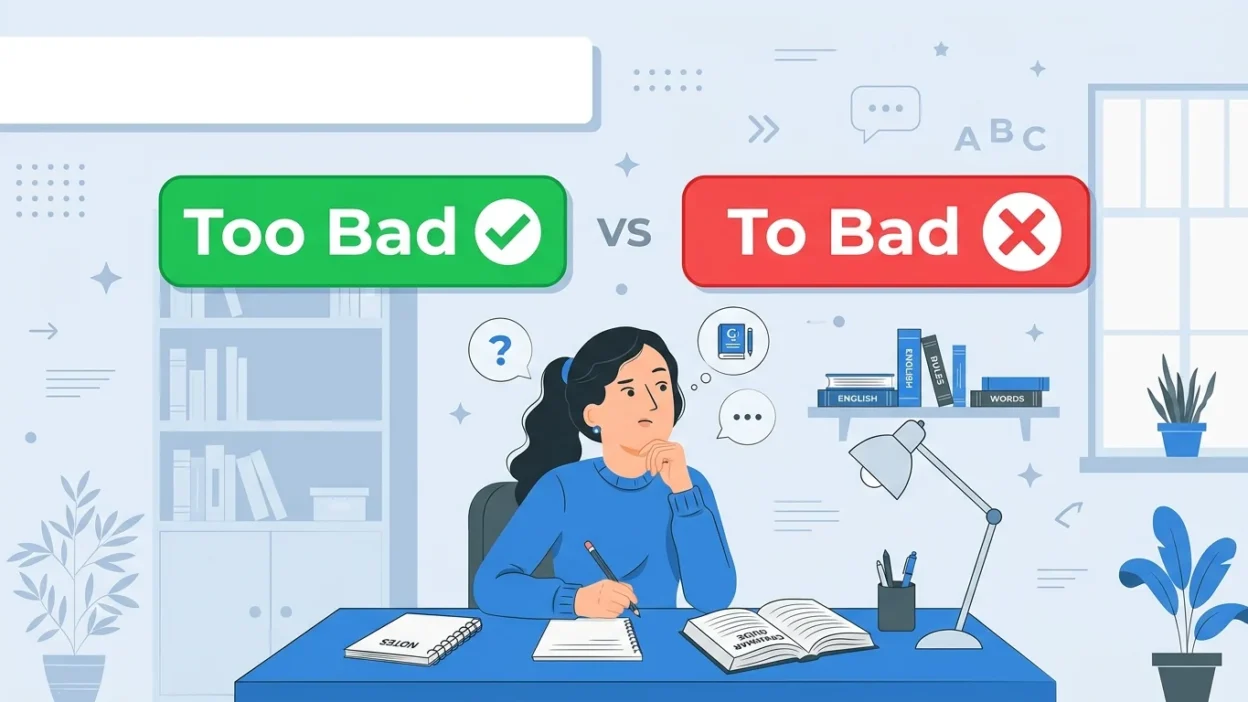
Too bad is the correct phrase when you mean something unfortunate, disappointing, or unlucky.
- ✅ Too bad = unfortunate or disappointing
- ❌ To bad = usually grammatically incorrect
- Use too bad in conversations, emails, texts, and everyday writing.
- To bad only appears in very rare sentence structures and is generally a mistake.
Why People Confuse It
People confuse too bad and to bad because to and too are homophones. Homophones are words that sound the same but have different meanings and spellings.
Another reason is that both words are very common in English. Writers may accidentally choose to instead of too because they are typing quickly or relying on spell check.
The confusion becomes even more common in informal writing such as:
- Text messages
- Social media posts
- Online comments
- Emails
- Chat conversations
Too Bad
Too bad is a common English expression.
It means:
- Unfortunate
- Disappointing
- Regrettable
- Unlucky
People often use it when something did not happen as expected or when a situation is disappointing.
Meaning Examples
- It’s too bad that the concert was canceled.
- That’s too bad. I wanted to join you.
- It’s too bad we missed the train.
In these examples, too bad means something unfortunate happened.
To Bad
To bad is usually incorrect.
The word to is normally used as:
- A preposition
- Part of an infinitive verb
Examples:
- Go to school.
- Want to learn.
- Travel to London.
Because bad is an adjective, placing to directly before it usually creates an incomplete or incorrect phrase.
Incorrect Examples
- ❌ That is to bad.
- ❌ It was to bad to miss.
- ❌ I’m feeling to bad.
These sentences should use too bad or another correct structure.
Comparison Table
| Feature | Too Bad | To Bad |
| Correct in standard English? | Yes | Usually no |
| Meaning | Unfortunate or disappointing | Normally no clear meaning |
| Part of speech | Adverb + adjective | Preposition + adjective |
| Common in everyday English | Very common | Rare |
| Used in conversations | Yes | No |
| Example | That’s too bad. | That’s to bad. ❌ |
When to Use Each
Use “Too Bad” When:
- Something unfortunate happened
- You feel disappointed
- You express sympathy
- You describe an unlucky situation
Examples:
- That’s too bad.
- It’s too bad we arrived late.
- It’s too bad she couldn’t come.
Use “To Bad” When:
In standard English, you usually should not use it.
If you write to bad, it is almost always a spelling mistake that should be corrected to too bad.
Examples
Here are everyday examples of too bad used correctly:
- It’s too bad that school was closed today.
- That’s too bad because I wanted to see the game.
- It’s too bad you missed the meeting.
- The weather was too bad for a picnic.
- That’s too bad. Better luck next time.
- It’s too bad the store was already closed.
- The timing was too bad for us to attend.
- It’s too bad they canceled the flight.
- That’s too bad, but we can try again tomorrow.
- It’s too bad we didn’t know earlier.
- That’s too bad for the whole team.
- It’s too bad the event ended early.
Common Mistakes
Mistake 1: Using “to” Instead of “too”
❌ That is to bad.
✅ That is too bad.
Mistake 2: Assuming Both Spellings Are Acceptable
❌ Both phrases mean the same thing.
✅ Only too bad is generally correct.
Mistake 3: Ignoring Context
❌ It is to bad we missed the bus.
✅ It is too bad we missed the bus.
Memory Trick
A simple trick is to remember that too means:
- Also
- Excessively
- More than enough
The word too contains an extra O.
Think of that extra letter as representing extra feeling or emphasis.
When something is unfortunate or disappointing, use too bad.
Extra O = extra meaning = too bad.
American vs British English
There is no significant difference between American and British English for this phrase.
Both varieties use:
- ✅ Too bad
Both consider:
- ❌ To bad
to be incorrect in normal writing.
Whether you are writing in the United States, the United Kingdom, Canada, Australia, or elsewhere, the rule remains the same.
Similar Words
Many English learners confuse too bad with other similar expressions.
Too vs To
- Too = also, excessively, unfortunately in expressions
- To = direction, purpose, or infinitive marker
Too Much vs To Much
- ✅ Too much
- ❌ To much
Too Late vs To Late
- ✅ Too late
- ❌ To late
Too Difficult vs To Difficult
- ✅ Too difficult
- ❌ To difficult
The same spelling rule applies in all of these examples.
Final Verdict
If you are choosing between too bad and to bad, the correct answer is almost always too bad.
Use too bad when something is unfortunate, disappointing, regrettable, or unlucky. It is a standard English expression understood by speakers around the world.
The spelling to bad is generally a mistake and should be corrected in most situations. Remember that too carries the meaning needed in the expression, while to does not.
Frequently Asked Questions
Is “too bad” a real English phrase?
Yes. It is a very common English expression that means unfortunate or disappointing.
Is “to bad” ever correct?
In normal English writing, it is usually incorrect and considered a spelling mistake.
What does “too bad” mean?
It means something unfortunate, unlucky, disappointing, or regrettable.
Why do people write “to bad”?
Because to and too sound the same when spoken.
Can I use “too bad” in formal writing?
Yes. It is acceptable, although formal writing may sometimes use words such as unfortunate or regrettable instead.
Is “too bad” rude?
Not usually. However, tone matters. It can sound sympathetic or dismissive depending on the context.
Do Americans and British people use “too bad”?
Yes. The phrase is common in both American and British English.
Remember This
Too bad = correct and means unfortunate or disappointing.
To bad = usually incorrect and should normally be changed to too bad.
When in doubt, remember the extra O in too and choose too bad.
Conclusion
The difference between too bad and to bad is simple once you understand the role of the words involved. Too bad is a common and correct English expression used to describe unfortunate situations, disappointments, and regrets. It appears frequently in everyday conversations, messages, and written communication.
On the other hand, to bad is generally not correct in standard English and is usually the result of a spelling mistake. Whenever you want to express that something is unfortunate, choose too bad. Remember the extra O in too, and you will avoid this common error every time.

Hadley Price creates heartfelt contemporary fiction exploring relationships, hope, resilience, and personal growth. Her emotionally rich storytelling connects with readers through memorable characters and inspiring life experiences worldwide.