Many English learners get confused by sell and sale because the words look similar and are closely connected. You often see them in stores, online shopping, advertisements, and everyday conversations. Since both words relate to buying and selling, it is easy to think they can be used in the same way.
The truth is that sell and sale have different jobs in a sentence. One is an action, while the other is a thing or event. Knowing the difference will help you write better emails, speak more naturally, and avoid common grammar mistakes. In this guide, you’ll learn the meaning of each word, when to use it, simple memory tips, and plenty of real life examples.
Quick Answer
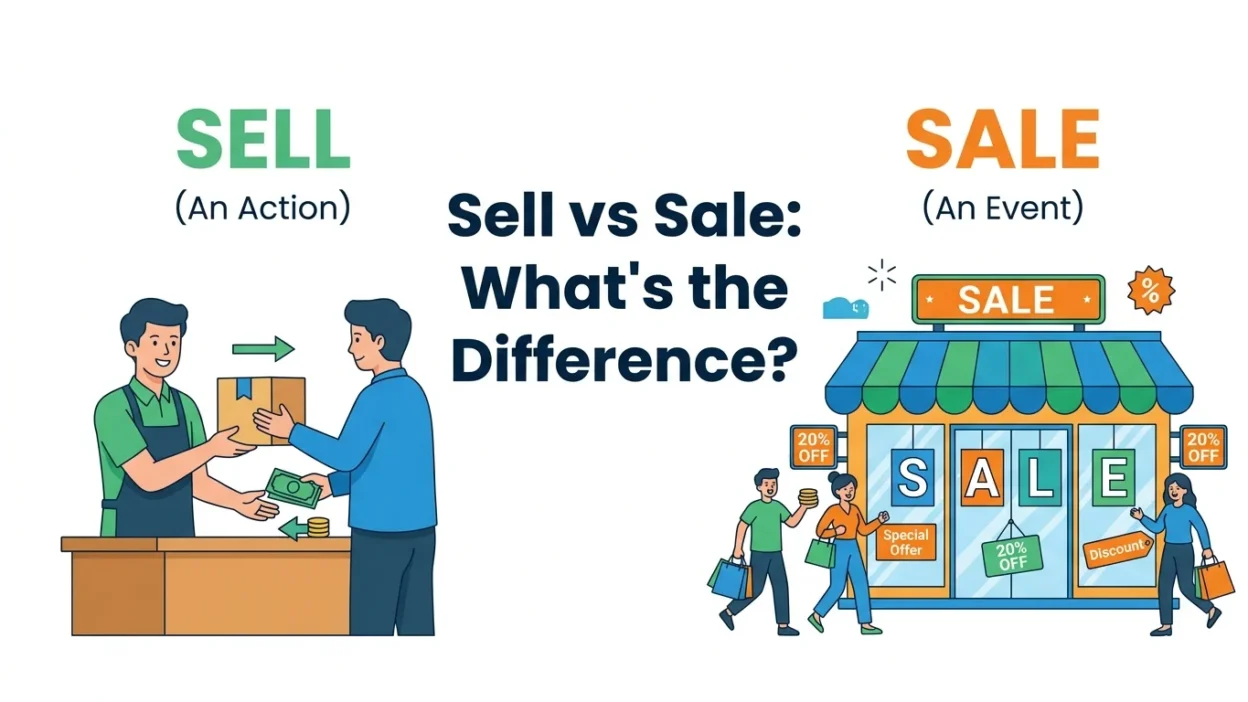
Sell is a verb that means to give something to someone in exchange for money.
Sale is a noun that means the act of selling something or a time when products are offered at lower prices.
- Sell = action
- Sale = thing, event, or result
- You sell a product.
- You have a sale at a store.
Why People Confuse Sell and Sale
People confuse these words because they have almost the same spelling and pronunciation. Both are connected to business, shopping, and money.
Another reason is that advertisements often use both words together, such as:
- “We sell electronics.”
- “Our summer sale starts today.”
Since they appear in similar situations, many learners accidentally use one instead of the other.
What Does “Sell” Mean?
Sell is a verb. It describes the action of giving something to another person in exchange for money.
Examples
- I want to sell my old bicycle.
- They sell fresh vegetables every morning.
- She plans to sell her house next month.
- This shop sells handmade gifts.
- We sold our car last year.
Common Forms of Sell
- Sell
- Sells
- Selling
- Sold (past tense and past participle)
What Does “Sale” Mean?
Sale is a noun. It refers to the act of selling, the result of selling, or a special event where prices are reduced.
Examples
- The store is having a big sale this weekend.
- The house is for sale.
- Ticket sales increased this month.
- The final sale was completed yesterday.
- The winter sale attracted many customers.
Sell vs Sale Comparison Table
| Feature | Sell | Sale |
| Part of speech | Verb | Noun |
| Meaning | To exchange something for money | The act of selling or a discount event |
| Shows | Action | Thing, event, or result |
| Example | They sell books online. | The bookstore has a summer sale. |
| Question answered | What do you do? | What happened or what event is it? |
When to Use Each
Use Sell When:
- Talking about an action
- Describing what a person or business does
- Explaining that something is exchanged for money
Examples:
- I sell handmade jewelry.
- They sell coffee every morning.
- She wants to sell her laptop.
Use Sale When:
- Talking about a shopping event
- Referring to the act of selling
- Describing business results
Examples:
- The clothing store has a holiday sale.
- Car sales improved this year.
- The painting is for sale.
Examples of Sell and Sale in Sentences
Here are more everyday examples.
- We sell fresh fruit every day.
- The supermarket is having a weekend sale.
- They decided to sell their apartment.
- The car is for sale.
- She sold her old phone online.
- Our biggest sale happens in December.
- I don’t want to sell my guitar.
- The company reported record sales this year.
- He sells homemade cookies.
- The furniture sale starts tomorrow.
- They sold all the tickets.
- The online sale attracted thousands of customers.
Common Mistakes
Here are mistakes learners often make.
❌ I want to sale my bike.
✅ I want to sell my bike.
❌ The shop will sell tomorrow with lower prices.
✅ The shop will have a sale tomorrow.
❌ This phone is for sell.
✅ This phone is for sale.
Memory Trick
A simple way to remember the difference is:
- Sell = Do something.
- Sale = Event or result.
Another easy trick:
If you can replace the word with action, use sell.
If you can replace it with event, offer, or discount, use sale.
American vs British English
There is no difference between American English and British English when using sell and sale.
Both varieties use these words in the same way and with the same meanings.
Examples:
- American English: The store is having a sale.
- British English: The shop is having a sale.
The only difference may be the word store in American English and shop in British English.
Similar Words
Learning related words can make the difference even clearer.
- Buy
- Purchase
- Trade
- Market
- Offer
- Price
- Discount
- Bargain
- Vendor
- Customer
- Retail
- Wholesale
Final Verdict
The difference is simple once you know the role each word plays.
- Sell is a verb that describes the action of exchanging something for money.
- Sale is a noun that refers to the act of selling, the result of selling, or a discount event.
Whenever you’re unsure, ask yourself whether you’re talking about an action or a thing/event. If it’s an action, choose sell. If it’s an event or result, choose sale.
Frequently Asked Questions
Is it “sell” or “sale” a car?
Use sell.
Example: I want to sell my car.
Is it “for sell” or “for sale”?
The correct phrase is for sale.
Example: The house is for sale.
Can “sale” be used as a verb?
No. Sale is always a noun.
Is “sold” related to “sell”?
Yes. Sold is the past tense and past participle of sell.
Why do stores advertise a sale?
A sale encourages customers to buy products, often because prices are reduced.
Can I say “sales” instead of “sale”?
Yes, when talking about multiple selling activities or business results.
Example: Online sales increased this year.
Is “sell” always about money?
Usually, yes. It means exchanging something for payment, although it can also be used figuratively, such as “sell an idea.”
Remember This
- Sell = Verb = Action
- Sale = Noun = Event or Result
- You sell products.
- Products are for sale.
- A store has a sale, but people sell things.
Keeping this simple rule in mind will help you choose the correct word every time.
Conclusion
Although sell and sale are closely related, they have different grammatical roles. Sell describes the action of giving something in exchange for money, while sale names the event, process, or result of that action. Understanding this distinction makes your English clearer and more accurate.
The next time you write an email, create an advertisement, or talk about shopping, remember this easy rule: people sell things, and stores have sales. With regular practice and the examples in this guide, using sell and sale correctly will soon become natural.

Quinn Mitchell is celebrated for historical fiction that combines authentic settings, unforgettable characters, and compelling narratives. His thoughtful writing brings history alive while inspiring curiosity and deeper understanding among readers.