English has many word pairs that sound similar but have completely different meanings, and worn vs warn is a good example. These words can easily be confused in writing because they are pronounced differently by only a small amount, especially in fast speech. However, their meanings, grammatical roles, and uses are entirely separate. Worn is usually connected with wearing clothes or something becoming damaged through use, while warn means to tell someone about a possible danger, problem, or consequence.
Understanding the difference between worn and warn becomes much easier when you look at how each word functions in a sentence. Worn is commonly used as the past participle of wear, whereas warn is a verb meaning to alert or advise someone. In this guide, you’ll learn their definitions, pronunciation, grammatical forms, common mistakes, and practical examples so you can confidently choose the correct word every time.
Quick Answer
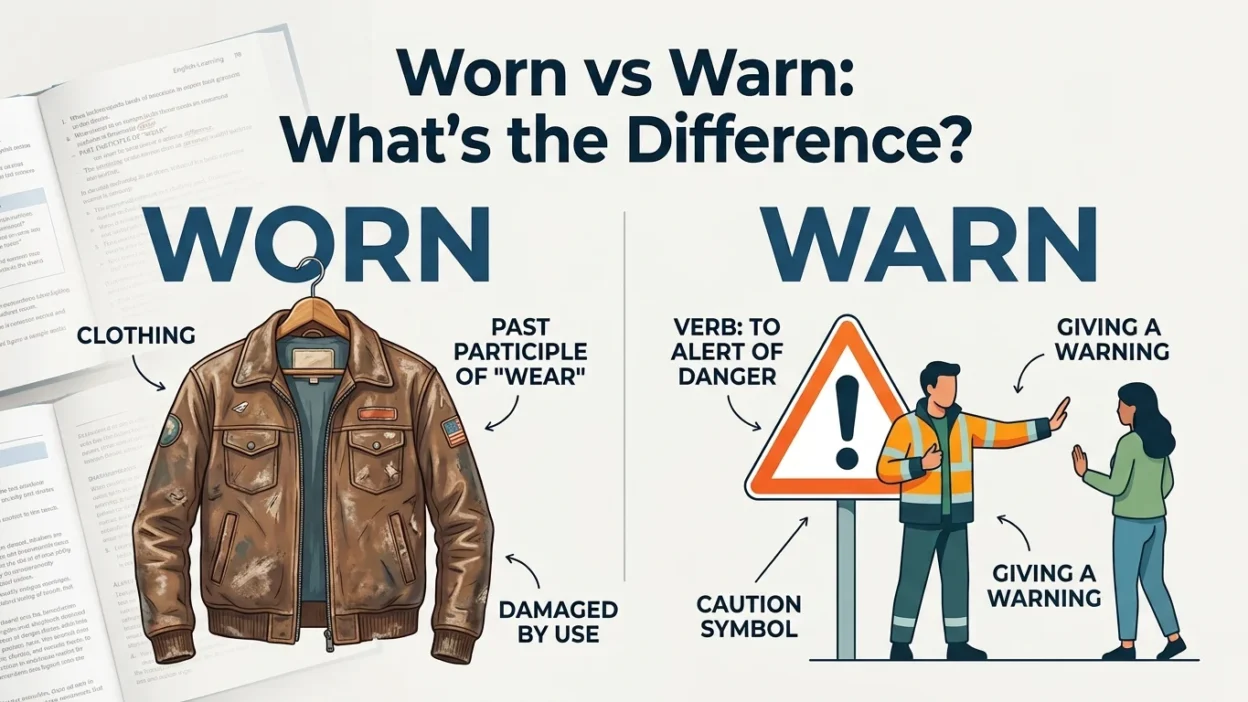
Worn is the past participle of wear and describes something that has been put on or damaged through use. Warn is a verb meaning to alert someone about danger, a problem, or a possible consequence. For example: “She has worn that dress before” and “They warned us about the storm.”
Why People Confuse It
The confusion usually comes from the similar appearance and sound of worn and warn.
Both words:
- Have four letters.
- Contain the same basic consonant sounds.
- Can sound quite similar in some accents.
- Are common English words.
- Are frequently encountered in everyday conversation and writing.
There is also a major pronunciation issue. Worn is generally pronounced /wɔːrn/, while warn is also commonly pronounced /wɔːrn/ or very similarly in many varieties of English.
So, unlike many confusing word pairs, pronunciation may not always help you distinguish them. Context is especially important.
First Word: Worn
Worn is the past participle of the verb wear.
It can describe something that someone has put on their body:
- “He has worn this jacket many times.”
- “She had worn a blue dress to the party.”
It can also describe something that has become damaged, faded, or less effective because it has been used repeatedly:
- “The carpet looks worn.”
- “These shoes are completely worn out.”
Forms of Wear
The verb wear has an irregular form:
- Present: wear
- Past: wore
- Past participle: worn
For example:
I wear glasses every day.
I wore them yesterday.
I have worn them for years.
Meaning of Worn
Depending on the context, worn can mean:
- Put on the body — “She has worn the necklace before.”
- Used until damaged or faded — “The old sofa is badly worn.”
- Tired or exhausted — “After the long journey, he looked worn.”
The phrase worn out is especially common when something is extremely used or someone is very tired.
Second Word: Warn
Warn is a verb meaning to tell someone about a danger, problem, risk, or possible negative consequence.
For example:
- “I warned him about the slippery road.”
- “The teacher warned the students not to run.”
- “They warned us that the weather could change.”
The noun form is warning, as in:
The sign gave us a warning about falling rocks.
Common Forms of Warn
Unlike wear, warn is a regular verb:
- Present: warn
- Past: warned
- Past participle: warned
- -ing form: warning
For example:
The doctor warns him about the risks.
The doctor warned him yesterday.
The doctor has warned him several times.
Comparison Table
| Word | Part of Speech | Main Meaning | Example |
| worn | Past participle/adjective | Put on or damaged through use | “He has worn the jacket before.” |
| warn | Verb | Alert someone to danger or a problem | “She warned me about the traffic.” |
The simplest distinction is:
Worn = related to wear.
Warn = alert someone.
When to Use Each
Use worn when you’re talking about:
- Clothes or accessories someone has put on
- Something damaged by repeated use
- Something faded or deteriorated
- A person who looks tired or exhausted
- The result of the verb wear
Example:
“The soles of my shoes are badly worn.”
Use warn when you’re talking about:
- Giving someone an alert
- Pointing out danger
- Advising someone about a possible problem
- Telling someone about a consequence
- A warning or caution
Example:
“She warned me not to touch the hot pan.”
A Simple Test
Ask yourself:
Can I replace the word with “wear/wore”?
If yes, you probably need worn.
Are you alerting or cautioning someone?
If yes, you need warn.
Examples
- She has worn that coat every winter.
- The mechanic warned me about the damaged brakes.
- My favorite shoes are completely worn out.
- The guide warned the tourists about the steep path.
- He had worn his new suit only once.
- I warned my brother to drive carefully.
- The carpet looks worn after years of use.
- The weather service warned residents about heavy rain.
- She has worn glasses since childhood.
- The teacher warned the class about the upcoming test.
- The old leather bag is badly worn.
- They warned us that the road might be closed.
- After working all day, he looked worn and exhausted.
- I warned her that the deadline was approaching.
Notice that the meanings never overlap. Worn describes wearing, use, condition, or tiredness, while warn involves giving an alert or caution.
Common Mistakes
Mistake 1: Using “warn” when you mean “wear”
Incorrect:
“She has warn a beautiful dress.”
Correct:
“She has worn a beautiful dress.”
Remember that the past participle of wear is worn, not warn.
Mistake 2: Using “worn” when you mean “warn”
Incorrect:
“He worn me about the danger.”
Correct:
“He warned me about the danger.”
When you’re alerting someone, use warn or its past form warned.
Mistake 3: Confusing “worn out” with “warned”
Worn out means extremely tired or heavily used.
“I was worn out after the trip.”
Warned means someone gave you a caution or alert.
“My friend warned me about the difficult journey.”
These expressions have completely different meanings.
Mistake 4: Forgetting the irregular verb pattern
Many learners remember:
wear → wore
but forget the past participle:
wear → wore → worn
This is important when using have, has, or had.
Memory Trick
Here’s an easy way to remember the difference:
WORN has “OR” like “wore.”
Think:
wear → wore → worn
If you’re talking about something being put on, think WORN.
For WARN, think of a warning.
WARN = WARNING = ALERT
So remember:
WORN → WEAR
WARN → WARNING
This simple association can help you choose the right word even when the two sound nearly identical.
American vs British English
There is essentially no difference in meaning between worn and warn in American and British English.
The main potential difference is pronunciation. In some accents, the vowel sounds in worn and warn may be noticeably different, while in other accents they can sound extremely similar.
Because pronunciation varies by region, context remains the safest way to distinguish them in speech.
The spelling and grammatical uses remain the same in both major varieties of English:
- worn = past participle of wear
- warn = alert or caution someone
Similar Words
Understanding related words can make the distinction even easier.
Words Related to Worn
- wear — to have clothing or something on the body
- wore — past tense of wear
- worn out — extremely tired or heavily used
- used — not new because it has been used
- frayed — worn at the edges
- faded — having lost color
Words Related to Warn
- warning — an alert about danger or trouble
- caution — advice to be careful
- alert — a notice about possible danger
- advise — recommend a particular action
- cautionary — intended to make someone careful
- notify — formally inform someone
FAQs
1. Is “worn” the past tense of “wear”?
No. Wore is the simple past tense of wear, while worn is its past participle.
- I wore my jacket yesterday.
- I have worn my jacket many times.
2. What does “warn” mean?
Warn means to alert or advise someone about a possible danger, problem, or negative consequence.
Example: “The police warned drivers about the icy roads.”
3. Is “worn” pronounced the same as “warn”?
In some accents, they may sound the same or very similar. In others, there is a noticeable difference. Context can therefore be important when distinguishing them in speech.
4. Can “worn” describe a person?
Yes. Worn can describe someone who looks tired, exhausted, or stressed.
Example: “She looked worn after several sleepless nights.”
5. What is the difference between “worn out” and “warned”?
Worn out means extremely tired or heavily used. Warned means someone gave a caution or alert.
Example: “I was worn out after work.”
Example: “My colleague warned me about the deadline.”
6. Which is correct: “I have warn him” or “I have warned him”?
The correct sentence is “I have warned him.” The past participle of warn is warned.
7. Which is correct: “She has wore it” or “She has worn it”?
The correct sentence is “She has worn it.” After has, use the past participle worn.
Final Verdict
Worn and warn are completely different words despite their similar spelling and pronunciation. Worn comes from the irregular verb wear and refers to something that has been put on, used extensively, damaged, or, in some contexts, a person who looks tired. Warn, on the other hand, is a regular verb meaning to alert someone about danger, trouble, or a possible consequence.
If you’re describing clothing, repeated use, physical deterioration, or tiredness, choose worn. If you’re giving someone an alert or telling them to be careful, choose warn. Once you connect worn with wear and warn with warning, the distinction becomes much easier to remember.
Remember This
WORN = WEAR → wore → worn
WARN = WARNING → alert or caution
If someone has worn something, they have had it on or it has become used. If someone warns you, they are trying to keep you aware of a possible problem.
Conclusion
The difference between worn vs warn is simple once you focus on meaning rather than pronunciation. Worn is connected to wear, while warn is connected to giving a warning. Although they can sound alike in some English accents, their grammatical roles and meanings make them easy to separate in context.
For confident English writing, remember the two word association: worn = wear and warn = warning. This distinction will help you avoid common spelling and grammar mistakes in emails, essays, conversations, and everyday communication.

Nova Turner specializes in imaginative science fiction blending futuristic technology, thrilling adventures, and powerful human emotions. Her innovative storytelling inspires curiosity, creativity, and exploration among readers of every age.