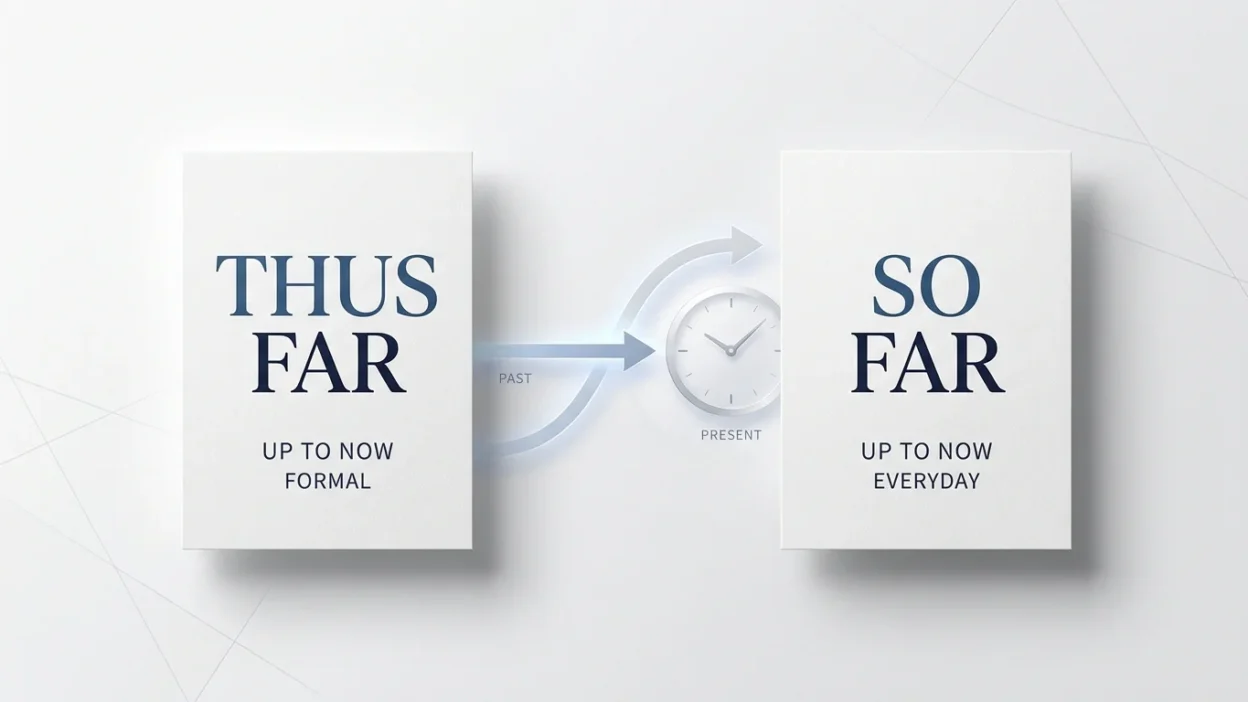
If you have ever wondered whether “thus far” and “so far” mean the same thing, you are not alone. Both expressions are used to talk about something that has happened or been true up to a particular point in time. For example, you can say, “The project has been successful so far” or “The project has been successful thus far.” In both sentences, the basic meaning is nearly identical.
The main difference is tone and usage. “So far” is much more common in everyday English and sounds natural in casual conversations, emails, and general writing. “Thus far” is more formal and is often found in academic, professional, literary, or official writing. Understanding this small difference can help you choose the expression that fits your context. In this guide, we will compare thus far vs so far, explain their meanings, show real world examples, and help you remember when to use each one.
Quick Answer
“Thus far” and “so far” generally mean the same thing: “up to now” or “until this point.” The key difference is tone. “So far” is more common and conversational, while “thus far” sounds more formal, deliberate, or literary.
Why People Confuse It
People often confuse thus far vs so far because both expressions can be used in almost exactly the same sentence.
Consider these examples:
- We have received five applications so far.
- We have received five applications thus far.
Both sentences mean that five applications have been received up to the present time.
The difference is not usually about grammar or basic meaning. It is primarily about register, style, and context.
“So far” is the everyday choice. Native speakers frequently use it when talking about experiences, progress, results, events, and situations.
“Thus far” is less common in casual speech. It can make a sentence sound more formal or polished.
In simple terms:
- So far = up to now → common and conversational
- Thus far = up to now → formal and less common
First Word: Thus Far
“Thus far” means “up to this point” or “until now.”
The word thus can mean “in this way” or “as a result,” but in the fixed expression “thus far,” it has the meaning of “to this point.”
Examples
- Thus far, the experiment has produced positive results.
- No major problems have occurred thus far.
- The team has performed well thus far.
- Thus far, we have completed three stages of the project.
“Thus far” is grammatically correct, but it generally carries a more formal tone.
You might see it in:
- Academic writing
- Research papers
- Formal reports
- Business writing
- Legal or official language
- Literary writing
- Formal speeches
It is also possible to use “thus far” in ordinary conversation, but it can sound somewhat more formal than necessary.
Is “thus far” correct?
Yes. “Thus far” is a standard English expression.
It is not an incorrect or outdated version of “so far.” It simply has a different stylistic feel.
Second Word: So Far
“So far” means “up to now,” “until now,” or “up to this point.”
It is one of the most natural ways to describe something that has happened or remained true until the present moment.
Examples
- So far, everything is going well.
- I have read three chapters so far.
- So far, we haven’t had any problems.
- How is your new job going so far?
“So far” works particularly well in:
- Everyday conversation
- Text messages
- Emails
- Informal writing
- News writing
- Business communication
- General online content
Because it is so common, “so far” is usually the safest choice when you are unsure.
Comparison Table
| Feature | Thus Far | So Far |
| Basic meaning | Up to now | Up to now |
| Grammar | Correct | Correct |
| Tone | Formal | Neutral/conversational |
| Frequency | Less common | Very common |
| Everyday speech | Less natural | Very natural |
| Academic writing | Appropriate | Appropriate |
| Business writing | Appropriate | Appropriate |
| Casual conversation | Possible but formal | Preferred |
| Meaning | Usually the same | Usually the same |
| Best general choice | Formal contexts | Most contexts |
When to Use Each
Choosing between thus far and so far is mostly a matter of context.
Use “so far” when:
You want your English to sound natural, direct, and conversational.
For example:
We haven’t had any complaints so far.
This sounds completely natural in everyday communication.
Use it when speaking with friends, coworkers, customers, or general audiences.
Use “thus far” when:
You want a more formal or polished tone.
For example:
The evidence gathered thus far supports the original hypothesis.
This sentence sounds appropriate in an academic or formal context.
A useful rule
If you could naturally say “up to now” and you are speaking casually, “so far” is usually the better choice.
If you are writing something formal and want a more elevated expression, “thus far” may work well.
Examples of Thus Far vs So Far
Here are more than ten examples showing how the two expressions work.
1. Progress
- We have completed five tasks so far.
- We have completed five tasks thus far.
Both mean five tasks have been completed up to this point.
2. Performance
- The team has played extremely well so far.
- The team has performed extremely well thus far.
The second sounds more formal.
3. Problems
- We haven’t encountered any problems so far.
- We haven’t encountered any problems thus far.
Both are grammatically correct.
4. Research
- The research has produced encouraging results so far.
- The research has produced encouraging results thus far.
“Thus far” fits especially well in formal research writing.
5. Experience
- I’m enjoying my new job so far.
- I’m enjoying my new job thus far.
The first sounds much more natural in conversation.
6. Project updates
- So far, the project is on schedule.
- Thus far, the project remains on schedule.
The second has a more formal, report like tone.
7. Reading
- I’ve read four chapters so far.
- I’ve read four chapters thus far.
“So far” is the natural everyday choice.
8. Weather
- So far, the weather has been excellent.
- Thus far, the weather has been excellent.
Both work, but the first sounds more conversational.
9. Sales
- We have sold 200 units so far.
- We have sold 200 units thus far.
“Thus far” could be appropriate in a formal sales report.
10. Results
- So far, the results look promising.
- Thus far, the results appear promising.
The second sounds more formal and analytical.
11. Learning
- I’ve learned a lot so far.
- I’ve learned a lot thus far.
The first is far more natural for ordinary conversation.
12. Investigation
- The investigation has uncovered no evidence so far.
- The investigation has uncovered no evidence thus far.
The second may sound more appropriate in an official report.
13. Journey
- The trip has been amazing so far.
- The trip has been amazing thus far.
“So far” is the obvious choice for casual speech.
14. Development
- So far, the plan seems to be working.
- Thus far, the plan appears to be working.
The second has a more formal tone.
Common Mistakes
Mistake 1: Assuming “thus far” and “so far” have different meanings
In most situations, they do not.
Both generally refer to a period extending from the beginning of something until now or another stated point.
Mistake 2: Using “thus far” everywhere
Although “thus far” is correct, it can sound unnecessarily formal in casual conversation.
Instead of:
How is your vacation going thus far?
Most speakers would naturally say:
How is your vacation going so far?
Mistake 3: Thinking “so far” is informal or incorrect
“So far” is completely standard English.
It is not grammatically inferior to “thus far.” In fact, it is generally more common in modern everyday English.
Mistake 4: Confusing “thus far” with “therefore”
“Thus” can mean “therefore” in other contexts, but “thus far” is a fixed expression meaning “up to now.”
For example:
The project has been successful thus far.
Here, “thus far” does not mean “therefore.”
Mistake 5: Writing “thus far” when you mean “in this way”
These are different uses of thus.
- He explained it thus. → in this way
- We have completed three stages thus far. → up to now
Understanding the complete phrase prevents confusion.
Memory Trick
Use this simple trick:
SO FAR = NOW
If you are talking about what has happened up to now, “so far” is your everyday choice.
THUS FAR = FORMAL SO FAR
Think of “thus far” as the more formal cousin of “so far.”
Remember:
So far = natural and common
Thus far = formal and polished
When in doubt, choose “so far.”
American vs British English
There is no major difference in meaning between thus far and so far in American and British English.
Both expressions are understood in both varieties of English.
However, “so far” is generally much more common in everyday communication, regardless of whether the speaker is American or British.
“Thus far” appears more naturally in formal contexts in both varieties, including academic writing, reports, formal commentary, and literary prose.
So this is not primarily an American vs British English distinction. It is a distinction in register and frequency.
Similar Words
Several other expressions can communicate a similar idea.
Up to now
This is a direct alternative to “so far.”
Up to now, everything has gone well.
Until now
This can also refer to the period before the present moment.
Until now, nobody had noticed the error.
Depending on the sentence, “until now” can sometimes emphasize a change or new development.
To date
“To date” is relatively formal and common in professional or academic writing.
To date, the company has received 500 applications.
As of now
“As of now” focuses strongly on the current situation or status.
As of now, the plan remains unchanged.
Hitherto
“Hitherto” means “until now” or “up to this time,” but it is much more formal and less common in modern everyday English.
The method had hitherto been considered unreliable.
For most modern writing, “so far” is more natural.
Final Verdict
So, thus far vs so far is not really a question of right versus wrong. Both expressions are grammatically correct and usually communicate the same basic idea: up to now or up to a particular point.
The important difference is style. Choose “so far” for everyday English, casual conversation, emails, and most general writing. Choose “thus far” when a more formal, academic, professional, or literary tone is appropriate.
Remember This
“So far” and “thus far” usually mean the same thing. “So far” is the natural everyday choice, while “thus far” is more formal.
FAQs
1. Is “thus far” the same as “so far”?
Yes. In most contexts, “thus far” and “so far” mean “up to now” or “up to this point.” The primary difference is tone rather than meaning.
2. Is “thus far” formal?
Yes. “Thus far” generally sounds more formal or literary than “so far.” It is especially suitable for academic, professional, official, and formal writing.
3. Is “so far” grammatically correct?
Yes. “So far” is completely correct standard English and is much more common in everyday communication.
4. Which is better: “thus far” or “so far”?
Neither is universally better. “So far” is usually better for natural, everyday English, while “thus far” can be better when you want a formal tone.
5. Can I use “thus far” in conversation?
Yes, but it may sound more formal than necessary. In ordinary conversation, “so far” will usually sound more natural.
6. Can “thus far” be used in academic writing?
Absolutely. “Thus far” is a suitable expression for academic and formal writing, although “so far” is also grammatically acceptable.
7. What is another word for “so far”?
Depending on the context, alternatives include up to now, until now, to date, as of now, and thus far.
Conclusion
The difference between thus far and so far is mainly about style, not meaning. Both expressions can describe something that has happened or remained true up to the present point. “So far” is more frequent, natural, and conversational, making it the best choice for most everyday situations.
“Thus far,” on the other hand, adds a formal or polished quality to your writing. It works particularly well in academic papers, reports, official documents, and other situations where a more formal register is appropriate. If you remember just one rule, remember this: use “so far” for natural everyday English and “thus far” when you want a more formal tone.

Hadley Price creates heartfelt contemporary fiction exploring relationships, hope, resilience, and personal growth. Her emotionally rich storytelling connects with readers through memorable characters and inspiring life experiences worldwide.