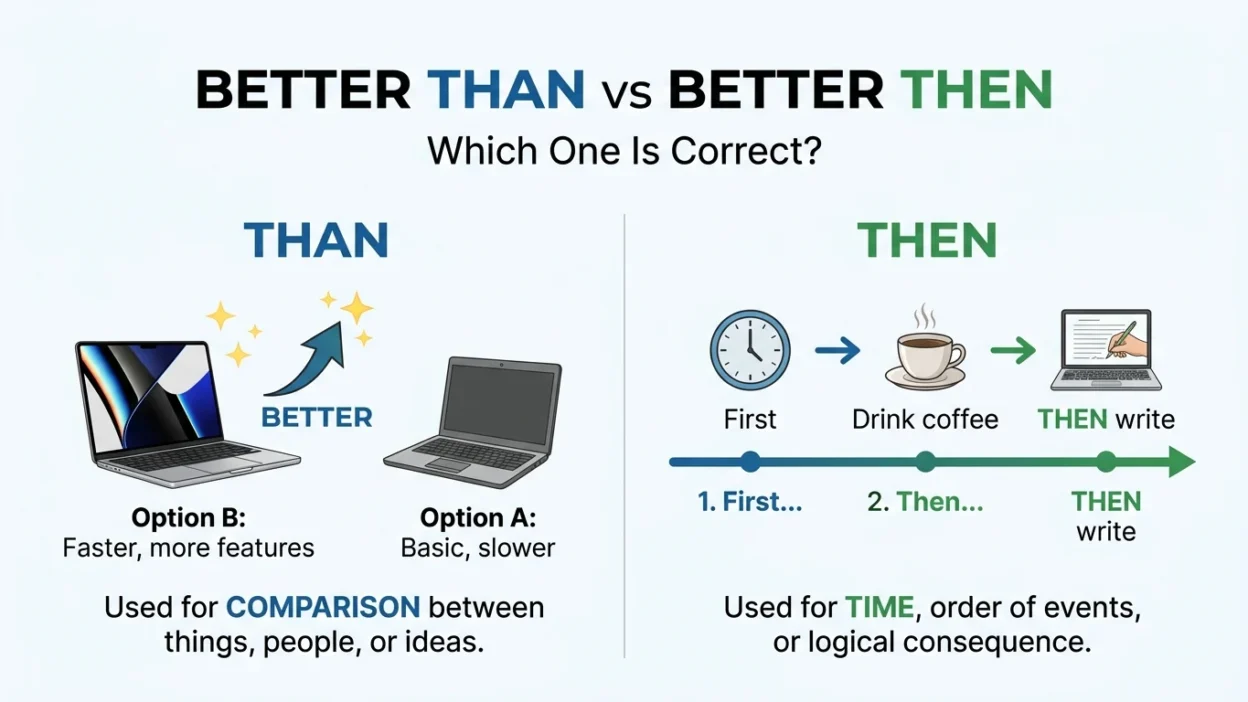
If you have ever hesitated between “better than” and “better then,” you are not alone. These two expressions sound almost identical when spoken, but they have completely different meanings and grammatical functions. The correct choice is usually “better than” when you are comparing two people, things, actions, or situations. For example, “This book is better than the movie” uses than because it introduces a comparison.
The confusion happens because than and then are both common English words with similar pronunciation in some accents. However, then is mainly used to talk about time, sequence, or consequences. “We finished dinner, then watched a movie” is correct, but “This movie is better then that one” is not standard English. Understanding this simple distinction can help you avoid a common grammar mistake in emails, essays, conversations, and professional writing.
Quick Answer
“Better than” is correct when making a comparison. Use than after comparative words such as better, faster, taller, and more interesting. Use then for time, sequence, or results. Therefore, write “better than,” not “better then,” when comparing two things.
Why People Confuse It
The main reason people confuse than and then is pronunciation. In many varieties of English, the two words can sound very similar in rapid speech.
There is also a spelling issue. Both words are extremely common, but they perform different grammatical jobs:
- Than → used for comparisons.
- Then → used for time, sequence, or consequences.
The phrase “better than” is especially common because better is a comparative adjective. Whenever you compare one thing with another, than is normally the word you need.
For example:
- My new phone is better than my old one.
- Sarah runs faster than I do.
- This route is shorter than the other route.
The important point is that than belongs to comparison, while then belongs to sequence or time.
First Word: Better Than
“Better than” is the correct phrase when you are comparing two or more things.
The word better is the comparative form of good. It tells us that one person or thing has a higher quality, ability, performance, or value than another.
Examples:
- This restaurant is better than the one downtown.
- I feel better than I did yesterday.
- Her second presentation was better than the first.
- Experience is sometimes better than formal training.
The word than introduces the second part of the comparison.
A useful structure is:
Subject + comparative adjective + than + comparison
For example:
This laptop is better than my old laptop.
Here, better describes the laptop’s quality, while than connects it to the thing being compared.
Second Word: Better Then
“Better then” is generally incorrect when you are trying to make a comparison.
The word then has a different job. It usually refers to a time, a sequence, or something that happens as a result.
For example:
- We had dinner, then we went home.
- Finish your homework, then you can play.
- Back then, I lived in London.
- If you study consistently, then you are more likely to improve.
Notice that none of these examples compares two things using then.
There are unusual sentences in which better and then can appear next to each other, but they do not form the comparative expression “better than.”
For instance:
It is better to leave now; then we can avoid the traffic.
Here, then means something like “after that” or “in that case.” It is not part of the comparison.
Comparison Table
| Expression | Correct? | Main Meaning | Example |
| better than | Yes | Makes a comparison | This plan is better than the old one. |
| better then | Usually no | Incorrect for comparison | This plan is better then the old one. |
| then | Yes | Shows time or sequence | We ate, then we left. |
| than | Yes | Introduces a comparison | She is taller than me. |
When to Use Each
Use “than” for comparisons
Use than after comparative forms such as:
- better than
- worse than
- faster than
- slower than
- taller than
- shorter than
- older than
- younger than
- more expensive than
- less difficult than
Examples:
- This option is better than the first one.
- The train is faster than the bus.
- This exercise is more difficult than I expected.
Use “then” for sequence
Use then when describing what happens next.
- First, read the instructions. Then, answer the questions.
- She finished work and then called me.
- We went to the store, then drove home.
Use “then” for a past or future time
- I was living there then.
- Things were different then.
- We did not know each other then.
Use “then” for a consequence
In some sentences, then means “in that case” or introduces a result.
- If you do not want it, then give it to someone else.
- If that is true, then we need another plan.
Examples
Here are more examples showing the correct use of better than:
- This solution is better than the one we tried yesterday.
- My new job is better than my previous one.
- Walking is often better than sitting all day.
- She performed better than anyone expected.
- This restaurant is better than I remembered.
- The blue design looks better than the red one.
- He believes practice is better than talent alone.
- Today’s weather is better than yesterday’s.
- This explanation is better than the one in the textbook.
- Your second draft is much better than the first.
- The new system works better than the old system.
- Fresh fruit can be a better choice than processed snacks.
Now compare those sentences with examples of then:
- We finished the meeting and then went for lunch.
- I lived in that neighborhood then.
- Read the first chapter, then answer the questions.
- If you are ready, then we can begin.
These examples demonstrate why the two words should not be treated as interchangeable.
Common Mistakes
Mistake 1: Using “then” after “better”
Incorrect:
This method is better then the old one.
Correct:
This method is better than the old one.
Mistake 2: Assuming similar pronunciation means similar meaning
Words can sound alike or nearly alike without having the same function. Than and then are a classic example.
Mistake 3: Forgetting the comparison
If your sentence answers the question “better than what?”, you almost certainly need than.
For example:
This camera is better than that one.
The word than introduces the thing being compared.
Mistake 4: Confusing “then” with other time expressions
Remember that then can often be replaced by phrases such as:
- after that
- at that time
- in that case
For example:
We ate, then we left.
This means:
We ate, and after that, we left.
That meaning has nothing to do with comparison.
Memory Trick
Here is an easy way to remember the difference:
THAN = comparison.
THEN = time or sequence.
Think of than as the comparison word:
better than, faster than, taller than, more useful than
Think of then as the “next” word:
first this, then that.
A simple memory sentence is:
Better THAN = compare. Then = next.
If you remember just those two ideas, you will avoid most than vs. then mistakes.
American vs British English
There is essentially no difference between American and British English regarding the standard use of “better than.”
Both varieties use than for comparisons:
- American English: This option is better than the other.
- British English: This option is better than the other.
Likewise, both use then for time and sequence:
- We went home then.
- Finish this, then start the next task.
Pronunciation can vary between speakers and regions, which may contribute to the confusion. However, the spelling and grammatical distinction remain the same in standard written English.
Similar Words
Understanding related comparative structures can make the than vs. then distinction easier.
Worse than
Used to say that something has lower quality or is less desirable.
The traffic today is worse than yesterday.
Faster than
Used to compare speed.
A train is usually faster than a bus.
More than
Used to indicate a greater amount, degree, or number.
We need more than ten people.
Less than
Used to indicate a smaller amount or degree.
The journey took less than an hour.
Rather than
Used to express preference or an alternative.
I would walk rather than take the bus.
In all these comparative expressions, than is the correct word.
FAQs
Is “better than” always correct?
When you are making a comparison, “better than” is the standard and correct expression. For example, “This book is better than that one.”
Is “better then” grammatically correct?
Not when then is being used to make a comparison. In a sentence such as “This book is better then that one,” then should be replaced with than.
What is the difference between than and then?
Than is primarily used for comparisons, while then usually refers to time, sequence, or a consequence.
How can I remember than vs. then?
Remember: than = comparison and then = next/time. If you are comparing two things, choose than.
Is “better than” a comparative phrase?
Yes. Better is the comparative form of good, and than introduces the second part of the comparison.
Can “better” and “then” appear in the same sentence?
Yes, but they do not normally form the phrase “better then.” For example: “This option is better; then we can move forward.” Here, then relates to sequence or consequence.
Is “better than” the same in American and British English?
Yes. Both American and British English use better than for standard comparisons.
Final Verdict
When you are deciding between “better than” and “better then,” the correct choice for a comparison is better than. The word than belongs with comparative expressions such as better than, faster than, bigger than, and more useful than. It connects the thing being described with the thing being compared.
Then, on the other hand, is about time, order, or consequence. You might say “We finished work, then went home,” but you would say “This job is better than my old one.” Once you connect than with comparison and then with sequence, this common English grammar confusion becomes much easier to avoid.
Remember This
Better THAN = comparison.
THEN = time, sequence, or consequence.
If you are comparing two things, write “better than,” never “better then.”
Conclusion
The difference between better than and better then is small in spelling but important in meaning. Than is the correct word after better when you compare people, objects, ideas, experiences, or situations. Then has a completely different role and usually tells us when something happened, what happened next, or what follows from a condition.
The good news is that you do not need to memorize a complicated grammar rule. Simply ask yourself whether you are comparing something or talking about time and sequence.
If you are comparing, choose than. If you mean “after that,” “at that time,” or “in that case,” choose then. This simple distinction will make your writing clearer and more accurate.

Nova Turner specializes in imaginative science fiction blending futuristic technology, thrilling adventures, and powerful human emotions. Her innovative storytelling inspires curiosity, creativity, and exploration among readers of every age.